

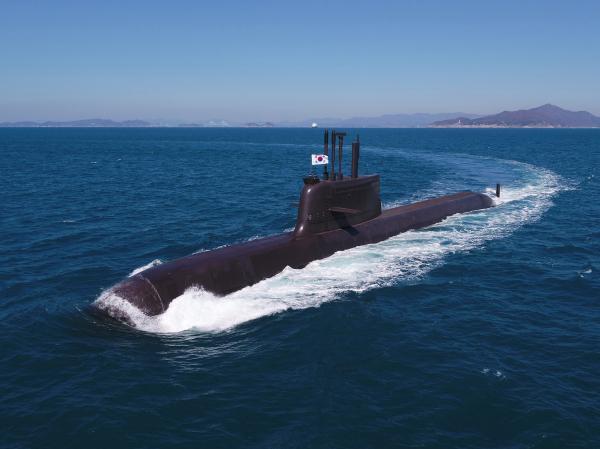
Kim Jong-un’s latest criticism sharpens a question facing Seoul: whether its multitrillion-won submarine program will deliver a military advantage commensurate with its cost.
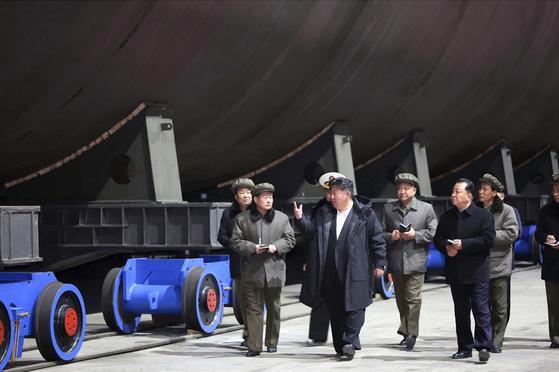
During an inspection of nuclear facilities Wednesday, Kim accused Washington of encouraging regional allies to acquire nuclear-powered submarines while expanding nuclear cooperation with them, according to the Korean Central News Agency (KCNA).
His remarks were interpreted as targeting South Korea’s submarine program and Japan’s consideration of similar capabilities. Nuclear propulsion, however, does not itself mean a vessel carries nuclear weapons.
Pyongyang has publicized its own ambitions. In December last year, it unveiled what it described as an 8,700-ton nuclear-powered strategic missile submarine under construction, although its propulsion capabilities have yet to be independently verified.
Seoul is pursuing three nuclear-powered submarines of approximately 8,000 tons each under the Jang Bogo N program. A preliminary estimate puts the cost at 28.9 trillion won ($21.5 billion), but the final budget remains unsettled.
The government aims to launch the first vessel in the mid-2030s, with operational deployment expected in the late 2030s or later.
The Defense Acquisition Program Administration approved the project’s basic implementation strategy earlier this month and waived a feasibility study, clearing the way for development to begin in 2027.
Supporters argue that greater underwater endurance and mobility would improve South Korea’s ability to detect and track North Korean submarines carrying submarine-launched ballistic missiles (SLBMs), potentially limiting Pyongyang’s ability to launch nuclear attacks from sea.
Whether those advantages would translate into effective operations around the Korean Peninsula remains contested.
A three-page assessment dated Nov. 23 by Jeong Kyeong-woon, a research fellow at the Korea Association of Military Studies, and reviewed by AJP argues that nuclear propulsion alone would not guarantee the ability to detect, track or destroy North Korean ballistic missile submarines.
It also questions whether three vessels could sustain continuous operations once training, maintenance and any reactor-refueling requirements are taken into account. Refueling needs would depend on the reactor and fuel design ultimately selected.
The assessment points to political and operational constraints on tracking North Korean submarines near their bases, including the escalation risks of operating north of the Northern Limit Line, the disputed maritime boundary in the Yellow Sea.
The distinction is between possessing a more capable submarine and maintaining an effective submarine-hunting force. Propulsion is only one part of that task.
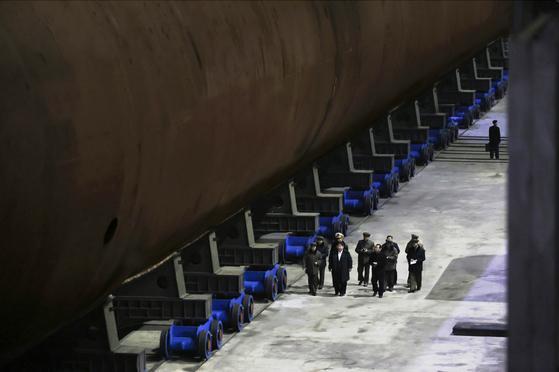
The financial commitment would also extend well beyond building the vessels.
A detailed breakdown of South Korea’s long-term operating and maintenance costs has not been publicly released. Reactor design, fuel arrangements, maintenance facilities and specialist personnel will all affect the eventual bill.
The U.S. experience illustrates how support requirements can erode both budgets and operational availability. A Government Accountability Office report estimated that the U.S. Navy spent about $4.2 billion, in 2025 dollars, during fiscal years 2016–2025 on attack submarines waiting to enter shipyards or delayed in completing maintenance.
Those costs are not a forecast for South Korea. They underscore the need to plan for the infrastructure and workforce that keep nuclear-powered vessels at sea, rather than treating construction as the principal hurdle.
Several experts called for a government-wide body to coordinate the Defense Ministry, procurement authorities and agencies responsible for nuclear technology, funding and negotiations with Washington.
They also emphasized the need for dedicated safety oversight of military nuclear reactors, which operate under different conditions from civilian power plants and involve sensitive military information.
France offers one model. It operates both nuclear-powered ballistic missile submarines and nuclear-powered attack submarines under a military nuclear safety framework separate from civilian regulation.
Its Delegate for Nuclear Safety and Radiation Protection for Defense-Related Installations and Activities, known as the DSND, sits under the defense minister but is independent of the organizations operating military nuclear facilities. Its responsibilities cover safety oversight from authorization and commissioning through modification, shutdown and dismantling.
South Korea’s Defense Ministry said Thursday that talks with Washington over the submarine program were continuing.
“We are holding close consultations at the government level across diplomatic and defense channels, and are also coordinating closely with the United States,” a ministry official said in response to an AJP question.
“We take North Korea’s stated intention to expand tactical nuclear operations on the Korean Peninsula very seriously,” a ministry spokesperson said during a regular briefing.
“North Korea must immediately stop attempting to justify its nuclear development and comply with United Nations Security Council resolutions.”
The ministry said Seoul would strengthen U.S. extended deterrence through the bilateral Nuclear Consultative Group and further develop its three-axis defense system against North Korean nuclear and missile threats.
Kim’s objections add political urgency to Seoul’s plans. They do not settle the questions of military utility, fleet availability or lifetime cost.
For Seoul, the test is not simply whether it can build a nuclear-powered submarine, but whether it can keep enough vessels operating safely and effectively to justify the investment.

Kim Hee-su
Kim Hee-su is a bilingual reporter at AJU Press, covering defense and foreign affairs. Before joining AJP in 2025, she worked at The Korea Times, where she wrote interview stories, including a profile of North Korean defector Kim Gum-hyok, and produced digital content. She also previously worked as a researcher for KBS News 9’s International News Department, supporting correspondents in 10 countries around the world. She graduated from the University of Toronto in Canada with a double major in Book and Media Studies and East Asian Studies.
Copyright ⓒ Aju Press All rights reserved.
