

Teasing can be tantalizing—up to a point. Beyond that, it becomes simply annoying.
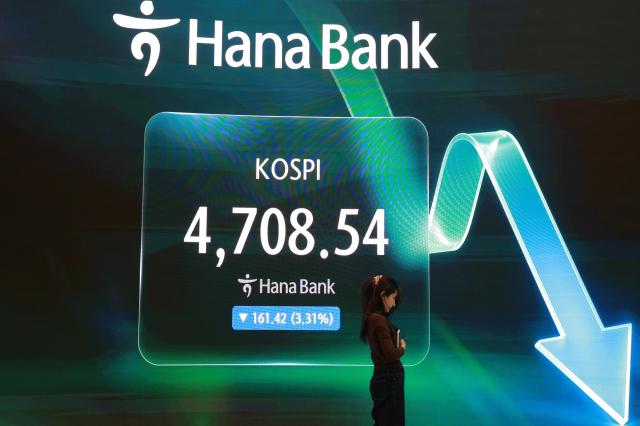
Seoul has been teasing investors with a rescue fund and fidgeting over its deployment as its stock market sinks among the worst performers of the second half, despite being home to two of the world’s chip behemoths, Samsung Electronics and SK hynix.
Officials are checking contributions, weighing the appropriate size and considering when to intervene. Each announcement is intended to convey resolve. With repetition, however, it increasingly reveals reluctance.
A government can exhaust the persuasive power of a rescue fund before spending a single won.
“In the short run, the market is a voting machine but in the long run it is a weighing machine,” Warren Buffett wrote in his 1987 shareholder letter, quoting his mentor Benjamin Graham. Korean companies still carry considerable earnings weight. Investors, meanwhile, are voting with their feet.
Bank of Korea Governor Shin Hyun-song expressed his bewilderment at semiconductor valuations after Thursday’s rate-setting meeting.
“The combined market capitalization of semiconductor stocks is just over 2,000 trillion won ($1.5 trillion). That it amounts to only three times this year’s earnings (of 700 trillion won) is difficult to explain logically,” Shin said.
Investors have reasons to look beyond this year’s profits. Memory earnings are cyclical, and doubts about AI financing, returns and future investment deserve attention. Exceptional profits can make stocks look deceptively cheap before the cycle turns.
Yet the central bank’s outlook hardly suggests an economy running out of strength. It projects growth of 3.9 percent this year and 4.1 percent next year. Even its combined downside scenario—delayed AI investment, tighter financing and increased Chinese memory supply—leaves next year’s growth in the mid-3 percent range.
The distance between that assessment and the anxiety consuming the stock market has become difficult to ignore.
Through Nov. 26, the KOSPI had fallen 17.79 percent from its October close, compared with declines of 13.40 percent in Taiwan, 9.15 percent in Japan and 3.39 percent in Shanghai, according to Financial Supervisory Service data.
Seoul and Taipei are particularly exposed to the shifting mood around AI. Their chip-heavy markets rise on confidence in the next wave of data center spending and recoil at doubts over its financing and returns. The Jensen Huang debacle added another source of turmoil, leaving investors trading on the fortunes of Nvidia’s chief executive as well as the prospects of their own semiconductor companies.
Both markets had substantial gains to surrender. The KOSPI remained 11.79 percent above its year-end level, while Taiwan’s TAIEX was still up 35.18 percent. But their shared vulnerability makes the divergence in official responses all the more striking.
Taiwan has committed money. Seoul continues to discuss its availability.
Taipei authorized its National Financial Stabilization Fund to intervene on Nov. 6 and subsequently confirmed that purchases had begun. The NT$500 billion funding ceiling represents capacity rather than money already spent, but investors know there is an actual buyer behind the announcement.
Taiwan has also prohibited short sales below the previous session’s closing price, with exemptions for certain hedging transactions, and raised the minimum margin requirement for margin short sales to 150 percent from 130 percent.
These restrictions stop short of an outright ban. They nonetheless make the authorities’ determination to temper the selling pressure unmistakable.
Korea need not reproduce the package. It already operates an uptick rule, and further restrictions could complicate trading just as Seoul is trying to establish a more predictable market for international investors.
But caution over short selling does not explain why the rescue fund must remain indefinitely in reserve.
Korea’s hesitation is compounded by the modest size of its proposed defense. The stabilization fund carries commitments of 10.76 trillion won, or about $8 billion—roughly half Taiwan’s NT$500 billion, or approximately $15 billion, capacity. Neither figure represents money already spent. The difference is that Taipei has begun buying, while Seoul is still checking whether contributors can deliver their pledges.
Korea’s financial firepower has also failed to keep pace with its market. The first stabilization fund, established in 1990, amounted to 4.86 trillion won, equivalent to 5.6 percent of KOSPI market capitalization. Today’s commitment is more than twice as large in nominal terms but covers only about 0.3 percent of the market.
That disparity has prompted calls for a substantial increase. Mirae Asset Group Chairman Park Hyeon-joo has proposed expanding the fund to 100 trillion won. Authorities are examining additional contributions, although the size, timing and terms of any deployment remain unsettled.
There are sound reasons to preserve some capacity. Lee Hyo-seob, a senior researcher at the Korea Capital Market Institute, warned that rapid spending could expose the fund’s remaining resources and make its purchases predictable.
Previous interventions also offer no clear evidence that official buying alone produced a sustained recovery.
But preserving resources and preserving confidence are increasingly competing considerations. The funds prepared in 2020 and reconsidered in 2022 were never deployed. Those precedents may encourage officials to believe that reassurance will again suffice. They may equally encourage investors to assume that another announcement will lead nowhere.
A larger commitment would strengthen Seoul’s hand. A measured deployment would establish that it intends to use it.
The fund would not have to match that outflow to influence sentiment. A credible buyer can encourage others to reconsider whether the retreat has gone too far. Its purchases would give substance to the government’s assessment that corporate fundamentals remain sound.
An old funding pledge, repeatedly dusted off, offers less reassurance.
Korea Development Bank has been checking whether participating institutions can honor their commitments and provide additional contributions. Because the money is called when needed, those arrangements matter. They should now produce an executable decision and a measured opening round of purchases.
The reservations are serious. Participating institutions could lose money. Broad index purchases would channel considerable support toward the semiconductor giants whose fortunes already dominate the market. Selecting individual companies would invite disputes over fairness. Withdrawal could become difficult once investors grow accustomed to official support.
Clear investment principles, limits on exposure and an exit framework would help contain those risks. None becomes easier to resolve through another week of hesitation.
There is also concern that domestic institutions would end up buying shares from departing foreigners. That possibility is inherent in any intervention during an overseas sell-off. The relevant question is whether the purchases restore more orderly trading at a reasonable cost.
Inaction carries its own costs. Falling collateral values can trigger margin calls, forcing investors to sell into an already retreating market. Household losses weigh on spending. Depressed valuations make fresh equity more expensive. A reassessment of future earnings can become a liquidation driven by immediate financial necessity.
For now, Korea has room to respond before the strain spreads further.
Between end-October and Nov. 26, the dollar rose only 0.63 percent against the won. Korea’s sovereign credit-default-swap premium stood at 23.7 basis points, slightly below October’s 24.1. The yield gap between three-year AA-minus corporate bonds and government bonds narrowed to about 67 basis points from 69.
These indicators suggest that the equity rout has been accompanied by comparatively steady currency and credit conditions. That gives policymakers breathing room—and a chance to contain the damage before several markets require attention at once.
Taiwan’s intervention offers no guarantee of recovery. Its benchmark remained about 1.4 percent below its Nov. 6 authorization-day close on Thursday. Its smaller monthly decline cannot be attributed solely to official purchases, nor can anyone establish how far it would have fallen without them.
Still, Taipei has accepted that restoring confidence requires taking some risk.
A stabilization fund cannot manufacture AI profits or prevent the next memory downturn. It can ease indiscriminate selling and give investors time to distinguish weakening prospects from prices depressed by fear.
Seoul has already described the volatility as exceptional. Its central bank governor has questioned the logic of chip valuations. Financial officials insist that the resources are available.
The longer those declarations go unanswered by action, the more expensive it may become to make them credible.
Investors have heard enough about what the government stands ready to do. The next announcement should tell them what it has done.
*The author is the managing editor of AJP.
**The views expressed are the author's own.
Copyright ⓒ Aju Press All rights reserved.
