

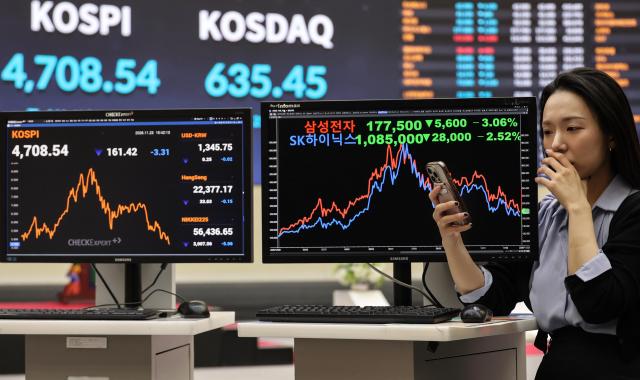
SEOUL, November 29 (AJP) -Asian economies are putting together bigger institutional defenses against the roller-coaster ride in AI stocks, with South Korea exploring a doubling of its stock market stabilization fund, China reinforcing the role of its state investors and Taiwan already putting public money to work.
The interventions come as the fortunes of Asian stock markets and their economies have become increasingly intertwined with the global AI investment cycle, leaving policymakers exposed to abrupt reversals in technology valuations.
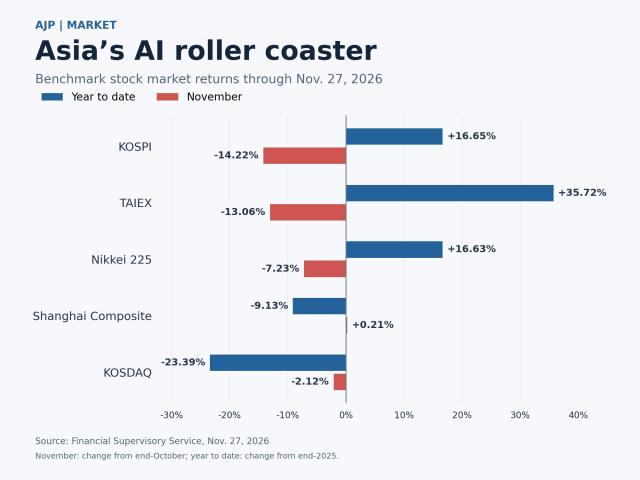
South Korea's benchmark KOSPI has lost 14.22 percent in November alone, even after Friday's 4.34 percent rebound to 4,915.7. Taiwan's TAIEX has shed 13.06 percent this month, while Japan's Nikkei 225 has fallen 7.23 percent. China's Shanghai Composite has lost more than 15 percent from its May peak.
Korea packages a bigger institutional rescue
South Korea's five largest financial groups — KB, Shinhan, Hana, Woori and NH NongHyup — are reviewing plans to raise their respective commitments to the stock market stabilization fund to as much as 2 trillion won, potentially paving the way for a doubling of the fund to around 20 trillion won ($15 billion), according to financial industry sources.
Their combined commitments would rise to 10 trillion won from 4.7 trillion won. Additional contributions from the Korea Development Bank (KDB), securities firms and insurers could bring the total fund to around 20 trillion won from the existing 10.76 trillion won.
The fund's investment management committee met Sunday ahead of an emergency meeting of financial institutions chaired by the Financial Services Commission (FSC) on Monday.
Unlike an immediately deployable pool of cash, the Korean fund operates on a capital-call basis, requiring participating institutions to provide money when requested.
Banks are seeking regulatory concessions in return for larger commitments, arguing that the additional exposure would weigh on their common equity Tier 1 (CET1) capital ratios even before the money is deployed, potentially reducing their capacity for corporate lending, dividends and share buybacks.
During the pandemic-induced market turmoil in 2020, regulators lowered the risk weighting on banks' contributions to the stabilization fund to 100 percent from the 300 percent ordinarily applied to listed equity holdings.
Even a 20 trillion won fund, however, would represent only around 0.5 percent of the capitalization of the KOSPI market. The benchmark's market value has more than quadrupled since the original fund was established in March 2020, raising questions about whether its existing size can deliver a sufficiently powerful signal to investors.
The KOSPI, once the poster child of the global AI trade with gains of as much as 116 percent through late June, has surrendered most of its advance, leaving it just 16.65 percent higher for the year.
Foreign investors have sold a net 16.4 trillion won worth of Korean stocks in November alone, despite returning as net buyers of 1.82 trillion won on Friday, according to Financial Supervisory Service (FSS) data.
Seoul is also packaging emergency market defenses with longer-term institutional reforms to strengthen domestic demand for equities and reduce dependence on foreign capital.
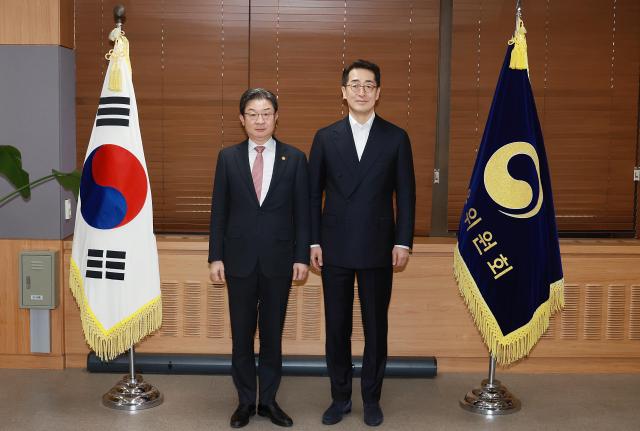
FSC Chairman Lee Eog-weon on Thursday met Meritz Financial Group Vice Chairman Kim Yong-beom, who will head a new private-sector capital market reform committee tasked with strengthening shareholder rights, restructuring the KOSDAQ market and fostering long-term institutional demand for equities.
"The value of one share held by a controlling shareholder equals the value of one share held by an ordinary shareholder," Kim said in a statement outlining what he described as the first constitutional principle of capital markets.
Kim warned that Korean investors increasingly have alternatives in overseas markets and that domestic reforms must deliver tangible results before capital migrates elsewhere.
Beijing reinforces its 'national team'
China will be strengthening its state-backed market intervention apparatus as renewed U.S. tariffs and tighter restrictions on advanced AI chips compound the fallout from the global technology selloff.
Premier Li Qiang on Friday chaired a State Council executive meeting that called for a greater role for the country's so-called "national team" of state investors in countering market volatility.
Central Huijin Investment, the domestic investment arm of sovereign wealth fund China Investment Corp., will have its function as a quasi-stabilization fund strengthened to ensure sufficient market liquidity.
Beijing will also encourage greater inflows of medium- and long-term capital and press listed companies to increase dividend payments and share repurchases.
The Shanghai Composite jumped 3.73 percent Friday to 3,606.5 following Beijing's intervention signal. Despite the rebound, it remains 15 percent below its May closing peak and 9.13 percent lower for the year.
The damage has been considerably greater in technology shares. China's STAR 50 technology index had lost 47 percent from its June 30 closing level as of Thursday.
Taiwan puts its money to work
Taiwan has gone further than its Asian peers in translating promises of market support into action.
Taipei authorized its National Financial Stabilization Fund to intervene on Nov. 6 and subsequently confirmed that purchases had begun. The fund's NT$500 billion ($15.18 billion) financing ceiling is roughly equivalent to the expanded rescue fund under consideration in South Korea.
The Taiwanese authorities have also restricted short sales below the previous session's closing price, subject to exemptions for certain hedging transactions, and raised the minimum margin requirement for short selling to 150 percent from 130 percent.
The restrictions stop short of an outright ban but underscore Taipei's determination to temper speculative selling pressure.
Even those measures have not insulated Taiwan from the global AI rout. The TAIEX closed Friday at 39,308.1, more than 21 percent below its Oct. 6 intraday record of 49,968.92. Its year-to-date gain has narrowed to 35.72 percent.
From AI boom to state-backed defense
The three Asian economies differ in their intervention mechanisms but share a growing vulnerability: the outsized influence of technology stocks on their capital markets.
South Korea and Taiwan dominate critical segments of the global AI semiconductor supply chain, while China's technology sector faces the additional pressure of Washington's efforts to restrict its access to advanced computing power.
Tags: Asian stock markets, AI selloff, KOSPI, TAIEX, Shanghai Composite, stock market stabilization fund, Central Huijin, Korea financial regulators, Taiwan stabilization fund, China national team, Nvidia, semiconductor stocks, foreign capital outflows, capital market reform.
Copyright ⓒ Aju Press All rights reserved.
