

 KOSPI slides as Samsung earnings fall short of expectations
Samsung Electronics posted its highest-ever quarterly profit on Thursday, yet its shares fell 4.1 percent. The decline suggested that investors are increasingly focused on shareholder returns rather than record earnings in South Korea's chip sector. The country's benchmark KOSPI fell 1.24 percent or 74.78 points, to 5,937.66, as institutional investors sold a net 457.9 billion won (US$342.9 million) worth of shares. Samsung Electronics closed a
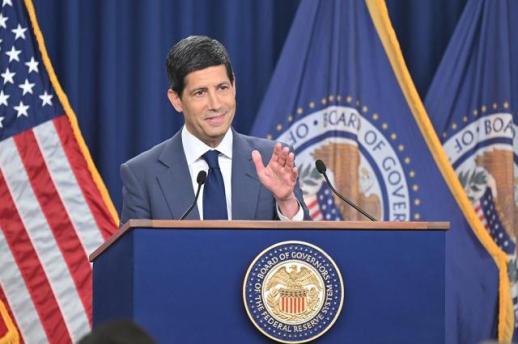 BOK stays cautious as Fed turns less hawkish
The Bank of Korea (BOK) said Thursday it would remain vigilant over domestic financial and foreign exchange markets despite investors taking a less hawkish-than-expected view of the Federal Reserve's latest rate decision. The BOK held a market monitoring meeting at 8 a.m., chaired by Deputy Gov. Kwon Min-soo, to assess the outcome of the Federal Open Market Committee meeting and its potential impact on South Korean markets. The Fed kept the federal f
 Chip rally keeps KOSPI above 6,000
SK hynix's third-quarter results kept South Korea's main index above 6,000 on Thursday, but the gain rested on a handful of chip heavyweights. The Korea Composite Stock Price Index (KOSPI) opened higher, rising 25.4 points, or 0.4 percent, to 6,037.8. However, LG Energy Solution shares tumbled after LG Chem sold a 2.5 trillion won (US$1.87 billion) stake in the battery maker, weighing on battery stocks and the tech-heavy KOSDAQ. The KOSDAQ,
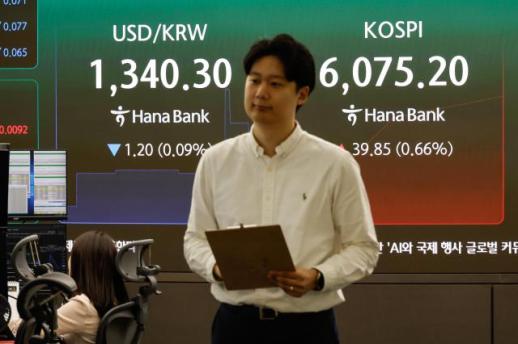 Won slides as hawkish Fed concerns lift dollar
South Korea's won closed down 14.0 won at 1,337.7 per dollar Wednesday as a stronger dollar and concerns over hawkish signals from the Federal Reserve outweighed strong domestic equity gains. The local currency weakened sharply from Tuesday's close of 1,323.7, reversing part of a recent rally that had pushed the won toward its strongest levels in about two years. The won opened at 1,326.0 per dollar before losses accelerated during the se
 SK hynix payout carries Seoul's benchmark above 6,000
SK hynix pledged about 100 trillion won ($74.7 billion) in 2026 shareholder returns after the largest quarterly operating profit in its history, and the prospects of Samsung Electronics doling out additional rewards pushed the KOSPI above 6,000 for the first time in 10 sessions. The main index in Seoul jumped 374.1 points, or 6.6 percent, to 6,012.4. Foreign investors and institutions bought a combined 1.78 trillion won ($1.33 billion) of shares as SK
 Korea's FX deposits stretch $14 billion September
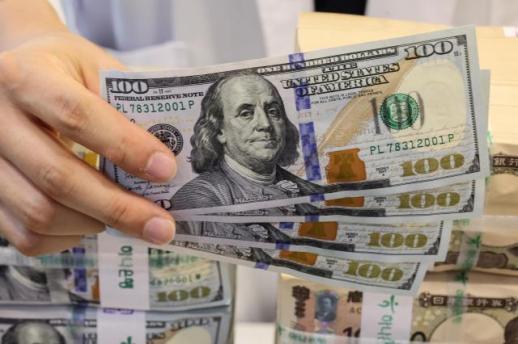
South Korea's resident foreign currency deposits at foreign exchange banks stretched by $14.09 billion in September on burgeoning dollar revenue for the Korean Inc. and bond proceeds ,central bank data showed Wednesday. The deposits stood at $154.71 billion at the end of September, up from $140.62 billion a month earlier, according to the Bank of Korea (BOK). Dollar-denominated deposits increased by $12.99 billion to $132.90 billion, accou
 KOSPI briefly touches above 6,000 on 8% surge in chip stocks
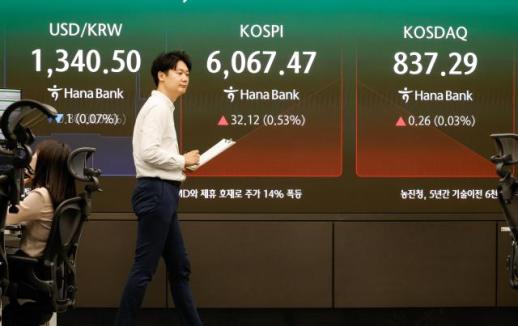
The KOSPI briefly touched above 6,000 as 8-percent surge in bellwether memory chip stocks drew strong buying from foreign and institutional capital. As of 11:10 a.m., KOSPI was trading 5.96 percent higher at 5,974.34. with SK hynix and Samsung Electronics both 8 percent higher at 1,4510,000 won and 239,500, respectively, as investors were relieved of chip boom peak-out after SK hynix said its HBM and DRAM supplies for the next three years have already been b
 Asian stocks rally as renewed AI optimism lifts KOSPI above 5,800
Asian stocks opened higher on Wednesday, with South Korea's benchmark KOSPI rising nearly 3 percent to surpass the 5,800 mark, as renewed optimism over AI-related investment and record earnings from chipmaker SK hynix boosted investor sentiment. In Seoul, the benchmark KOSPI jumped 2.93 percent to 5,803.37 in morning trading, while the tech-heavy KOSDAQ rose 3.15 percent to 767.28 as of around 9:10 a.m. The rally followed another strong session on Wa
 Korea Inc.'s stock-funded cash calls face a market reckoning
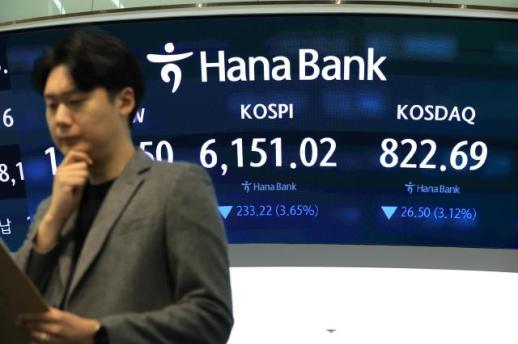
Retail investors borrowed money to buy stocks while Korean companies worked in reverse, using their shareholdings to raise cash. Both strategies came under pressure as stocks plunged and borrowing costs rose. For Korea Inc., one route was the price return swap (PRS), a financial arrangement that allows companies to raise funds while retaining potential gains from the underlying shares. The catch is that they also remain exposed to losses. Companies
 Korea's debt issues up 78% Sept following back-to-back rate hike
A rush of debt sales bolstered securities pipeline in September after a back-to-back rate hikes in the previous two months, while IPO remained thin amid weak stock market, government data showed Tuesday. Companies issued securities worth 28.56 trillion won ($21.56 billion) in September, up 74.9 percent from 16.33 trillion won in August - 28.17 trillion won in bonds and 385.3 billion won in equities, according to the Financial Supervisory Service.