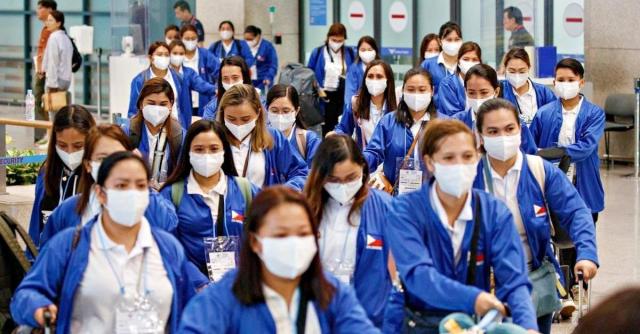
In a paper published Saturday in the journal of the Korean Association for Immigration Policy and Administration, Lee Mi-ae, a professor at Jeju National University’s Research Institute for the Tamla Culture, examined the experiences of Filipino domestic and care workers employed under a pilot project run by the Seoul Metropolitan Government and the Ministry of Employment and Labor. The program brought 100 Filipino housekeepers to Korea to provide child care and household support for dual-income, single-parent and multi-child families.
Lee and her research team conducted surveys and in-depth interviews between April and May last year with 21 Filipino workers in their 20s and 30s, along with two interpreters.
During the first six months of the program, participants earned an average monthly wage of 1.92 million won ($1,301) before taxes. After deductions for housing, insurance and communication costs, their take-home pay fell to about 1.18 million won, or roughly 51 percent of South Korea’s average monthly wage in 2024, which stood at 3.74 million won.
Their hourly wage was set at 9,860 won, 27 to 35 percent lower than that of domestic childcare providers and household workers, whose pay ranges from 13,590 won to 15,000 won per hour.
Even under a standard 30-hour workweek, monthly deductions of 470,000 to 520,000 won for items such as housing left many workers with less than 1 million won in net pay.
Several respondents also reported being asked to perform tasks beyond their original scope of work. In addition to child care, they said they were expected to clean the house, wash dishes, care for pets and provide English lessons.
Lee attributed these problems to the exclusion of migrant domestic and care workers from the policymaking process, saying discussions focused mainly on users’ needs and employers’ interests.
“Workers’ experiences and voices must be reflected at every stage of policymaking,” she wrote, calling for stronger labor protections. She also stressed that migrant domestic workers should be allowed to change workplaces without automatically losing their residence status and that their fundamental labor rights be protected.
Lee further urged policymakers to move beyond a narrow focus on low wages and re-evaluate the social value of child care and household labor.

Copyright ⓒ Aju Press All rights reserved.