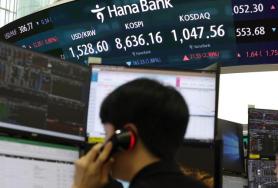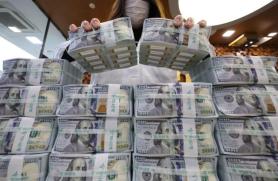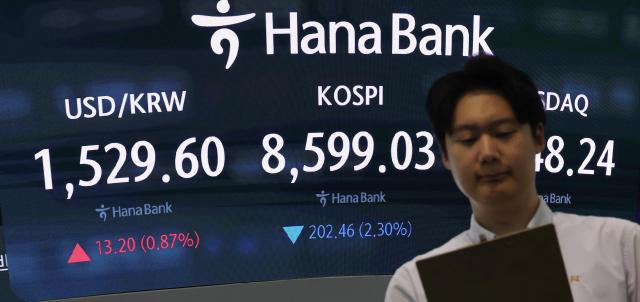
Downward pressure on the Korean won is intensifying as investors question how much domestic monetary policy can do on its own. A stronger greenback, surging oil prices and synchronized tightening fears among major central banks are adding to the strain.
In the Seoul foreign exchange market on Thursday, the exchange rate opened at 1,530.0 per dollar, down 13.6 won from the previous session's daytime closing price, marking the first time the rate opened in the 1,530 won range in 17 years and three months since March 2009, during the height of the global financial crisis.
On a closing basis, the won-dollar exchange rate has already remained in the 1,500 won range for 12 consecutive sessions.
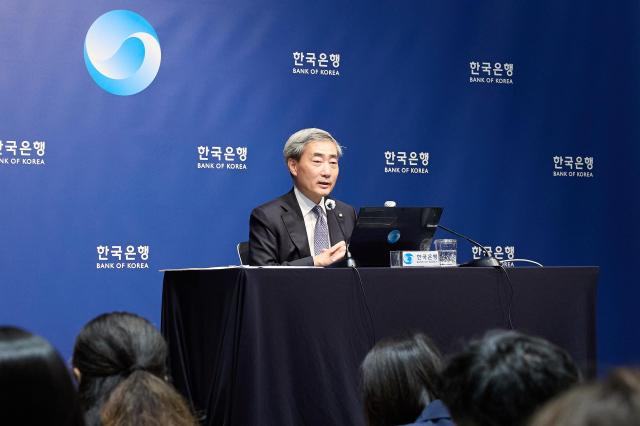
Generally, an increase in the benchmark interest rate supports the won's value by boosting yields on won-denominated assets and narrowing the interest rate gap with the United States. This time, however, market dynamics are being driven more by global monetary tightening and commodity price shocks than by the BOK's rate-hiking potential.
The won's recent weakness reflects heightened sensitivity to shifts in the global liquidity environment rather than South Korea's own rate path. Consequently, even a 25-basis-point rate hike by the BOK could have its stabilizing effect offset if a stronger dollar, high oil prices and foreign equity liquidation persist.
Oil prices above $100 per barrel remain a persistent burden on the South Korean economy, even if the shock has been partially priced in. Given South Korea's heavy reliance on the Strait of Hormuz for most of its crude oil imports, soaring oil prices increase demand for greenbacks to settle energy import bills and raise concerns over a deteriorating trade balance.
Adding to the pressure, the growing likelihood of a Bank of Japan rate hike has triggered a broader repricing of monetary policy across major Asian economies. BOJ Governor Kazuo Ueda said the previous day that there is a "clear need" to discuss the appropriateness of a rate hike, warning that delaying normalization could place a growing burden on the economy and the financial system.
With the Federal Reserve, the BOK and the Bank of Japan (BOJ) all maintaining a tightening bias, a single 25-basis-point move by the local central bank may not be enough to defend the currency. Amid renewed strength in the greenback, concerns have grown that the U.S. Federal Reserve could pivot back toward a hawkish stance, while international crude prices have surged as cease-fire negotiations in the Middle East war fell back into deadlock.
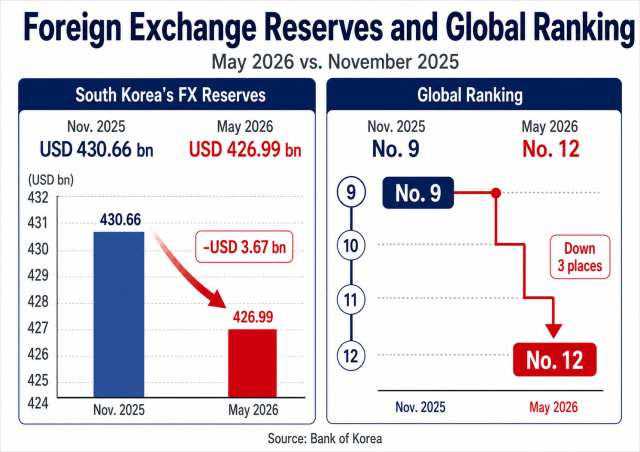
Shrinking foreign exchange reserves are also fueling market anxiety. South Korea's FX reserves stood at $430.66 billion at the end of last November, before the BOK was presumed to have stepped up market-stabilization measures, but fell to $426.99 billion at the end of last month, representing a decline of US$3.67 billion over six months.
The latest available global ranking also points to a deterioration, with South Korea falling to 12th as of the end of April from ninth at the end of last November.
Aggressive selling of domestic equities by foreign investors is further exacerbating the won's depreciation. Foreign investors offloaded a net 6.6 trillion won worth of KOSPI shares in May alone, adding to dollar demand in the local foreign exchange market.
A peculiar anomaly has emerged in the market: even though the exchange rate has failed to pivot stronger, the bond market is weakening as it pre-emptively prices in an interest rate hike. The benchmark three-year government bond yield rose 8.5 basis points to 3.858 percent, its highest level since November 2023, while the 10-year yield climbed 9.4 basis points to 4.229 percent.
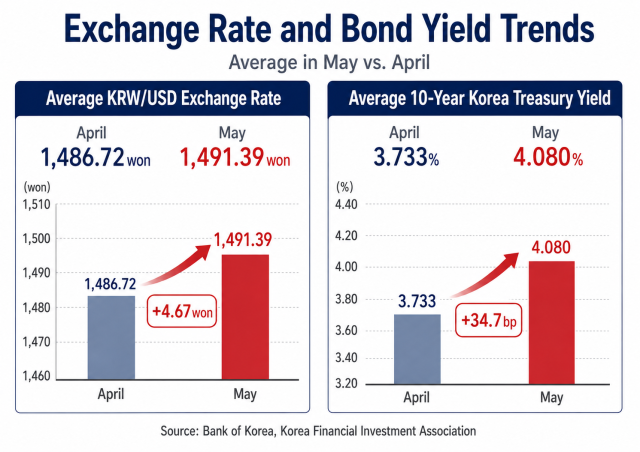
The broader strain was already visible in May, when the average won-dollar exchange rate weakened to 1,491.39 won from 1,486.72 won in April and the average 10-year yield rose 34.7 basis points to 4.080 percent.
The government and financial authorities are also heightening their vigilance. Koo Yun-cheol, Deputy Prime Minister and Minister of Economy and Finance, noted widening volatility in domestic financial and FX markets during a market monitoring meeting on Thursday, signaling that relevant agencies would respond immediately if excessive one-sided moves emerge.
While the remarks were closer to a cautionary statement than a heavy-handed verbal intervention, they were interpreted as a sign that authorities could strengthen their response now that the exchange rate has entered the 1,530 won range.
Experts stress that active intervention by the central bank and foreign exchange authorities is essential as the high-exchange-rate environment drags on.
"There is no entity capable of blocking the exchange rate ceiling other than the foreign exchange authorities," said Lee Nak-won, an FX derivatives specialist at NH Nonghyup Bank, back in March, when the won-dollar rate skyrocketed to the 1,530 won level.l.
Ultimately, the crux of the issue lies not in the BOK's rate-hike declaration itself, but in whether global dollar strength, high oil prices and foreign outflow pressure begin to subside. Unless Fed tightening fears cool and crude prices stabilize, reversing the won's downward trajectory through the BOK's baby steps alone will remain an uphill task.

Copyright ⓒ Aju Press All rights reserved.