
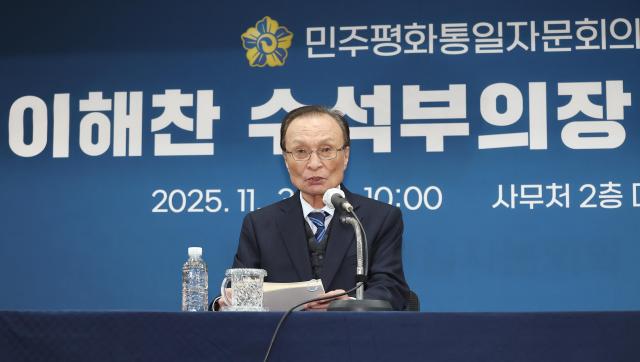
Lee, the vice chair of the Peaceful Unification Advisory Council (PUAC) that directly reports to the president, died Sunday at a hospital in Ho Chi Minh City after suffering cardiac arrest. He was 73.
The funeral, jointly hosted by PUAC and the ruling Democratic Party, will run from Jan. 27 to 31, according to PUAC officials. Lee’s body is expected to arrive at Incheon International Airport early Tuesday before being transferred to the funeral venue.
The service will be conducted as a “social funeral,” a form of public memorial reserved for figures deemed to have made significant contributions to society. The five-day period is longer than the customary three-day funeral in South Korea.
Lee arrived in Ho Chi Minh City on Thursday but collapsed the following day while preparing to return to Korea after flu-like symptoms worsened. He was rushed to a nearby hospital and underwent an emergency stent insertion procedure but later died.
A seven-term lawmaker, Lee was dubbed as a kingmaker on the liberal camp. He commanded key posts in all liberal governments - education minister under President Kim Dae-jung, prime minister under President Roh Moo-hyun, chairman of the Democratic Party during the Moon Jae-in administration, and senior vice chair of PUAC under President Lee Jae Myung.
Lee’s political career was rooted in South Korea’s democracy movement. During the Yushin era, he was imprisoned for his involvement in pro-democracy activism, including the National Federation of Democratic Youth and Students case and the fabricated Kim Dae-jung insurrection plot case. He later entered formal politics under the post-1987 democratic system, experiencing firsthand both military rule and democratic transition.
“South Korea today has lost a great teacher in the history of its democracy.," mourned President Lee on Facebook. He added that Lee “devoted his entire life to protecting and expanding democratic values amid the turbulence of modern Korean history.”
Copyright ⓒ Aju Press All rights reserved.
