

Planet of Ants=By Susanne Foitzik and others, translated by Nam Gi-cheol, Bookshill.
The author, a biology professor at Johannes Gutenberg University Mainz in Germany, is widely regarded as a leading ant researcher. Drawing on expeditions around the world, the book recounts encounters with ants and explains how colonies divide labor among queens, workers and scouts. It also describes survival strategies such as raiding other colonies like slave hunters, enslaved ants that eventually rebel, and ants that raise mites like livestock. The society can look familiar at first glance, but the closer view shows how different it is from human life.
“Ants take John F. Kennedy’s famous line to an extreme: ‘Ask not what your country can do for you; ask what you can do for your country.’ A Malaysian ant’s answer is: ‘I can even blow myself up!’ Ants do not explode their bodies because they are too stupid and doing it for fun. It is a last resort chosen in a fierce struggle for survival.” (p. 310)

The author, a professor at Northumbria University in the U.K., argues that human-made forms carry traces of the human body and senses. Starting with hands and feet, the book traces the origins of shapes found in homes and roads, as well as knockoffs and vintage goods. It concludes that civilization is an extension of the body — and that those extensions, in turn, standardize our bodies and senses. Using the shapes of coins and banknotes, the author says circles and rectangles are optimal forms chosen by human hands. He also describes how wheel width can set road width, which then limits wheel size, showing how human-made forms can end up shaping human behavior. The book even raises the possibility that, in the distant future, human hands could lose fine control and become organs optimized for only the simplest tasks.
“Many products, not just banknotes, are made in rectangular shapes for spatial efficiency. From small items to buildings and cities, our world works by fitting smaller things into larger frames. Rectangles and box shapes are better than other forms at using space because they can be packed together without gaps. That is also why the blocks in the game Tetris combine into rectangles: It delivers the satisfaction of filling the screen tightly, without empty spaces.” (p. 183)
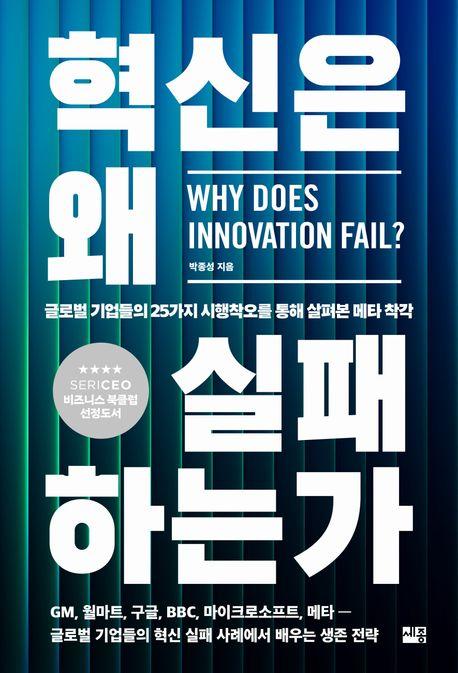
Why Innovation Fails=By Park Jong-seong, Sejong Books.
A business consultant, the author argues that innovation often collapses because of a structural illusion that almost anyone can fall into — what he calls a “meta illusion.” The book tracks five recurring “meta illusions” over more than a century, from the electrical revolution of the 1900s to generative AI in the 2020s. It cites 25 cases of failed innovation by global companies, including GM’s $9 billion robot factory, the BBC’s 170 billion won digital project, and data behind Microsoft’s AI chatbot once touted as a world-changer. The author says recognizing and preventing these illusions can help companies pursue genuine innovation.
“During the Ocado fire, the fact that reporting was delayed by as much as an hour even amid loud alarms strongly suggests that automation bias was at work — the complacent belief that ‘Could there really be an error in this perfect system?’ Excessive trust in the system paralyzed critical thinking and stripped away instinctive crisis-response judgment.” (p. 256)
* This article has been translated by AI.
Copyright ⓒ Aju Press All rights reserved.