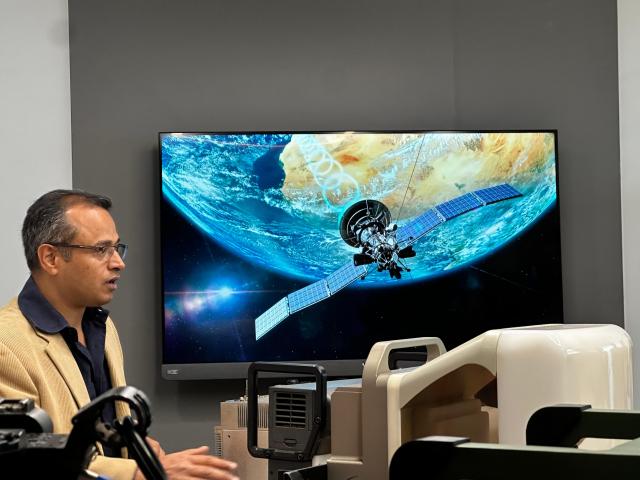
“We would be very happy to work with the satellite and telecom businesses of Korean companies such as SK Telecom, Samsung Electronics and LG Electronics,” said Venkatesh Kumaran, president of Astrome Technologies, at the company’s headquarters in Bengaluru.

Astrome is actively seeking what it calls a “reputable South Korean partner” — an intermediary capable of translating advanced technology into operational engagement with South Korea’s military and major defense contractors.
Such a partner, Kumaran said, would play a central role in joint research and development, regulatory coordination and market entry.
“Our technology is highly specialized. To deploy it effectively in Korea’s defense ecosystem, we need a partner that understands both the engineering and the institutional landscape,” he said.
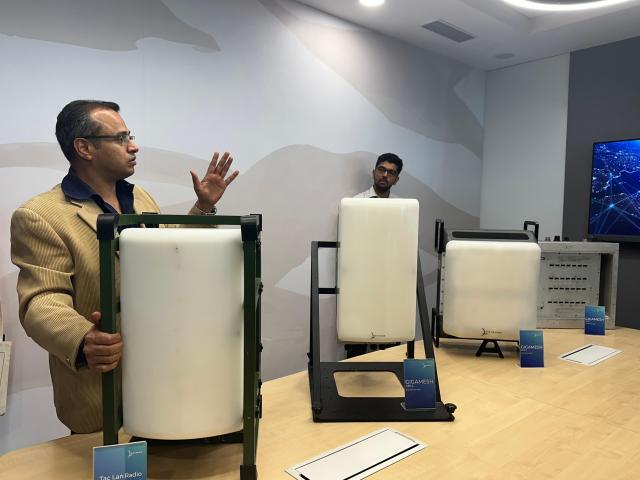
The biggest challenge for high-speed communication at sea or on the move is stability.
Traditional antennas are often bulky, mechanical devices that must physically rotate to track a moving ship or satellite. In harsh military environments, these moving parts are highly prone to wear and tear, leading to frequent maintenance issues and mechanical fatigue.
Astrome’s core systems eliminate these vulnerabilities by using electronically steerable beams. Instead of moving the dish itself, the technology compensates for platform movement and environmental vibrations entirely through electronic signals, requiring zero mechanical components.
The design is particularly suited for naval vessels and mobile ground platforms — sectors in which South Korea’s defense industry has established global competitiveness.
“We are a small company, but we have cracked a technology that no one else in the world has,” Kumaran said. “Building products together with a Korean partner could create immense synergy in R&D and deployment.”
Leadership in E-band phased arrays
While South Korea is a global leader in 5G, the industry has faced challenges in deploying higher-frequency millimeter-wave networks due to technical hurdles and high costs. As the world shifts its focus toward 6G and the E-band spectrum (around 80 GHz)—a frequency range critical for high-capacity, low-latency communications—Astrome’s technology offers a ready-made solution that South Korea is currently striving to master.
Its GigaMesh system drastically reduces deployment time. While traditional systems require hours of manual alignment by specialists, GigaMesh can be operational within 30 minutes, with subsequent control managed remotely through software.
The system also supports multi-point transmission, enabling a single transmitter to serve multiple receivers simultaneously. According to the company, this reduces capital expenditure by up to 50 percent compared with conventional equipment.
“Even major players like Ericsson and Nokia have not been able to do this,” Kumaran said. “We are the only ones who have cracked it and secured patents. Even if someone starts today, it would take three years to catch up.”
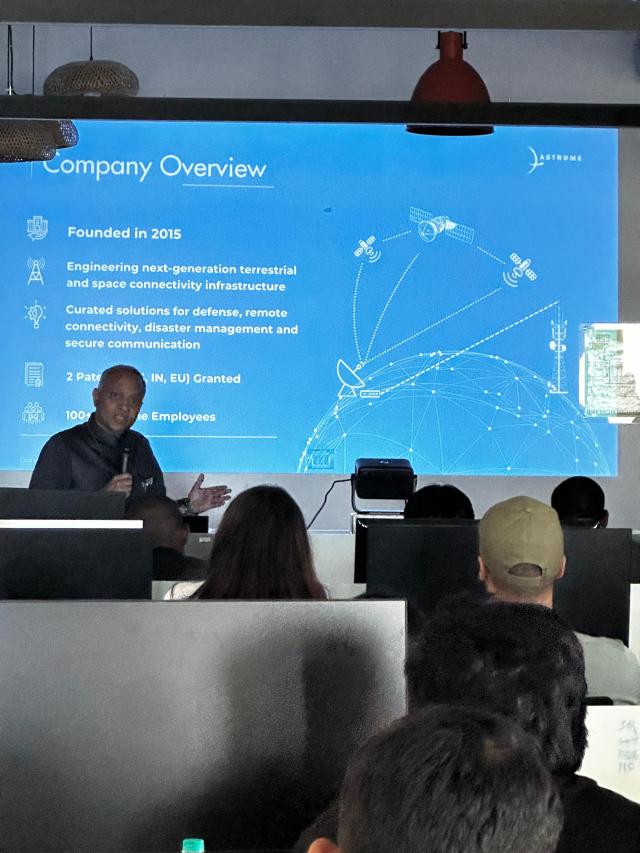
Building on its terrestrial wireless expertise, Astrome has expanded into a full satellite communications ecosystem.
Its portfolio includes GigaSat, a flat-panel satellite ground terminal for maritime and land-mobile platforms, and SpaceNet, a software-defined E-band payload capable of delivering more than 180 gigabits per second per satellite.
The company’s defense credentials were recently reinforced when India’s Ministry of Defence awarded Astrome for its Anti-ECM Tactical LAN Radio, a system designed to resist jamming and interception.
The equipment successfully completed trials in environments ranging from desert heat to high-altitude cold, underscoring its operational resilience.
Astrome’s engagement with South Korea predates its current partnership push and is rooted in early-stage investment.
The company has received funding from South Korean venture capital firms, including Impact Collective and The Ventures, which supported its transition from a startup to a deep-tech defense supplier.
“We received Korean investment at a very early stage,” said Brighu Bhattrahalli, head of global commercial business at Astrome. “That support was critical during our formative period.”
Korean investors participated in a $3.4 million bridge funding round in September 2021, which was used to expand Astrome’s presence in the U.S. market and conduct international operator trials.
To date, Astrome has raised more than $14 million in total funding. Company executives say Korean capital has played an important role in technology refinement and international credibility.
That support enabled Astrome to finalize its patented digital beamforming phased array architecture — the core platform behind its GigaMesh and GigaSat products.
The technology is designed to deliver high-speed, cost-effective connectivity in remote and underserved regions, while also meeting military-grade reliability standards.
“With the right Korean partner, we believe our systems can be scaled for both civilian and defense applications,” Kumaran said. “The opportunity is strategic, not just commercial.”

Copyright ⓒ Aju Press All rights reserved.