
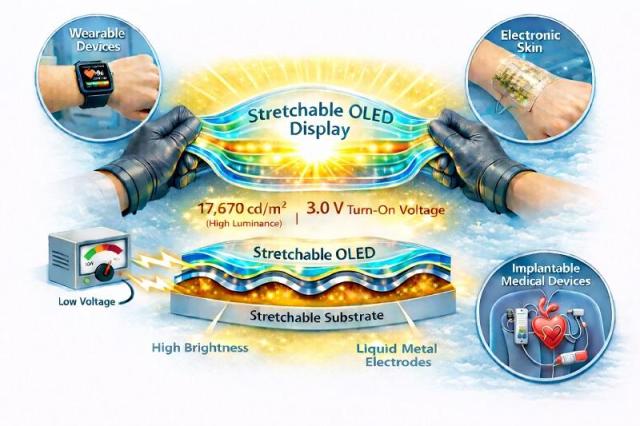
SEOUL, March 03 (AJP) - A joint research team has developed a new stretchable organic light-emitting diode (OLED) that maintains its brightness even when stretched, overcoming a major technical barrier in the development of flexible electronics. The technology achieved world-record performance levels for brightness and efficiency, significantly improving the prospects for commercializing wearable displays and electronic skin.
The Korea Advanced Institute of Science and Technology (KAIST) announced on March 3 that a team led by Professor Cho Him-chan, in collaboration with the University of Chicago and Soochow University, created a hybrid liquid metal cathode. This component allows the display to remain conductive and bright while being pulled or deformed, a task that has historically caused stretchable screens to dim or fail.
In conventional stretchable OLEDs, the electrodes often suffer from mechanical instability. When the material is stretched, the electrical connection weakens, leading to a sharp drop in performance. To solve this, the researchers used liquid metal particles thinner than a human hair. By densely packing these particles and rupturing only the top layer, they created a smooth, continuous metal surface that conducts electricity efficiently. The intact particles underneath serve as a cushion, absorbing physical shock and allowing the electrode to stretch like rubber.
The resulting display reached a maximum brightness of 17,670 candelas per square meter at 9.5 volts, which is brighter than most high-end smartphone screens. It also recorded a current efficiency of 10.35 candelas per ampere, the highest level reported to date for this type of technology. Even when pulled to its limits, the device showed almost no loss in brightness, addressing the most significant weakness of previous stretchable display prototypes.
Testing showed that the OLED remains stable even after being stretched and released multiple times. This durability is essential for practical applications, such as clothing-integrated displays or medical devices that must adhere to the moving surface of human skin or internal organs. The technology is expected to be used in various fields, including soft robotics and bio-interfaced optoelectronics.
"We have solved the fundamental material problem that has limited the performance of stretchable displays," Professor Cho Him-chan said. "This hybrid liquid metal cathode technology will be a key foundation for next-generation flexible electronic devices."
The study, with Lee Won-bum as the first author, was published in the journal Advanced Materials on December 28, 2025. It was selected as the inside back cover for that issue.
(Paper information)
Journal: Advanced Materials
Title: Hybrid Liquid Metal Cathode Enables High-Performance Intrinsically Stretchable OLEDs
DOI: https://doi.org/10.1002/adma.202518254
Copyright ⓒ Aju Press All rights reserved.
