
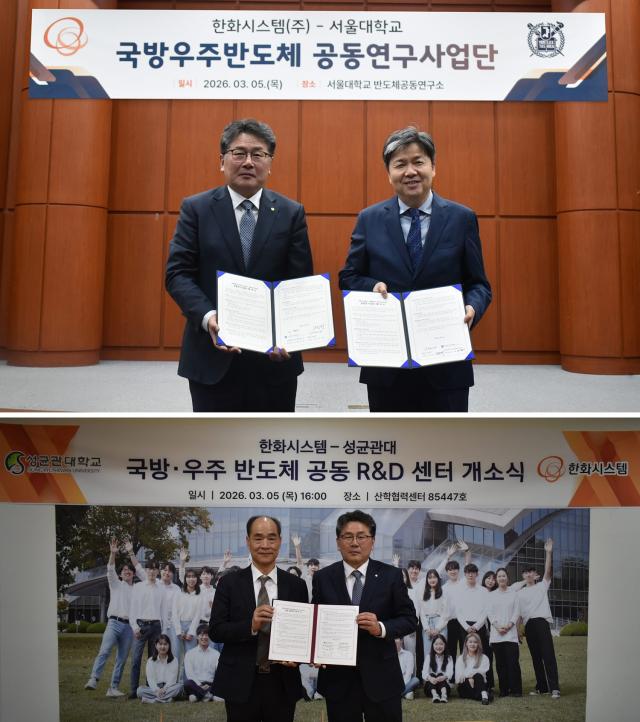
Hanwha Systems said March 5 that it held ceremonies with Seoul National University and Sungkyunkwan University to establish joint research and development centers to secure design technologies for defense and space semiconductors.
The centers will be set up at SNU’s Semiconductor Joint Research Institute and at Sungkyunkwan University’s College of Information and Communication Engineering on its Natural Sciences Campus, the company said.
Hanwha Systems and SNU will conduct joint research through 2031 to develop high-frequency semiconductor design technology for communications, it said. The chips are expected to be key components for applications including communications satellites, mobile terminals and unmanned aircraft, supporting high-speed, low-latency, high-performance military communications linking land, sea, air and space domains.
Hanwha Systems said it previously won a development project in December for a “transceiver space semiconductor for low-Earth-orbit communications satellites,” one type of communications chip. The transceiver is described as a core component for military LEO satellite communications, designed to reliably transmit and receive satellite signals between ground and space in extreme space environments.
With Sungkyunkwan University, Hanwha Systems will jointly develop domestically made, high-power, high-efficiency, wideband semiconductors for radar, the company said. The chips are core components used in radar antennas — the “eyes” of systems such as surface-to-air guided weapons, fighter jets and observation satellites — and are used to generate radio waves and amplify received signals for target search and tracking.
The company said the technology could be used broadly, including in multifunction radars applied to Cheongung-II and L-SAM, as well as AESA radars for fighter aircraft and SAR for observation satellites. Hanwha Systems said it plans to build joint research infrastructure with each university and pursue work in stages, from early research and technology acquisition to component commercialization. It also plans longer-term cooperation, including expanded industry-academia exchanges and recruitment of top talent.
Defense semiconductors are specialized chips used in advanced weapons systems such as missiles, radar and military communications, requiring far higher reliability and stability than chips for other industries, the company said. Hanwha Systems said it expects the partnerships to help it internalize high-quality domestic defense semiconductor design capabilities quickly and systematically.
Hanwha Systems said it aims to strengthen competitiveness in defense semiconductor technology across all stages, from components to integrated systems, and to become a leading company in localizing defense semiconductors in South Korea.
“This industry-academia partnership is an important starting point for securing core defense semiconductor technologies stably at home,” a Hanwha Systems official said. “Through sustained R&D and talent development, we will raise self-reliance in key semiconductor technologies for defense and contribute to strengthening South Korea’s defense industry competitiveness.”
* This article has been translated by AI.
Copyright ⓒ Aju Press All rights reserved.