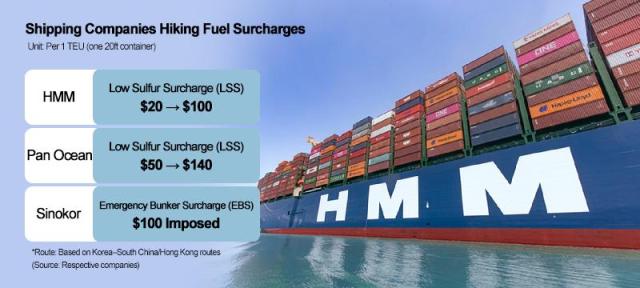
Sinokor Merchant Marine, one of Korea's largest container operators, said it will impose an emergency bunker surcharge of $100 per 20-foot equivalent unit (TEU) on export cargo bound for Southeast Asia, effective this month. Industry officials said other major container carriers are preparing similar measures, with surcharges ranging from $150 to $200 per TEU.
The moves come as global shipping lines including Maersk and OOCL roll out their own emergency surcharges in response to the Middle East crisis.
The latest fees mark another layer of cost escalation stemming from the 2026 Strait of Hormuz crisis, which began on Feb. 28 when the United States and Israel launched coordinated airstrikes on Iran under Operation Epic Fury. Iran retaliated by restricting passage through the strait, through which about 20 percent of global oil and a similar share of liquefied natural gas shipments normally pass.
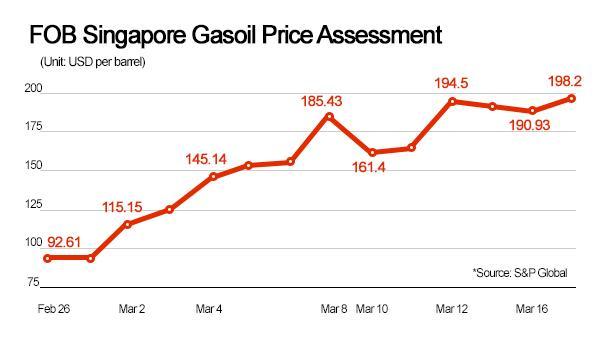
The disruption has hit marine fuel markets with particular force.
Bunker C fuel oil, the heavy fuel that powers most commercial vessels, is typically produced from the residue of heavier crude grades. Middle Eastern crudes, generally heavier and higher in sulfur content than most benchmark grades, have long been a key feedstock for such fuels.
Vessels stranded inside the strait are compounding the strain on ocean freight.
A total of 26 Korean-flagged ships remain stuck in the Strait of Hormuz, 10 of them belonging to eight small and mid-sized carriers, according to data from the Korea Shipowners' Association.
Those carriers are estimated to be losing about 580 million won ($392,086) a day from halted operations, higher fuel costs, war-risk insurance premiums and crew hazard pay.
The pressure is spreading into air logistics, where jet fuel costs are tracking the same Middle East supply disruption through the Singapore benchmark widely used across Asia.
Singapore Mean of Platts jet fuel averaged 511.21 cents per gallon for May, placing it in the top tier of Korea's 33-step fuel surcharge system, according to the aviation industry. It is the highest reading since the surcharge framework was introduced.
Korean Air set its May international fuel surcharge at up to 150,000 won ($101.40) per round trip, depending on distance. The top-end charge is roughly five times the January level.
With both sea and air freight costs rising in tandem, Korean exporters face the prospect of higher logistics bills feeding into consumer prices if the Hormuz disruption stretches further into the second quarter, industry officials said.
According to preliminary export and import price data for March released by the Bank of Korea on Wednesday, import prices in won terms jumped 16.1 percent from the previous month, the steepest increase since a 17.8 percent surge in January 1998. From a year earlier, they rose 18.4 percent.
Consumer prices rose 2.2 percent in March from a year earlier, still within the target range, but the Bank of Korea has warned that annual inflation could approach 3 percent if the war drags on.

Copyright ⓒ Aju Press All rights reserved.