

SEOUL, April 20 (AJP) - Professor Lee Gyu-tag from George Mason University Korea examined the cultural evolution and future trajectory of K-pop during a guest lecture at Kookmin University on April 16. Speaking as the featured guest for the 663rd Thursday Special Lecture, Lee explored how the genre's identity has shifted from a local South Korean product to a global phenomenon, the prominent university said Monday.
The lecture defined K-pop not merely as a broad term for all South Korean popular music, but as a specific cultural genre built upon a distinct production method and industrial structure. Professor Lee identified the "total management system"—integrating planning, production, and distribution alongside music, performance, and digital content—as a core element that evolved independently while being influenced by the division of labor models found in overseas music industries.
The meaning of the "K" in K-pop is undergoing a transformation as the genre expands globally. While early efforts emphasized South Korean identity, Professor Lee analyzed how recent strategies have shifted toward the global market, citing the release of English-language songs and the inclusion of members from diverse nationalities, such as the trajectory seen with BTS.
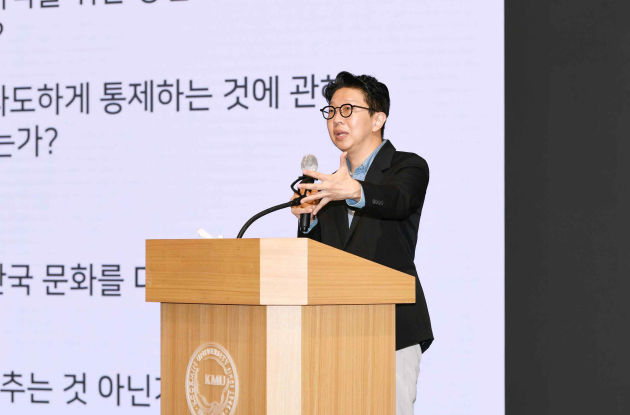
Professor Lee also noted that the term "K-pop" was first adopted abroad before being reintroduced to South Korea, helping to shape its current identity. He explained that the genre is unique because it is defined not only by its producers but also by the perceptions and evaluations of its international audience.
The competitive strength of the genre lies in its business model, the way it builds relationships with fans, and the "maximalist" characteristics found in its performance and style. While citing experimental cases where the "K" is removed or groups consist of various nationalities, Professor Lee maintained that the South Korean production system and cultural context remain the central foundation.
The lecture concluded with an assessment that the inherent ambiguity of K-pop could serve as a bridge for further expansion. Professor Lee emphasized the importance of understanding cultural context and pursuing balanced development for the industry moving forward.
KMU has operated its Thursday Special Lecture as a regular course featuring external speakers for 30 years, marking the first and longest-running program of its kind among South Korean universities. Approximately 670 speakers from various fields have participated, including former President Roh Moo-hyun, Cardinal Stephen Kim Sou-hwan, author Rhyu Si-min, and film director Park Chan-wook.
Copyright ⓒ Aju Press All rights reserved.
