
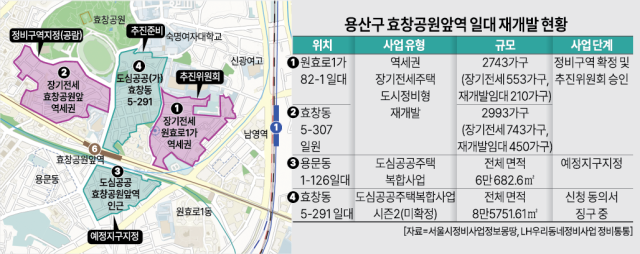
Debate over so-called “cage apartments” — criticism of high-density projects dominated by small units — is spreading to redevelopment plans around Hyochang Park Station in Seoul’s Yongsan district. Even so, projects in the area are moving ahead on the back of floor-area ratio incentives.
According to the redevelopment industry on April 21, the promotion committee for a station-area, long-term jeonse housing (Shift) urban renewal-type redevelopment project near 82-1 Wonhyo-ro 1-ga will hold an on-site briefing on April 23 to select a design firm.
The plan was finalized last month after passing the Seoul Metropolitan Government’s City Planning Commission. It expands the project to 2,743 homes, including 553 long-term jeonse units and 210 redevelopment rental units.
The area applied for a public redevelopment program in 2020 but failed to meet the aging-building criteria. It was selected in 2021 for Seoul’s “Shift Season 2” program. In exchange for supplying some homes as long-term jeonse units priced at about 80% of market levels, the project can receive a floor-area ratio close to 500%.
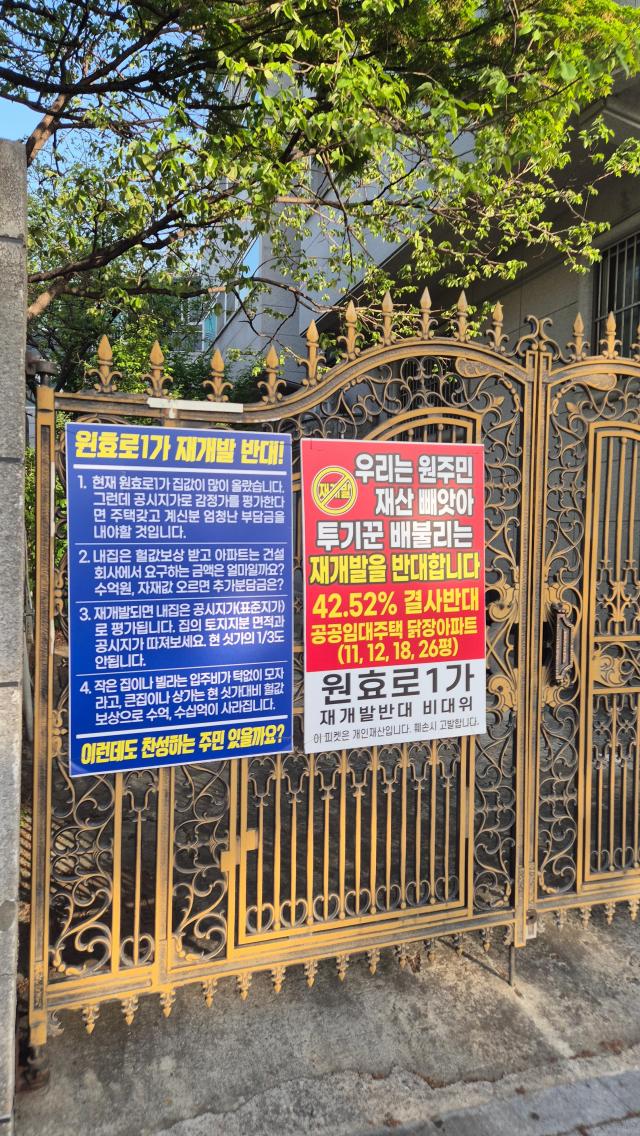
Some residents say high-density construction could worsen living conditions and have raised the “cage apartment” issue. In the neighborhood, several villa households displayed placards claiming the rental share would exceed 40%. A nearby real estate agent said owners with larger land shares and existing rental income are more likely to oppose the plan out of concern that profits could fall after redevelopment.
The promotion committee rejected that claim, saying the rental share is “about 29%.” It said rentals currently account for 23% by area and could drop to the low 20% range if eased base floor-area ratio benefits are applied. The committee added that support already exceeded 70% when it received approval as a promotion committee and said the project faces no obstacles. It aims to obtain approval to establish the association in September and select a builder by the end of the year.
Disputes over rental ratios and project profitability are spreading more broadly. Around Hyochang Park Station, multiple redevelopment models — including Moa Town, station-area Shift and the urban public housing complex project — are being pursued at the same time, fueling conflicts of interest depending on the approach.
The Hyochang-dong 5-307 area has also adopted the station-area long-term jeonse housing urban renewal-type redevelopment model. With the designation of the redevelopment zone and public notice of the plan issued on April 16, the project is moving forward. It calls for 2,993 homes, including 450 redevelopment rental units and 743 long-term jeonse units. Of the total, 1,941 units would be in the 40 to 60 square meter range, reflecting a high-density approach.
Near Exit 5 of Hyochang Park Station on Subway Line 6, the Yongmun-dong 1-126 area is facing internal conflict over whether to proceed under a public-led model or switch to a private approach. Amid the dispute, some have claimed opposition stands at 37%. The area was selected in 2022 as an eighth-round candidate site for the urban complex project. To be designated as a main project zone, it must secure consent from at least two-thirds, or 66.7%, of landowners.
Under the urban complex project, the Korea Land and Housing Corp., or LH, becomes the project operator. Incentives include higher floor-area ratios and reduced burdens for public contributions, while 20% to 30% of the homes are used as public housing. That differs from the privately proposed station-area Shift program.
Elsewhere, in the Hyochang-dong 5-291 area, organizers are collecting consent forms to participate in the urban public housing complex project. A preparatory committee said that under Season 2, rules for the station-area type were revised — including allowing floor-area ratios up to 1.4 times the legal cap — so the economics are not weaker than private redevelopment.
* This article has been translated by AI.
Copyright ⓒ Aju Press All rights reserved.