
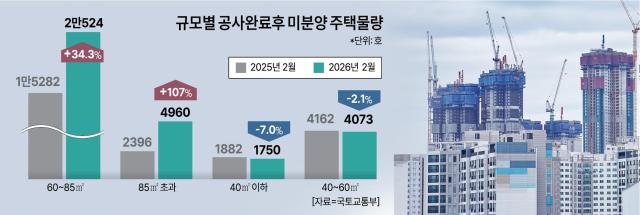
Completed but unsold homes nationwide — often called “distressed” inventory — have topped 30,000 units, with unsold stock rising fastest in non-capital regions and in mid- to large-size housing, deepening structural imbalances in the market.
An analysis of the Ministry of Land, Infrastructure and Transport’s unsold-housing data for the past five years showed that as of February, completed but unsold homes stood at 31,307 units, setting a record high for the sixth straight month. Their share of all unsold homes also surged to 47.3% from 11.3% in 2023.
The increase has been most pronounced in larger homes. Unsold mid-size units (60 to 85 square meters of exclusive floor area) totaled 20,524, accounting for 65.6% of the total. Unsold large units (over 85 square meters) reached 4,960, up 107% from a year earlier — the steepest rise among size categories. By contrast, smaller units (40 square meters or less and 40 to 60 square meters) fell or held steady, suggesting demand is absorbing them.
Regional gaps were also clear. Jeju (36%), Daegu (31%) and Ulsan (30%) had relatively high shares of units over 85 square meters, while Seoul’s unsold homes were overwhelmingly small units, at 94%. As unsold inventory worsens outside the capital area, the buildup is increasingly concentrated in mid- to large-size homes.
The trend is widely attributed to end-user demand clustering in smaller, less expensive homes. Analysts cited high interest rates and tighter lending rules that raise financing burdens, along with shifting demand as one- and two-person households increase.
A construction company official said, “The larger the home, the heavier the price burden, and when households aren’t large, they tend to avoid mid- to large-size homes,” adding that as investment demand fades and the market shifts toward owner-occupiers, unsold mid- to large-size units are rising in provincial areas.
The burden is concentrated outside the capital region. Of all completed but unsold homes, 27,015 units — 86.3% — were in non-capital areas, with Chungnam (65.5%), Busan (58.5%) and Incheon (44.2%) posting large increases over the past year.
The backlog is feeding stress in the construction sector. The Construction Industry Knowledge Information System, known as KISCON, reported 1,088 business-closure filings in the first quarter, up 17.6% from a year earlier, with about 60% coming from non-capital firms.
The Korea Research Institute for Construction Policy said the rise in closures reflects a structural shift, not just a normal cycle, as financially weak companies make up a larger share of the industry. It cited higher financing costs from rising rates, a construction slowdown and worsening profitability from accumulated unsold homes, compounded by a global slowdown and growing unpaid construction receivables — weakening liquidity and financial soundness at the same time.
Song Seung-hyeon, head of City and Economy, said closures are being driven by a combination of mounting provincial unsold inventory, rising construction costs and heavier financing burdens. “With weak sales blocking cash recovery, higher material and labor costs and high interest rates are overlapping, spreading a liquidity crisis centered on small and midsize builders,” he said. He added that steps should include expanding purchases of unsold homes, supporting project-finance lending and stabilizing construction costs, while also restructuring troubled projects.
* This article has been translated by AI.
Copyright ⓒ Aju Press All rights reserved.