
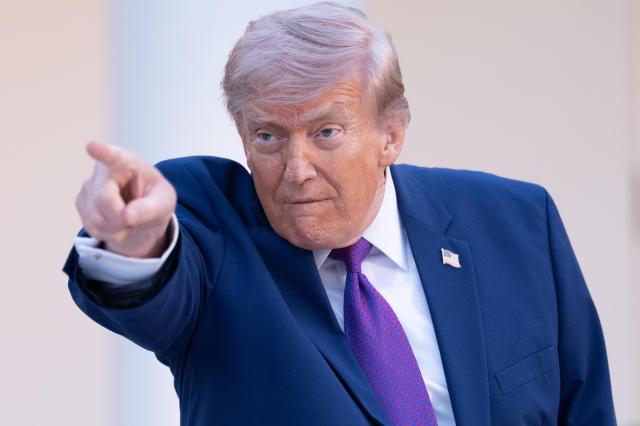
President Donald Trump and Chinese President Xi Jinping are set to hold their first summit in about six months since their meeting in Busan last October, amid growing expectations that South Korean companies could gain some benefits from expanded trade between the two nations.
According to industry sources on May 13, Trump indicated that a key agenda item for the U.S.-China summit on May 14 would be to expand trade between the two countries. He stated via Truth Social that he would ask President Xi to open up China.
Trump's delegation for the trip to China includes high-profile CEOs from American companies with significant investments in China, such as Elon Musk of Tesla and SpaceX, Jensen Huang of Nvidia, Tim Cook of Apple, Kelly Ortberg of Boeing, and Larry Fink of BlackRock.
Given his social media comments and the composition of his delegation, it is likely that Trump will directly or indirectly request that Xi open the tightly controlled Chinese market to U.S. companies following the imposition of mutual tariffs.
For instance, after the U.S. banned exports of Nvidia graphics processing units (GPUs) to China, China responded by offering indirect subsidies that cut electricity costs in half for users of domestically produced AI chips, resulting in a significant drop in Nvidia's market share in China while companies like Huawei saw a surge in their AI chip market share.
Experts believe that to partially lift the 'bamboo curtain,' the U.S. will have to offer some concessions, such as easing export restrictions on semiconductor equipment to China.
The U.S. has consistently blocked the export of advanced semiconductor manufacturing equipment to China since the Biden and Trump administrations, particularly equipment essential for producing advanced semiconductors below 7 nanometers, such as extreme ultraviolet (EUV) lithography machines.
However, the tightening of export regulations has significantly impacted South Korean companies like Samsung Electronics and SK Hynix, which operate semiconductor fabs in China. Restrictions on importing advanced semiconductor manufacturing equipment to Samsung's Xi'an fab and SK Hynix's Wuxi and Dalian fabs have hindered the miniaturization of NAND flash processes and increased business uncertainty.
As China is likely to demand the easing of semiconductor equipment import restrictions for companies like CXMT (ChangXin Memory Technologies) and YMTC (Yangtze Memory Technologies) in exchange for allowing imports of U.S. GPUs, there is potential for Samsung and SK Hynix to accelerate the advancement of their Chinese fabs.
If negotiations between the two sides are successful, there is a strong possibility that exports of rare earths and battery cathode and anode materials, which companies like Boeing and Tesla are seeking, will increase. Following the export restrictions on semiconductor equipment, China designated rare earths—key materials for advanced industries like semiconductors, automotive, and defense—as subject to an export licensing system, leading to supply chain disruptions as China controls approximately 60-70% of global rare earth production and over 80% of refining and processing.
Easing restrictions on rare earth exports could facilitate the procurement of critical minerals needed for domestic semiconductor equipment and defense materials, enhancing the competitiveness of related industries in conjunction with ongoing supply chain diversification efforts.
While battery cathode materials have seen some diversification away from reliance on Chinese sources, anode materials are still heavily dependent on China. The U.S. International Trade Commission (ITC) recently determined that Chinese anode materials are of superior quality compared to U.S. products, suggesting that a high tariff of about 160% may not be necessary.
If regulations on Chinese anode materials are relaxed, domestic companies like LG Energy Solution, which manufacture batteries in the U.S., could expedite their raw material procurement, boosting their electric vehicle (EV) and energy storage system (ESS) businesses.
Professor Kim Tae-hwang of Myongji University’s Department of International Trade stated, "Amid growing global uncertainties due to the Iran war, we hope that the U.S. and Chinese leaders will alleviate volatility and uncertainty in economic and trade areas through this summit. However, similar to last October's meeting, we should not expect significant improvements in bilateral relations from this encounter; rather, it should be viewed as a turning point for reducing uncertainties."
* This article has been translated by AI.
Copyright ⓒ Aju Press All rights reserved.