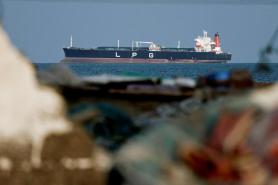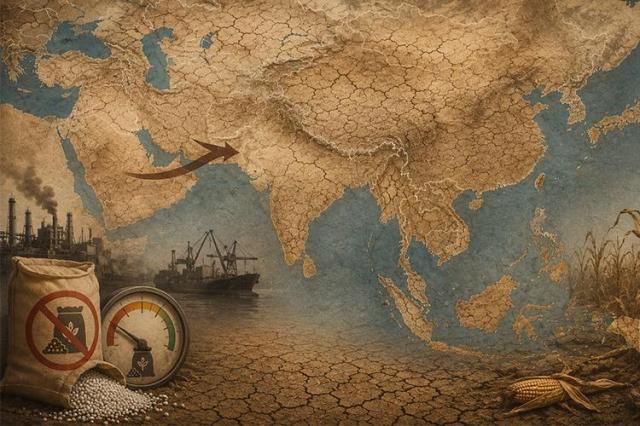
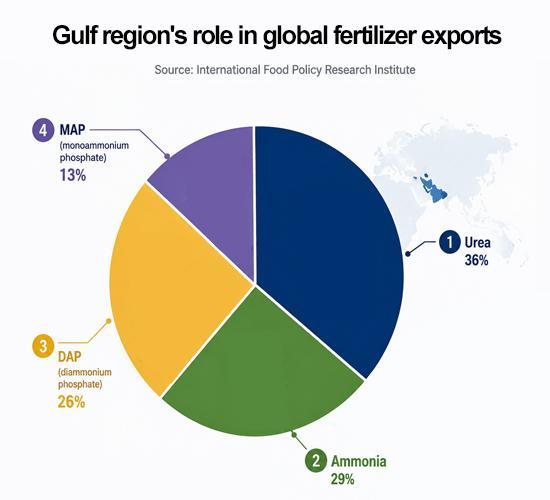
About one-third of global seaborne fertilizer trade and roughly 35 to 45 percent of world urea exports normally pass through the narrow Gulf corridor, according to the U.N. Food and Agriculture Organization. Daily tanker transits have collapsed by more than 90 percent since hostilities erupted on Feb. 28, effectively severing Asia's most important agricultural lifeline.
The result is a slow-burning crisis with a long tail. Energy prices spiked first. The deeper damage is now reaching the inputs that determine next season's harvest — and the harvest after that.
"Agriculture operates within a crop calendar that cannot be postponed," FAO Director-General Qu Dongyu said on May 7 at a ministerial meeting in Rome. "Fertilizers must be applied at specific moments in the crop cycle. If they do not arrive on time, yields are reduced, regardless of what happens later."
The FAO estimates that between 1.5 million and 3 million tons of fertilizer trade per month have been delayed since the war began. Middle Eastern granular urea jumped nearly 20 percent in a single week after the initial strikes; by mid-April, urea prices had risen around 52 percent in the United States and 60 percent in Brazil. The World Bank now expects overall fertilizer prices to climb 31 percent this year, with urea potentially up 60 percent against 2025 levels.
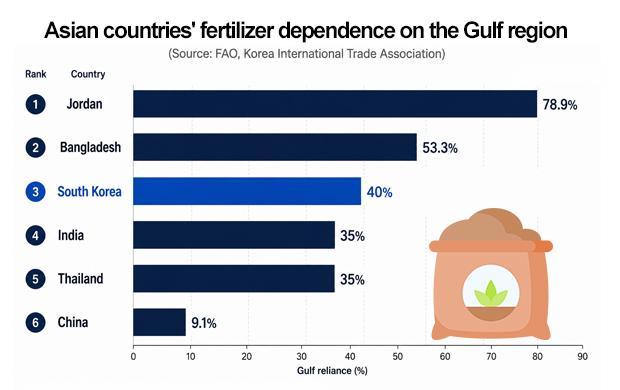
India, the world's second-largest fertilizer consumer, has felt the squeeze first and hardest. Urea import bids surged from around $510 per ton in February to nearly $950 by April, while domestic production fell from a typical 2.5 million tons a month to roughly 1.5 million tons in March as LNG supplies from Qatar were rerouted, according to government and industry data. New Delhi avoided an outright shortage only by paying premium spot prices — at a cost.
The country's fertilizer subsidy bill is now expected to exceed 2 trillion rupees, well above the budgeted level. Prime Minister Narendra Modi has urged farmers to reduce fertilizer use as part of a broader austerity drive to defend the rupee.
Bangladesh, where roughly 53 percent of fertilizer imports originate in the Gulf, has shut four of its five domestic fertilizer plants for lack of natural gas feedstock, leaving the country dangerously exposed ahead of its monsoon planting season.
The damage extends across Southeast Asia, the world's rice basket. The Philippine Department of Agriculture has warned that rice output could fall by as much as 20 to 50 percent owing to soaring fertilizer and fuel costs, compounded by looming El Niño conditions, with the country now forced to import a potentially record 6.9 million tons of rice this year.
Rice farmers in Thailand and Vietnam — the world's two largest rice exporters — are scaling back fertilizer use as costs collide with stagnant paddy prices. Indonesia, already heavily reliant on imported urea, has tendered for emergency phosphate cargoes through state-owned Pupuk Indonesia to stabilize domestic supply.
The chain reaction reaches into Northeast Asia. About 40 percent of South Korea's urea and ammonia imports — critical raw materials for nitrogen fertilizer — pass through the Strait of Hormuz, according to the Korea International Trade Association. Major Gulf suppliers including Industries Qatar and Saudi Arabia's SABIC Agri-Nutrients have declared force majeure on shipments to Asia.
Seoul's Ministry of Agriculture, Food and Rural Affairs convened an emergency review in March and has since extended freight and war-risk subsidies for fertilizer importers — limited relief for a country whose grain self-sufficiency hovers near 20 percent, with wheat self-sufficiency at roughly 2 percent.
The second-order effects are now coming into focus. Fertilizer applied in narrow planting windows means even a delay of weeks translates directly into smaller harvests. Removing nitrogen can cut wheat yields by more than half; inadequate phosphorus can reduce rice yields by around 30 percent, the FAO has warned.
What alarms agronomists most is the lag. Higher food prices grab headlines, but the structural damage accumulates quietly — thinner farmer margins, depleted soil fertility, sliding productivity and a multi-year drag on output.
The shock spreads beyond food. Gulf shipments also carry sulfur — vital for phosphate fertilizers, mining and metallurgy — along with methanol and monoethylene glycol, key feedstocks for the plastics, textiles and packaging that anchor Asian manufacturing supply chains. China has responded by expanding export controls on nitrogen and phosphate fertilizers to protect domestic supply. Others have fewer options.
For now, Asia's grain silos remain comparatively full, cushioned by last year's strong harvests and FAO food price readings that have risen only modestly. That buffer will not last if the war drags into the autumn planting season.
"This is not only a geopolitical crisis," Qu said in Rome. "It is a disruption at the core of the global agri-food system."

Copyright ⓒ Aju Press All rights reserved.