
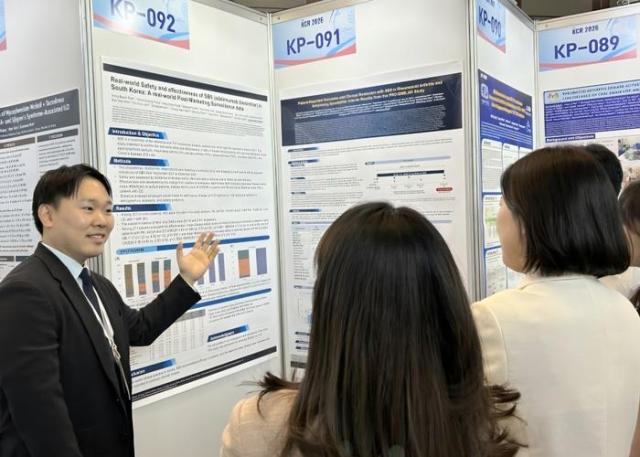
Samsung Bioepis has publicly released clinical data on its biosimilar Adaloche for autoimmune diseases for the first time. The data indicates improvements in health-related quality of life (HRQoL) among domestic patients, with a safety profile comparable to existing products, confirming the potential for stable disease management.
Samsung Bioepis participated in the International Congress of the Korean Rheumatism Association (KCR 2026), held from May 14 to 16 at the Conrad Hotel in Yeouido, Seoul, where it presented two studies on the therapeutic effects and safety of Adaloche.
Adaloche is a biosimilar of adalimumab, used in the treatment of autoimmune diseases such as rheumatoid arthritis and ankylosing spondylitis. The studies are significant as they are based on observational and post-marketing surveillance (PMS) data from patients prescribed the drug in real-world settings.
In an observational study involving 488 patients with rheumatoid arthritis and ankylosing spondylitis, the health-related quality of life indicator (EQ-5D-5L) improved by an average of 0.09 points after 52 weeks of Adaloche treatment. Additionally, patients' self-assessed health status, measured by the EQ-VAS score, improved by 11.9 points. This suggests that Adaloche contributes not only to reducing disease activity but also to enhancing daily functioning and subjective well-being.
Samsung Bioepis also released results from a post-marketing surveillance study involving 303 patients across all approved treatment indications for Adaloche. The study found an adverse event rate of 29.7% and a serious adverse event rate of 2.6%, which the company stated is consistent with safety results observed in previous clinical trials.
A representative from Samsung Bioepis noted, "We plan to expand data collection for other autoimmune disease indications in the future."
In the first quarter of this year, Samsung Bioepis reported revenues of 454.9 billion won and an operating profit of 144 billion won, marking increases of 13.6% and 12.6%, respectively, compared to the same period last year, achieving the highest quarterly revenue in its history.
Buoyed by Samsung Bioepis's strong performance, its parent company, Samsung Epics Holdings, reported consolidated revenues of 453.9 billion won and an operating profit of 90.5 billion won, recovering from an operating loss of 63.6 billion won in November and December of last year.
Samsung Bioepis participated in the International Congress of the Korean Rheumatism Association (KCR 2026), held from May 14 to 16 at the Conrad Hotel in Yeouido, Seoul, where it presented two studies on the therapeutic effects and safety of Adaloche.
Adaloche is a biosimilar of adalimumab, used in the treatment of autoimmune diseases such as rheumatoid arthritis and ankylosing spondylitis. The studies are significant as they are based on observational and post-marketing surveillance (PMS) data from patients prescribed the drug in real-world settings.
In an observational study involving 488 patients with rheumatoid arthritis and ankylosing spondylitis, the health-related quality of life indicator (EQ-5D-5L) improved by an average of 0.09 points after 52 weeks of Adaloche treatment. Additionally, patients' self-assessed health status, measured by the EQ-VAS score, improved by 11.9 points. This suggests that Adaloche contributes not only to reducing disease activity but also to enhancing daily functioning and subjective well-being.
Samsung Bioepis also released results from a post-marketing surveillance study involving 303 patients across all approved treatment indications for Adaloche. The study found an adverse event rate of 29.7% and a serious adverse event rate of 2.6%, which the company stated is consistent with safety results observed in previous clinical trials.
A representative from Samsung Bioepis noted, "We plan to expand data collection for other autoimmune disease indications in the future."
In the first quarter of this year, Samsung Bioepis reported revenues of 454.9 billion won and an operating profit of 144 billion won, marking increases of 13.6% and 12.6%, respectively, compared to the same period last year, achieving the highest quarterly revenue in its history.
Buoyed by Samsung Bioepis's strong performance, its parent company, Samsung Epics Holdings, reported consolidated revenues of 453.9 billion won and an operating profit of 90.5 billion won, recovering from an operating loss of 63.6 billion won in November and December of last year.
* This article has been translated by AI.
Copyright ⓒ Aju Press All rights reserved.