
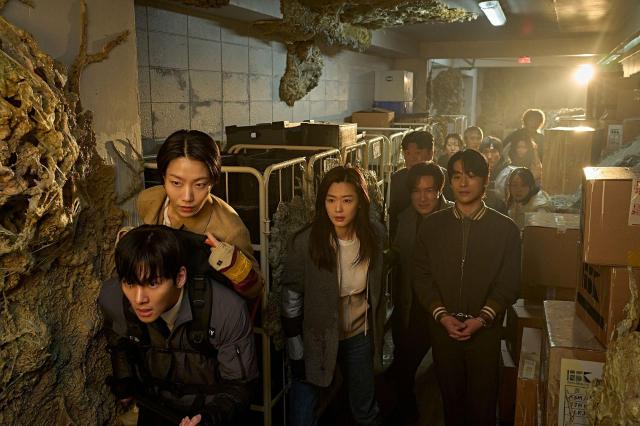
SEOUL, May 28 (AJP) - This year, the horror season has arrived earlier than usual, coinciding with the onset of summer.
When thinking of K-horror, zombies have become synonymous over time. South Korea's unique interpretation of the Asian zombie, which began with the traditional Jiangshi, has evolved once again this year. This time, the zombies are equipped with the ability to 'think,' fitting for the AI era.
Director Yeon Sang-ho's new zombie thriller 'Gunch' has surpassed 2.1 million viewers just six days after its release, making it a strong early summer box office hit. This pace is one day faster than the record set by the highest-grossing Korean film of 2025, 'Zombie Daughter,' which also crossed the 2 million mark.
'Gunch' is currently showing on 1,858 screens nationwide and has a reservation rate of 39.9%. Comparisons to 'Train to Busan,' which attracted 11.5 million viewers in 2016 and left a significant mark on the global zombie film market, are naturally emerging.
However, Director Yeon describes 'Gunch' not as a continuation of 'Train to Busan,' but as a work that fundamentally changes the way we view the zombie genre.

During a press conference at CGV Yongsan I-Park Mall, Yeon stated, "'Seoul Station,' 'Train to Busan,' and 'Peninsula' started from placing classic zombies in new settings. 'Gunch' is a film about zombies themselves. In a sense, it can be seen as my first film featuring a zombie protagonist."
This shift in perspective leads to a change in the film's premise. In 'Gunch,' the infected mutate rapidly and act as a collective rather than individually. Yeon explained, "It's a confrontation between zombies with collective intelligence and humans. The zombies evolve quickly from a primitive state, while humans regress from civilization to barbarism. What remains at the end of that regression could be the essence of humanity."
While 'Train to Busan' established the 'speed' of Korean zombies, 'Gunch' shifts the horror into the realms of 'connection' and 'collective intelligence.' Zombies are no longer just mindless flesh-eaters; they form a network.
From Vengeful Spirits to Systemic Collapse
Korean horror films have long been rooted in themes of vengeful spirits and the emotion of Han (grief). Unresolved resentment, unjust deaths, white-clad female ghosts, and settings like closed schools and broken family spaces have been central to Korean horror.
Although director Kang Bum-gu's 'The Evil Dead' is often cited as Korea's first zombie film from the early 1980s, the zombie genre remained peripheral for a long time. The crises and anxieties experienced by Korean society have since become fertile ground for zombie narratives. Following the 1997 financial crisis, rising unemployment and distrust in institutions shifted public fears in popular culture from individual grievances to collective collapse and systemic failure.
Recently, Korean horror has increasingly focused on themes of infection, isolation, social panic, and the disintegration of communities rather than supernatural revenge. 'Gunch' aligns with this trend.
Set in a confined building beset by a mysterious infection, the film depicts survivors confronting infected individuals who evolve in unpredictable ways. The title 'Gunch' evokes a biological concept, suggesting a group of individual organisms functioning as a single unit. The provocative aspect of the film lies in the fact that these infected individuals are not 'thoughtless monsters.'
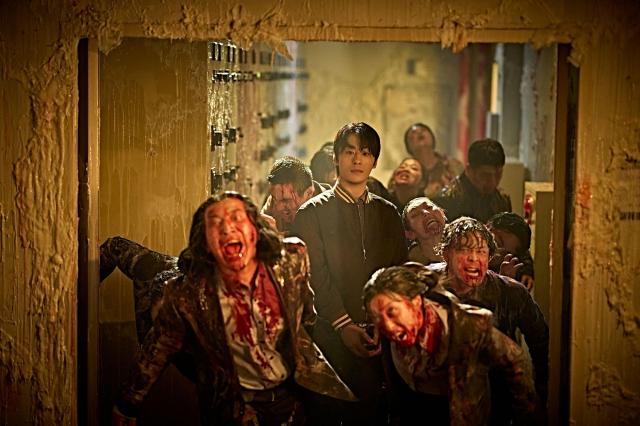
“Zombies Resembling AI” — Audience Reactions
Aaron Kim, a 20-year-old university student from Edinburgh visiting Seoul, initially had no plans to watch a Korean zombie film but was persuaded by a Korean friend to go to the theater.
Kim remarked, "In most zombie films I've seen, zombies are thoughtless beings that indiscriminately kill people. In 'Gunch,' the zombies have intelligence. I felt how unsettling and frightening that could be."
He found the film fresher compared to overseas zombie movies.
Kim noted, "Overseas zombie films generally follow similar patterns. Korean zombies are new. They run fast and are not simple. I would rate the film 8 out of 10."
He particularly connected the film's core concept to artificial intelligence.
He explained, "As people use AI more, more data enters a single system, and that system becomes increasingly powerful. The zombies in 'Gunch' felt like part of a larger circuit that continuously learns."
Jiyoon Lee, a 20-year-old university student living in New York, also evaluated 'Gunch' as taking a different direction from 'Train to Busan' and 'Kingdom.'
Lee said, "In previous works, people became zombies due to a virus and charged aggressively, but they didn't appear to be thinking beings. The zombies in 'Gunch' seem to have a clear purpose to spread the virus. Their ability to create collective intelligence and move together through their own communication network is chilling."

What Sets Korean Zombies Apart?
The reactions from both audience members resonate with the image that Korean zombie films have built since 'Train to Busan': fast, intense, and physically overwhelming zombies.
However, speed alone cannot explain the allure of Korean zombie films.
Korean zombie narratives typically embed infection within densely populated social spaces. Settings like trains, schools, apartment complexes, and closed buildings serve as the main stages, reflecting the high density of life in Korean society. The fear of having nowhere to escape arises not just from the closed spaces themselves but from the social relationships and institutions that trap individuals even in crises.
In this regard, Korean zombie films pose different questions than those shaped by George A. Romero's tradition in Western zombie films. While Western zombie narratives ask, 'What remains after civilization collapses?' Korean zombie films inquire, 'How quickly can society collapse while everyone is still trapped within the system?'
Film critic Lee Ji-hye believes the strength of Korean zombie narratives comes from the 'relationships' that infection disrupts rather than the infection itself.
Lee stated, "Korean zombie films often center around the premise that a beloved family member or friend has become a monster. The existing relationships are intricately woven into the narrative, significantly enhancing audience immersion."
He explained that sadness and guilt often accompany the narrative of infection in Korean zombie films.
Lee noted, "The fact that someone has become a zombie tends to bring about collective guilt or mourning. The two films show that Korean zombie cinema is no longer confined to a single genre."
This sentiment is evident in many key works of Korean zombie cinema. 'Train to Busan' intertwined themes of family sacrifice and class conflict, while 'Kingdom' placed infection against the backdrop of royal politics, famine, and systemic failure. 'All of Us Are Dead' transformed schools into theaters of bullying and survival, and 'Happiness' dissected fear, hierarchy, and selfishness through a quarantined apartment complex. 'Zombie Daughter' embraced the zombie theme within a family comedy, opening a new spectrum for K-zombies.
Lee also pointed out that the collapse of institutions is a core element of Korean zombie narratives.
He remarked, "Korean zombie films do not merely tell stories of zombies chasing people; they also address how social systems collapse in crises, how ineffectively governments and bureaucracies operate, and how human selfishness manifests."
While the hopping corpses of 1980s Hong Kong films combined Taoist folklore, Korean zombies are closer to modern disaster forms born from infection, institutions, and urban overcrowding.
'Gunch' pushes this genre a step further. Now, fear lies not only in the speed of the dead but also in the existence that learns, connects, and evolves collectively, targeting the vulnerabilities of human society.
* This article has been translated by AI.

Copyright ⓒ Aju Press All rights reserved.