
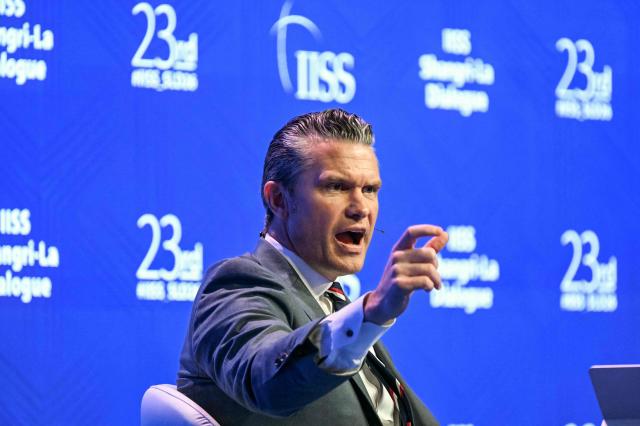
On May 30, local time, Hegseth held a press conference at the U.S. embassy in Singapore after the Shangri-La Dialogue, stating, "We have the capability to resume military action if necessary, and our stockpiles are more than adequate both there and globally." He added, "This reflects how we balance precision weapons with ample ammunition."
Hegseth also noted that the blockade operations against Iran are firmly in place, mentioning that the issue of the Strait of Hormuz was frequently discussed during bilateral meetings. He asserted, "The Strait of Hormuz will remain open, accessible to all, and free of tolls, as it should be."
U.S. Defense Secretary Pressures Allies to Increase Defense Spending
In his earlier speech at the Shangri-La Dialogue, Hegseth highlighted the importance of countering China and the necessity for allies to boost their defense budgets. He stated, "No nation, including China, can undermine the security of the U.S. and its allies through hegemonic actions," expressing justified concerns over China's military expansion in the Asia-Pacific region and beyond.He warned that if a hegemonic power dominates the Pacific, it would disrupt the regional balance of power, emphasizing, "What we seek is a truly stable equilibrium that benefits both the American people and our allies."
However, he also showed a desire to avoid direct confrontation with China, saying, "We do not want unnecessary conflict in this region." He noted that U.S.-China relations are at their highest level in years since the Trump administration, and that military-to-military communication channels are open and more frequent.
Hegseth stressed the need for allies to increase their defense spending, stating, "Regional security has relied too heavily on U.S. military power. Everyone must take responsibility to build a strong alliance. There will be no free riders." He added, "The era of the U.S. subsidizing defense spending for wealthy nations is over; we need partners, not dependents."
He reiterated the U.S. commitment to a $1.5 trillion military investment, urging allies and partners to raise their defense budgets to 3.5% of their GDP.
South Korea Receives Praise
Hegseth particularly commended South Korea for pledging to increase its defense spending to 3.5% of GDP, saying, "I applaud the pragmatism and leadership shown by South Korea." He described it as "a breath of fresh air" that allies like South Korea are taking the lead in military operations.
Regarding Taiwan, he reaffirmed that there is no change in the U.S. position, stating, "The core of the U.S. approach in the Pacific is to deny access across the First Island Chain (a hypothetical line connecting Japan, Okinawa, Taiwan, the Philippines, and the Malacca Strait)." He reiterated the necessity of defending Taiwan, but noted that future sales of U.S. weapons to Taiwan depend on decisions made by President Donald Trump.
Meanwhile, China delivered a relatively restrained message at the conference. According to the Global Times, a state-run English newspaper, Meng Xiangqing, head of the Chinese delegation, stated during a session on "Managing Threats to Strategic Stability" that "hegemonism threatens regional security." He expressed hope that "China and the U.S. can move closer together" and that military relations between the two countries develop in a healthy, stable, and sustainable direction.
In contrast, China strongly criticized Japan's military rearmament efforts. Meng warned, "The lessons of history remain vivid, and the world stands at a crossroads again," urging vigilance against the resurgence of militaristic thinking and the need to uphold the achievements of World War II and the post-war international order.
He noted that this year marks the 80th anniversary of the Tokyo Trials and claimed, "Some forces are glorifying war crimes and distorting the history of World War II while trying to whitewash their history of aggression."
On the Taiwan issue, he stated, "Taiwan independence forces cannot coexist with peace across the Taiwan Strait."
* This article has been translated by AI.
Copyright ⓒ Aju Press All rights reserved.