
SEOUL, August 19 (AJP) - Developing safe and affordable batteries is essential for operating large-scale energy storage systems, but current water-based models struggle to store energy quickly and in large volumes. To resolve this, researchers have designed a new electrode material that increases both energy capacity and charging speeds by utilizing particles previously thought to degrade battery performance, the Korea Advanced Institute of Science and Technology said Wednesday.
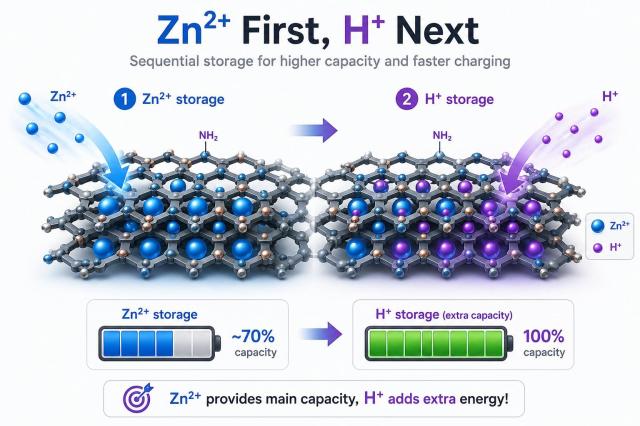
Conventional aqueous zinc-ion batteries face limitations because zinc ions are large and move slowly, restricting charging speeds. Additionally, smaller protons moving within the battery often create byproducts that hinder the zinc ions, leading engineers to traditionally suppress proton activity. The new design shifts this approach by controlling the sequence in which these particles are stored, allowing both the zinc ions and the protons to contribute to the battery's overall energy capacity instead of interfering with each other.
The Korea Advanced Institute of Science and Technology (KAIST)'s announcement outlines research led by Professor Park Sun-ah from the university's chemistry department, alongside co-first authors Park Geun-chan and Lee Kyu-won from the Pohang University of Science and Technology (POSTECH).
The research team used a two-dimensional conductive metal-organic framework with microscopic pores as the electrode material. They added amine functional groups inside these pores to act as designated storage spots for protons at specific voltages. This mechanism ensures the larger zinc ions enter the electrode first, followed by the smaller protons.
The process is similar to filling an empty jar with large rocks first and then pouring in fine sand to fill the remaining gaps. By securing the zinc ions first, the researchers prevented the protons from reacting too early and blocking the movement of other ions inside the device.
The newly developed material demonstrated a high storage capacity of 368.7 milliampere-hours per gram, meaning a small amount of the material can store a large volume of electricity. When the charging and discharging speed was increased by 16 times, the battery maintained 46.9 percent of its initial capacity, whereas standard batteries typically lose significant storage capability at high speeds. The material also showed stable performance after 500 rapid charge and discharge cycles.
Water-based zinc-ion batteries use water as an electrolyte to help ions move inside the device. Because they are less prone to fire risks, cheaper to produce, and carry a lower environmental burden than standard lithium-ion batteries, they are considered a strong candidate for future energy storage infrastructure.
"We have shown that protons, which were previously considered a hindrance that could degrade battery performance, can actually be utilized to store more energy," Professor Park Sun-ah said. "We expect that this principle can be applied to various electrode materials to develop batteries capable of rapidly storing larger amounts of energy."
(Reference Information)
Journal/Source: Chem
Title: Sequential Zn2+–H+ Storage in a 2D Conductive Metal-Organic Framework for Advanced Aqueous Zinc-Ion Battery
Link/DOI: 10.1016/j.chempr.2026.103129

Copyright ⓒ Aju Press All rights reserved.
