
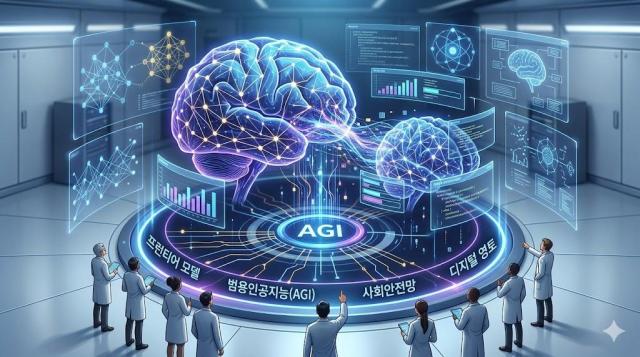
Artificial intelligence (AI) technology is racing toward a singularity. Having progressed beyond the inability to explain its thought processes, AI has now entered a phase where it can create AI itself.
Minister of Science and ICT Baek Kyung-hoon stated, "It is time for us to challenge ourselves to create AI frontier models on par with those of the United States and China." This declaration reflects a significant industrial transformation driven by advancements in AI technology.
Just as the steam engine evolved into the internal combustion engine and subsequently into the electronics industry, we are now witnessing an era where technology begets technology, leading to an 'infinite amplification of gaps.' Countries possessing advanced general-purpose AI (AGI) will experience rapid growth, while those relegated to technology consumption risk becoming data and knowledge colonies. Our future may become dependent on the technological ecosystems of the U.S. and China.
Building an independent frontier model also serves as a robust social safety net to address the knowledge and educational disparities within our society. If access to cutting-edge AI models is determined by capital, the gap between those who enjoy quality knowledge and education and those who are marginalized will widen uncontrollably.
The government's initiative to provide free AI services to all citizens through the 'Everyone's AI' project is part of this context. Ensuring that everyone has equal access to digital intelligence is fundamental to future welfare and upholding democratic values.
The issue of productivity polarization among companies cannot be overlooked. Large corporations with abundant capital can invest in high-performance frontier AI models worth trillions of won, maximizing their pace of innovation. In contrast, small and medium-sized enterprises (SMEs) and startups may be forced to rely on lower-performing, budget models, leading to predictable outcomes.
Technological inequality will result in productivity gaps among companies, ultimately leading to the decline of SMEs and the devastation of the industrial ecosystem. To foster coexistence and innovation between large and small businesses, the government must establish a reliable and accessible independent frontier AI infrastructure at the national level.
However, mere slogans and declarations will not suffice. The annual AI equipment investments of the so-called 'Big Four'—Microsoft, Amazon, Alphabet, and Meta—exceed 150 trillion to 200 trillion won per company. This amount surpasses the total annual research and development (R&D) budget of the South Korean government and even the total investment in the semiconductor industry.
Therefore, the government needs to innovate rigid personal data protection regulations and provide comprehensive support for high-quality data and computing resources for AI learning, effectively laying down an 'AI highway.' Rapidly resolving institutional uncertainties, such as the establishment of an AI fundamental law, is the responsibility of the political sphere.
The private sector must also invest with the belief that AI is the 'second semiconductor.' Just as it took the lead in investing massive capital to realize the dream of becoming a world-class semiconductor powerhouse, securing frontier AI models will also require significant capital investment. There is an urgent need for private companies to take bold risks and make decisive investments in the foundational technologies and infrastructure that will shape South Korea's digital territory.
The timeline for the era of AI creating AI is moving much faster than human predictions. Will we bequeath a digital colony bound by chains of technological dependency, or will we lead in the AI era? The steps we take now will determine the fate of South Korea for the next century.
* This article has been translated by AI.
Copyright ⓒ Aju Press All rights reserved.