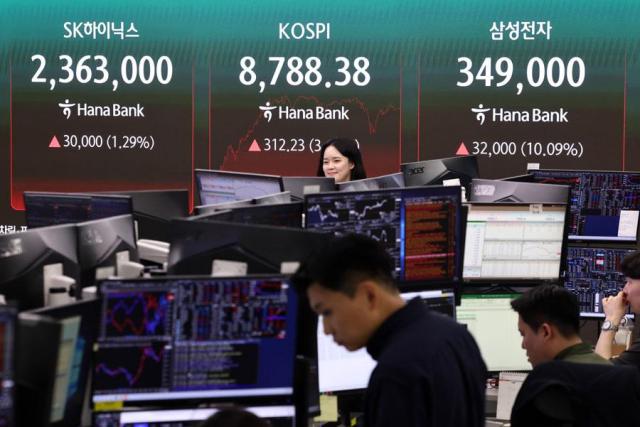
Samsung Electronics said it has begun shipping samples of its next-generation HBM4E memory, the industry's first 12-layer high-bandwidth chip and a generational step up in the AI memory hierarchy, sending its shares up 10.9 percent to 351,500 won (US$233.6) and pushing the company's market capitalization above 2,000 trillion won for the first time.
Goldman Sachs responded by raising its price target on Samsung to 480,000 won, framing the memory business as no longer a cyclical commodity but a piece of permanent AI infrastructure.
SK Hynix added 2.5 percent to 2,363,000 won, consolidating near all-time highs as its own HBM line remains substantially booked through year-end.
The day's second engine was a group-wide rerating of LG affiliates on expectations of a formal physical AI and robotics partnership with Nvidia, whose chief executive Jensen Huang is confirmed to visit Seoul this week. LG Electronics surged 29.9 percent to 380,500 won, LG CNS climbed 26.3 percent to 143,700 won, LG Corporation rose 13.9 percent to 167,000 won, and Doosan Robotics advanced 30.0 percent to 138,400 won. Naver jumped 15.8 percent to 271,000 won as AI infrastructure appetite spread into the software and platform layer.
The electronics products sector led all industry groups at 29.5 percent, with IT services up 11.5 percent and machinery up 8.4 percent, the widest single-session sector breadth of the current bull run and the first sign of the rally extending beyond the semiconductor core that has carried the index for most of the year.
Foreign investors remained net sellers, unloading 2.67 trillion won and extending their selling streak to a sixteenth consecutive session. They have now offloaded more than 50 trillion won since early May, a cumulative figure that dwarfs any comparable episode in South Korea's market history, including the panic during the 2020 coronavirus pandemic.
The decisive development came from domestic institutions, which turned net buyers of 2.62 trillion won, nearly matching the foreign outflow won for won in a scale of institutional conviction absent through most of May's run, while retail investors added a further 81.1 billion won.
The South Korean won strengthened to 1,504.5 against the dollar, recovering 5.6 won from Friday's close near 1,510.1, the first meaningful currency relief since the Bank of Korea flagged won weakness as an inflation transmission channel in last Thursday's rate decision.
The junior KOSDAQ diverged sharply, closing down 2.3 percent at 1,050.03 as flows concentrated in large-cap names on the main board.
Meanwhile, Japan's Nikkei 225 closed up 1.0 percent at 67,022.29, crossing 67,000 intraday for the first time in history, led by SoftBank Group's 14.9 percent surge to around 8,605 yen after founder Masayoshi Son announced plans to invest up to 75 billion euros, roughly 87 billion dollars, over five years to build AI data centers across France.
The commitment pushed SoftBank's market capitalization past Toyota's for the first time, marking a symbolic passing of leadership from Japan's industrial economy to its AI economy. Toyota Motor fell more than 4 percent to around 2,908 yen as investors rotated out of the traditional export bellwether.
China moved the other way, the Shanghai Composite slipping 0.3 percent to 4,055.09 with CATL down just over 1 percent and BYD off more than 2 percent, as mainland investors stayed cautious ahead of the July Politburo meeting. CNOOC bucked the trend with a gain of more than 1 percent, the clearest regional beneficiary of advancing Iran-Hormuz negotiations, in which a draft memorandum of understanding has reportedly been sent to both governments for final approval.
Monday's session told a single story in three chapters, Samsung's HBM4E shipment, SoftBank's French data center bet, and the advancing Hormuz framework, each an expression of the same reality, that the infrastructure buildout of the AI economy is now moving fast enough to set records across multiple time zones in a single session.
For South Korea, the question is whether Samsung's crossing of 2,000 trillion won marks the beginning of a sustained rerating or its culmination, a distinction that depends on whether HBM4E shipments convert from samples to volume orders, and on whether a won that strengthened for the first time in weeks can hold its ground if foreign selling extends into a seventeenth session on Tuesday.
Copyright ⓒ Aju Press All rights reserved.