
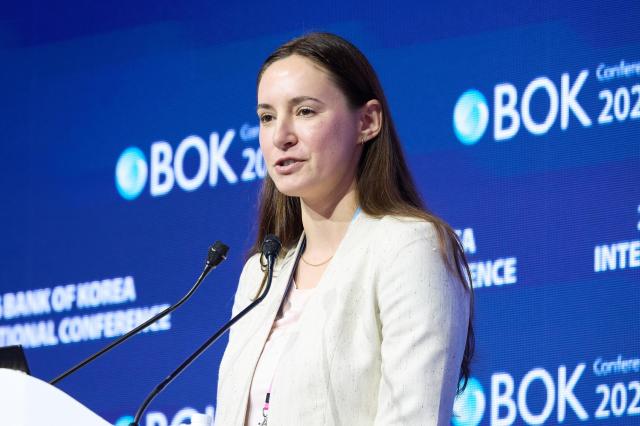
A recent analysis suggests that artificial intelligence (AI) will revolutionize the core functions of central banks. Given AI's potential applications in monetary policy formulation and financial stability monitoring, experts argue that central banks must undergo fundamental reforms.
Sophia Kazinnik, a senior researcher at Stanford University's Digital Economy Research Institute, presented these insights on June 2 at the '2026 BOK International Conference' in Seoul.
Kazinnik stated, "In monetary policy, AI can enhance the accuracy of real-time predictions by extracting and filtering high-frequency data, such as online product price listings and satellite image analysis, to complement the lag in official statistics. In terms of financial stability, large-scale unstructured text analysis can proactively identify signals of systemic risk."
Despite these advantages, the adoption of AI in global central banks has been slow due to the complexity of public objectives and the stringent accountability required. Sharing sensitive information externally poses additional challenges. In contrast, the Bank of Korea (BOK) implemented its sovereign AI, 'BOKI,' in January, becoming the first among global central banks to do so. This system is currently used for tasks such as report translation, regulatory searches, and policy support.
During the presentation, experts emphasized the necessity of building integrated databases, expanding computing infrastructure, and ensuring access to computing resources to facilitate AI utilization. Kazinnik noted, "Given the nature of central bank operations, a certain level of data barriers is inevitable for personal data and governance control. However, to resolve bottlenecks in large-scale data usage and perform advanced analytics, establishing a 'data lake' is essential."
When the Federal Reserve (Fed) in the United States integrated AI into its operations, it was found to significantly enhance productivity. The New York Fed alone saved approximately 1.17 million hours annually in its open market operations. Treasury Services at the St. Louis and Atlanta Feds are projected to save 3.18 million hours, while cash operations managed by the San Francisco, Kansas City, and Dallas Feds are expected to reduce labor hours by 3.51 million through AI.
Kazinnik recommended that to successfully implement AI, central banks should designate AI representatives within departments to foster a culture of self-directed learning, rather than solely relying on external experts. He emphasized, "For central banks to fully realize the potential of AI, they must fundamentally innovate not only the related infrastructure but also their operational processes, systems, and norms alongside the technology."
* This article has been translated by AI.
Copyright ⓒ Aju Press All rights reserved.