
Discussions on amending the Retail Industry Development Act to change mandatory closure days for large supermarkets to weekdays and allow early morning deliveries are expected to gain traction after the June 3 local elections. This comes amid growing concerns that offline retail regulations do not align with changing consumer environments. However, pushback from labor groups and small businesses remains a variable in the legislative process.
According to the retail industry on June 2, the National Assembly's Committee on Trade, Industry, Energy, and Small and Medium Enterprises has recently presented the amendment to the Retail Industry Development Act and referred it to a subcommittee for review. The proposals include those from Democratic Party lawmaker Kim Dong-ah and People Power Party lawmaker Kim Sung-won.
The two proposals differ in the scope of regulatory relief. Kim Dong-ah's proposal maintains offline sales regulations for large supermarkets but allows online deliveries during mandatory closure days and restricted hours. In contrast, Kim Sung-won's proposal goes further by permitting early morning deliveries and abolishing restrictions on late-night operations and mandatory closure days. Both proposals, however, agree that the existing regulatory framework needs to be revised as the focus of retail has shifted from offline to online. Notably, concerns have been raised that regulations originally intended to protect traditional markets and small retailers have created a disadvantage for large supermarkets compared to e-commerce companies like Coupang.
According to the Ministry of Trade, Industry and Energy's report on major retail companies' sales trends released on May 27, online retail sales increased by 7.5% compared to the same month last year, while offline sales grew by only 6.7%. Specifically, large supermarket sales dropped by 6.6%. Consequently, voices within the large supermarket sector have expressed that mandatory closure days and late-night operation restrictions place them at a competitive disadvantage in the online delivery market.
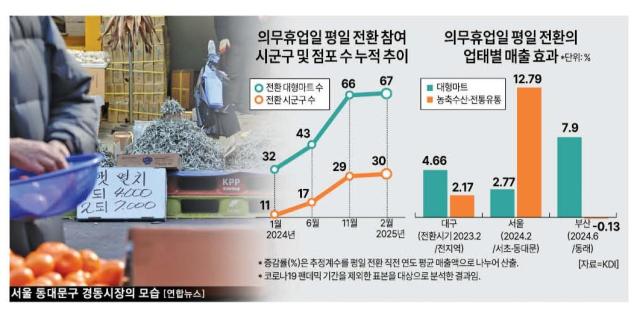
In this context, research supporting regulatory relief has emerged. Last month, the Korea Development Institute (KDI) analyzed cases where mandatory closure days for large supermarkets were changed from weekends to weekdays in Seoul, Gyeonggi, and Busan. The study found no evidence that this change led to decreased sales in traditional markets. In fact, some sectors reported increased sales due to the customer attraction effect of large supermarkets.
KDI posited that traditional markets are not in direct competition with large supermarkets across all areas. Therefore, even if large supermarket sales increase due to the weekday change, it does not necessarily lead to a corresponding decrease in traditional market sales.
However, significant challenges are anticipated before any legal amendments are finalized. Labor groups have opposed the allowance of early morning deliveries, arguing it infringes on workers' rights to rest. The Korean Confederation of Trade Unions' supermarket union recently criticized the National Assembly for advancing the Retail Industry Development Act amendment, stating, "The government and ruling party are pushing workers and small business owners to the brink," and labeled the expansion of early morning deliveries as a pro-chaebol policy that only fills the coffers of retail conglomerates.
There are interpretations that the political sphere's hesitance to engage in related discussions is influenced by the anticipated backlash ahead of the local elections. As a result, discussions may resume post-election under the pretext of enhancing industrial competitiveness and consumer benefits.
Meanwhile, there are also calls for regulatory relief for large supermarkets to be accompanied by coexistence programs for traditional markets. KDI suggested that if joint promotional events and increased availability of local specialties could link the customer attraction of large supermarkets with traditional markets and local businesses, regulatory relief could stimulate consumption and increase foot traffic in those areas. They advised that discussions on changing mandatory closure days should consider the coexistence structure of the local retail ecosystem.
* This article has been translated by AI.
Copyright ⓒ Aju Press All rights reserved.