
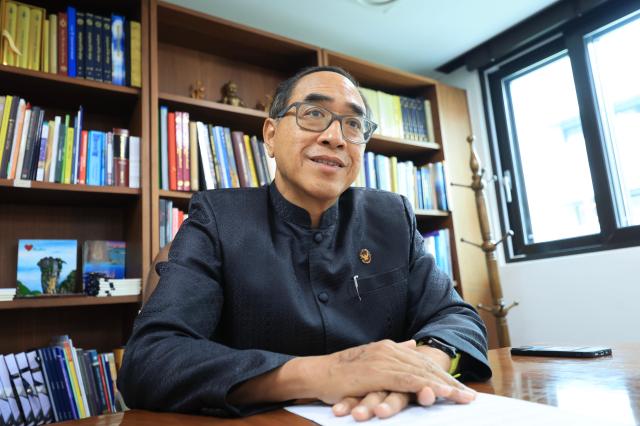
SEOUL, June 25 (AJP) - Contrary to its image abroad as a holiday resort or golfing destination, Thailand is strengthening its technology-driven manufacturing base to revive economic growth that has slowed to below 2 percent, while inviting South Korean capital, technology and expertise to accelerate its digital and industrial transformation, Thailand's ambassador to South Korea said.
"Korea in itself is an important market for Thailand, but more uniquely Korea's advancement in many industries has great potential to collaborate with Thai companies and corporations to process and manufacture many products for the global market," Ambassador Tanee Sangrat told AJP in an interview.
Thailand, in return, can provide new opportunities for Korean businesses amid geopolitical tensions and global supply-chain diversification as the Southeast Asian nation steps up efforts to attract foreign direct investment for industrial upgrading and greater economic resilience, he said.
The ambassador expressed optimism that the Comprehensive Economic Partnership Agreement (CEPA) between the two countries could be concluded this year, describing it as a catalyst for expanding bilateral ties beyond traditional trade.
"There are only a couple of issues left to be dealt with," Sangrat said. "Leaders of both sides have expressed the same goal."
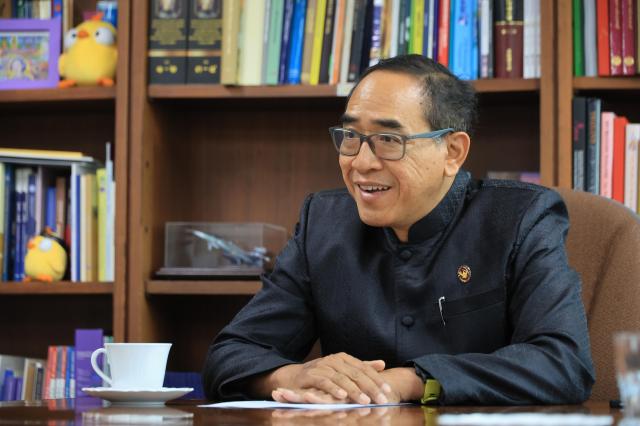
Bilateral trade currently stands at around $15 billion. Sangrat said CEPA could increase that by an additional $2 billion to $3 billion as Thailand works toward its longer-term goal of doubling trade to $30 billion.
South Korea is Thailand's 13th-largest trading partner, while Thailand ranks as Korea's 16th, well below Korea's roughly $90 billion trade volume with Vietnam.
Sangrat said CEPA would broaden cooperation into investment, digital industries and supply-chain partnerships while reinforcing Thailand's position as a gateway for Korean companies seeking to expand across ASEAN.
He also pointed to recently signed agreements on transport cooperation, institutional knowledge exchange and smart industrial estate development as foundations for deeper collaboration in logistics, industrial policy and infrastructure.
Thailand's long-term industrial ambitions are embodied in Thailand 4.0, the government's strategy to transform the country into one of Southeast Asia's leading digital economies through advanced manufacturing, digital innovation and technology adoption.
According to Thailand's National Broadcasting and Telecommunications Commission, wider adoption of 5G could generate an additional $9.3 billion in economic value by 2035, creating significant opportunities for foreign technology providers.
Thailand has also launched a national AI Strategy and Action Plan covering 2022 to 2027 under the supervision of the Ministry of Higher Education, Science, Research and Innovation and the Ministry of Digital Economy and Society.
"The areas that are most promising now are future industries — digital economy, semiconductors, AI," Sangrat said.
He said South Korea's expertise in advanced manufacturing makes it a natural partner as Thailand seeks to move further up the technology value chain.
South Korea's Ministry of Land, Infrastructure and Transport and Thailand's Ministry of Industry recently signed a memorandum of understanding on smart industrial estate development.
Defense is another emerging area of cooperation.
"Our Defense Technology Institute has been working on establishing an industrial park for defense industries in Kanchanaburi Province," Sangrat said.
"We want to invite Korean defense companies to take a look at our offer. I will be happy to work with them and invite them to invest in our defense industry."
Innovation is another pillar of bilateral relations.
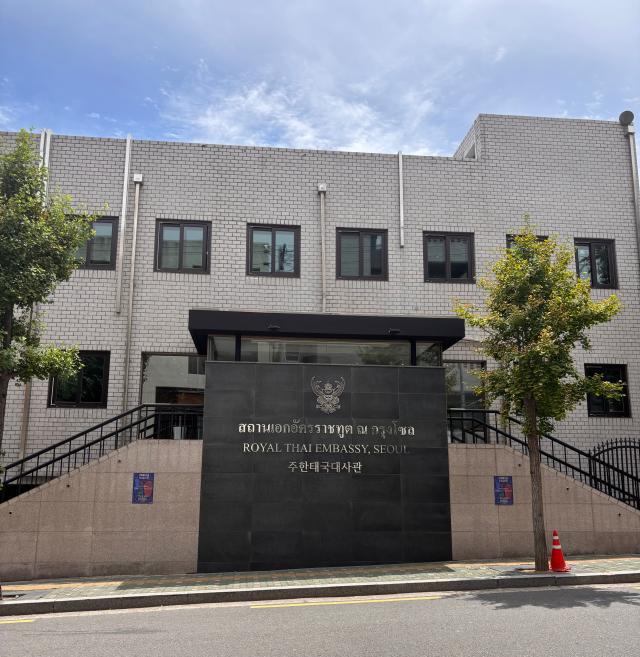
The recently launched Seoul-Thailand Startup & Innovation Space (STSiS) at the Thai Embassy in Seoul aims to connect startups, technology companies and investors from both countries. Sangrat said the initiative would help Thai startups enter Korea while supporting Korean firms seeking business opportunities throughout Thailand and ASEAN.
The push to diversify economic cooperation comes as tourism, traditionally the foundation of bilateral exchanges, has softened.
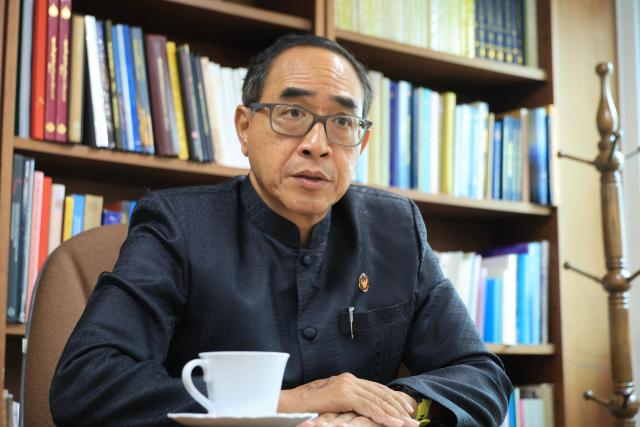
South Korean arrivals to Thailand fell to 1.55 million in 2025 from a record 1.87 million in 2024, a decline of 16.8 percent. During the first five months of 2026, arrivals fell another 7.6 percent year on year to 539,848, according to Thailand's Ministry of Tourism and Sports.
Beyond industry, Sangrat sees growing opportunities in healthcare and the silver economy as both countries confront rapidly aging populations.
Thailand has developed into one of Asia's leading medical hubs, attracting patients from the Middle East, Europe, Africa and across Asia with high-quality treatment at competitive costs.
"There is a silver lining in this transformation," he said.
"It's also an opportunity for Korean companies, Thai companies and foreign direct investment to invest in a wide spectrum of what you call the silver economy."
He said demand would continue to expand across senior healthcare, medical devices, hospital infrastructure, age-friendly housing and elderly care facilities.
"We want Korean companies to use Thailand as a base and expand not only into Thailand but across ASEAN."
Sangrat also called for closer cooperation in cybersecurity, disaster relief and humanitarian assistance as common security challenges intensify.
"Cybersecurity is something that is foremost on our mind," he said. "We are all threatened by cybersecurity, and we can address it directly through our partnership with Korea and our friends in ASEAN."
The ambassador said the relationship rests on decades of trust built through shared history, noting that Thailand was among the few Asian countries to send combat troops under the United Nations Command during the 1950-53 Korean War, contributing 11,786 personnel.
"I would like our Korean friends to look at Thailand not only for tourism purposes," he said. "Thailand should not only be known for tourism, but also as a land of innovation and technology."

Copyright ⓒ Aju Press All rights reserved.
