
SEOUL, June 09 (AJP) - South Korea's economy turned out strongest three-month performance in more than five years in the quarter ended March with nominal growth at a 50-year high, according to the finalized first-quarter figure, but the bigger surprise came from income — up record 9.2 percent — as booming chip prices amplified the gains from the AI-driven semiconductor boom.
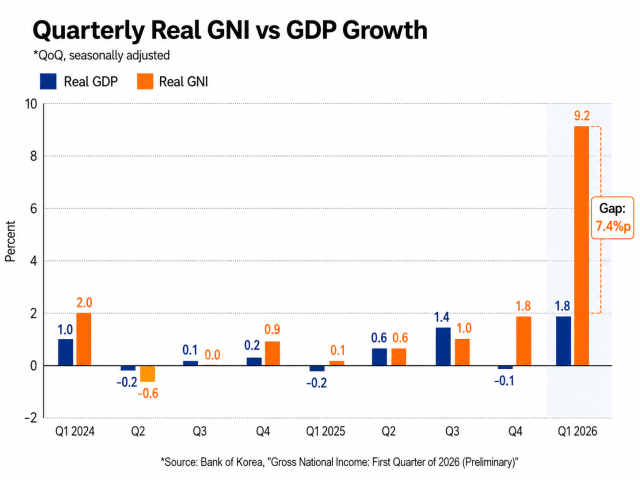
Real gross domestic product expanded 1.8 percent from the previous quarter in the January-March period, according to the Bank of Korea on Tuesday.
Real gross national income, a broader measure of purchasing power, jumped 9.2 percent over the same period, more than five times the pace of GDP growth and the strongest on record.
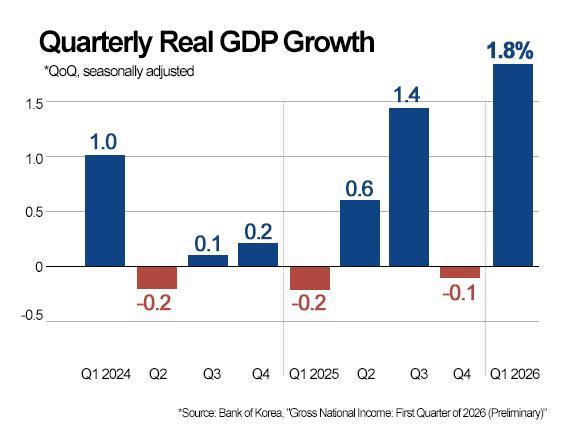
The economy grew 3.8 percent from a year earlier, up from a preliminary estimate of 3.6 percent released in April and marking the fastest annual expansion since the first quarter of 2021. The quarterly growth rate was the strongest since the third quarter of 2020, when the economy expanded 2.3 percent.
The upward revision reflected newly available data for the final month of the quarter, which showed stronger facilities investment and private consumption than initially estimated. Facilities investment was revised upward by 1.8 percentage points from the advance estimate, while private consumption was raised by 0.1 percentage point.
The gap between GDP and GNI reflected improved terms of trade and rising income earned abroad.
Real net factor income from overseas climbed to 11.6 trillion won ($7.56 billion) in the first quarter from 8.2 trillion won in the previous quarter, while higher semiconductor export prices boosted the purchasing power of income generated from the same volume of exports.
A key factor behind the surge was real gross domestic income (GDI), which measures the real purchasing power generated from domestic production.
While GDP shows how much the economy produced, GDI shows how much real income that production created after changes in export and import prices. Real GDI rose 8.7 percent on quarter and 13.2 percent from a year earlier.
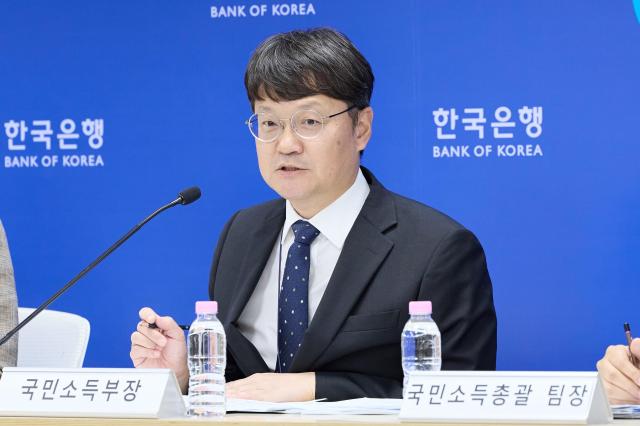
"Even if the same volume is exported, higher export prices and lower import prices increase the resources available for consumption and investment."
Kim compared the economy to a semiconductor company.
"GDP would show how many chips were produced, while GDI would reflect how much income was actually earned from selling them," he said.
He added that higher export prices and lower raw material costs would push up real GDI.
The strong data supported the Korean capital markets after suffering one of the worst Black Monday sessions.
Yields on both the three-year and 10-year government bonds fell more than 4 basis points in morning trading, while the benchmark KOSPI rose more than 3 percent. The U.S. dollar, which had climbed above 1,550 won, retreated sharply to 1,516.70 won.
Korea's broad economic performance in the first quarter was literally defined by semiconductors.
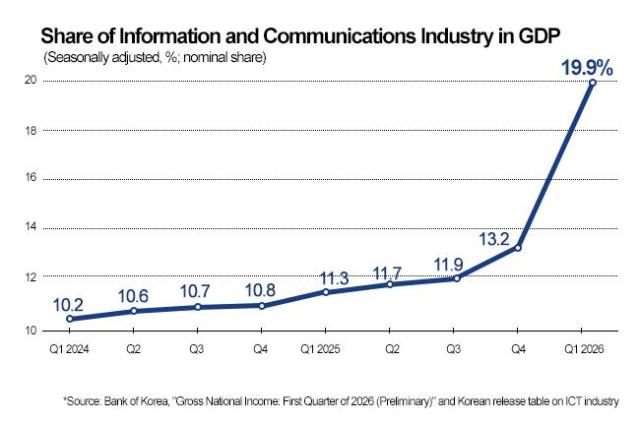
The central bank said information and communications technology industries contributed a record 19.9 percent of overall economic growth during the quarter, fueled by surging demand for AI-related chips and related investment.
Manufacturing output rose 3.9 percent from the previous quarter, led by computers, electronics and optical products.
Production of computers, electronics and optical products jumped 12.5 percent, while ICT manufacturing surged 15.4 percent. In contrast, non-ICT manufacturing contracted 0.9 percent, highlighting the widening gap between semiconductor-related industries and the rest of the economy.
The divergence points to an increasingly uneven recovery in which a handful of AI-linked industries are driving growth while broader manufacturing remains comparatively subdued.
Exports rose 5.9 percent from the previous quarter, led by semiconductors and other IT products, while imports increased 3.9 percent on stronger purchases of machinery, equipment and automobiles.
Facilities investment jumped 6.6 percent, reversing a decline in the previous quarter as companies stepped up spending on machinery and transportation equipment.
Private consumption rose 0.6 percent as spending increased on both goods and services, including clothing and finance-related services.
Construction investment increased 1.4 percent, snapping a prolonged downturn as both building construction and civil engineering projects improved. Construction output itself rose 2.2 percent from the previous quarter, the first meaningful rebound after a string of quarterly declines, although the sector remained 3.9 percent smaller than a year earlier.
Government consumption fell 0.4 percent, mainly due to lower health insurance benefit payments.
On the production side, services expanded a modest 0.6 percent, supported by wholesale and retail trade, accommodation and food services, and finance and insurance.
Financial and insurance activities rose 2.4 percent, reflecting strength in financial investment institutions and related services, while transport and information and communications services contracted.
The semiconductor boom also generated a sharp increase in corporate earnings.
Nominal GDP expanded 10.5 percent from the previous quarter and 17.1 percent from a year earlier, while nominal GNI increased 11.0 percent quarter-on-quarter and 17.1 percent year-on-year.
Employee compensation rose 4.0 percent from the previous quarter, but total operating surplus, a broad measure of corporate profits, surged 17.0 percent, indicating that much of the windfall accrued to companies rather than households.
Kim cautioned against interpreting the surge in nominal GDP as a sign of runaway inflation.
"The expansion in nominal GDP growth was not due to a surge in domestic prices, but was driven by higher export prices centered on semiconductors," Kim said.
"It is different in nature from the periods in the 1970s and 1980s, when nominal growth rose because of cost-push inflation."
The income surge also transformed the nation's saving and investment profile.
Korea's gross saving rate rose to 41.7 percent in the first quarter from 36.0 percent in the previous quarter, while the gross domestic investment ratio fell to 25.3 percent from 28.2 percent.
The household net saving rate, however, slipped to 8.8 percent from 9.1 percent, as high interest rates and a weaker won reduced room for savings.

Copyright ⓒ Aju Press All rights reserved.