
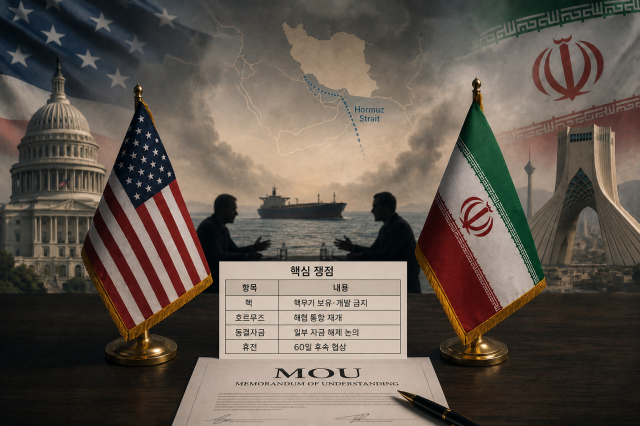
U.S. and Iran are quickly shifting from military confrontation to ceasefire discussions. President Donald Trump announced the cancellation of planned airstrikes against Iran and stated that the negotiations for a memorandum of understanding (MOU) to end the conflict have reached the final document coordination stage. However, Iran has maintained a cautious stance, asserting that it has not yet made a final decision. Key issues still under negotiation include nuclear facilities, uranium enrichment, the handling of frozen funds, and navigation through the Strait of Hormuz.
On June 11, during an event at the White House, Trump stated, "We have a great agreement regarding the war with Iran," adding that only the final document coordination remains. He indicated that a signing ceremony could take place as early as this weekend in Europe. CBS News reported that both countries might sign a letter of intent (LOI) or MOU early next week. Axios noted that Geneva, Switzerland, is being considered as the signing location, with an advance team heading to Europe in preparation for Vice President JD Vance's attendance.
This announcement followed discussions about a potential third airstrike against Iran. Following the controversy surrounding the crash and attack on a U.S. Apache helicopter, attacks against Iran resumed on June 9. Trump had mentioned the possibility of seizing Iran's main oil export terminal at Kharg Island and its oil infrastructure. However, he later canceled the planned airstrikes after receiving approval from the highest leadership regarding discussions with Iran.
Trump stated, "As soon as we sign the document, the Strait of Hormuz will be opened, and the U.S. maritime blockade against Iran will be lifted." The preliminary agreement reportedly includes provisions for Iran to restore shipping traffic in the Strait to pre-war levels within 30 days without tolls, while the U.S. would lift the blockade. Trump emphasized that a key point is Iran's commitment not to possess, purchase, or develop nuclear weapons in any form.
Iran, however, clarified that no final agreement has been reached. Esmail Baghaei, spokesperson for the Iranian Foreign Ministry, told the state-run IRNA news agency, "No final decision has been made, and reports regarding the time and place of the signing are all speculation." The semi-official Fars News Agency also cited sources from the negotiation team stating that there is no approved text related to the initial MOU with the U.S.
The Iranian military also issued a strong message. The Islamic Revolutionary Guard Corps (IRGC) declared through state-run Press TV that it is prepared to respond immediately to any threats or miscalculations, indicating that military tensions have not been fully resolved even during negotiations.
Nonetheless, the Iranian Foreign Ministry acknowledged that much of the document has been organized. Fars News reported that the U.S. has recently withdrawn additional demands and reverted to the initial draft, which had been nearing completion about two weeks ago. The existing proposal reportedly includes the opening of the Strait of Hormuz, a 60-day extension of the ceasefire, and subsequent negotiations on nuclear issues during this period. In return, the U.S. is considering temporarily allowing Iran to sell oil for 60 days and expanding sanctions relief based on progress in negotiations.
This MOU serves more as an interim document for subsequent discussions rather than a final peace agreement. Trump described it as "very strong and detailed," yet also "somewhat conceptual." How Iran will handle its existing stockpile of enriched uranium, whether to dismantle nuclear facilities, and limit uranium enrichment facilities are likely to be addressed in separate nuclear negotiations. A senior U.S. official indicated that discussions have taken place regarding diluting enriched uranium within Iran under U.N. supervision.
The handling of frozen funds also remains a contentious issue. Reuters reported that Iran has demanded the immediate release of $6 billion to $12 billion of the approximately $100 billion in funds frozen overseas. Trump did not provide specific comments on this matter.
The Israeli factor also remains a concern. Trump claimed that major stakeholders, including Israel, have approved the discussions. However, CNN and Axios reported that Israeli Prime Minister Benjamin Netanyahu was not informed of this announcement in advance. While Israel is not a signatory to the MOU, it has reportedly demanded the removal of nuclear materials, dismantling of uranium enrichment facilities, restrictions on missile production, and cessation of support for regional proxy forces.
Countries in the Middle East are also seeking to ease tensions. Qatar has stepped in to mediate between the U.S. and Iran, and reports indicate that high-level officials from the United Arab Emirates and Iran held secret face-to-face talks for the first time since the outbreak of war.
The possibility of a short-term ceasefire in the Middle East has increased compared to before. The U.S. is aiming to secure diplomatic achievements while avoiding further escalation, and Iran is increasingly compelled to negotiate amid military pressure and economic burdens. However, foreign media report that if disagreements over the expression of nuclear issues, conditions for handling frozen funds, guarantees for navigation through the Strait of Hormuz, and acceptance by Israel are not resolved, the ceasefire could be delayed or military tensions could rise again.
* This article has been translated by AI.
Copyright ⓒ Aju Press All rights reserved.