
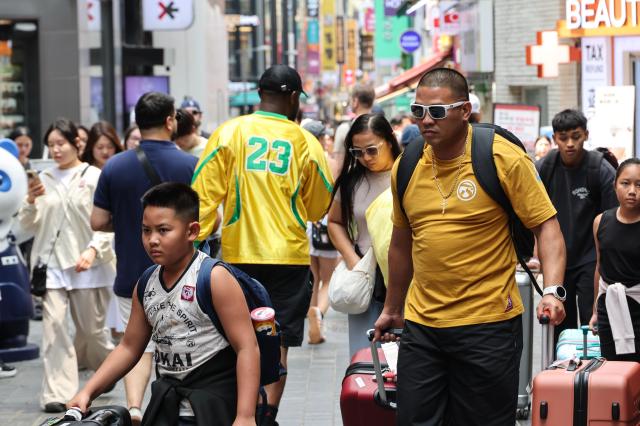
According to the Ministry of Culture, Sports and Tourism on Tuesday, 1.99 million foreign travelers visited South Korea in June, up 23.1 percent from a year earlier, lifting first-half arrivals to 10.71 million, a 21.3 percent increase from the same period last year.
Foreign arrivals through regional airports, including Gimhae, Daegu, Jeju and Cheongju, surged 42.5 percent in June to 395,246, far outpacing the 18.2 percent increase recorded at airports serving the Seoul metropolitan area. The figures point to a gradual shift away from Seoul-centric tourism as more overseas visitors travel directly to regional destinations.
China remained South Korea's largest source market with 649,582 visitors in June, up 36.2 percent from a year earlier. Japan followed with 348,216 visitors, while Taiwan contributed 223,127 travelers.
Arrivals also increased from North America, Europe and Southeast Asia, reflecting continued diversification of South Korea's inbound tourism market.
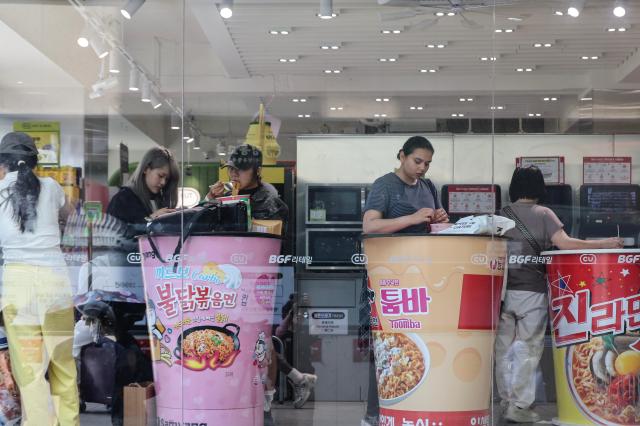
Foreign visitors spent 2.05 trillion won ($1.5 billion) using credit cards in June, marking the second consecutive month that spending exceeded the 2 trillion won mark. Cumulative foreign card spending reached 10.04 trillion won in the first half, up 50.8 percent from a year earlier. Last year, foreign visitor spending did not surpass 10 trillion won until September.
The quality of tourism also improved. South Korea's inbound visitor satisfaction score rose to 90.5 points in the second quarter from 89.8 a year earlier, while the share of tourists visiting destinations outside Seoul increased to 34.2 percent from 31.4 percent.
Travel destinations also have diversified beyond the capital reigon.
According to Yanolja Research, international arrivals through regional airports in the first quarter rose 40.1 percent from pre-pandemic 2019 levels, compared with a 19 percent increase at airports in the Seoul metropolitan area.
The biggest beneficiary of the trend has been Busan's Gimhae International Airport, which has become the country's fastest-growing international gateway outside the capital.
International passenger traffic at Gimhae reached about 6.07 million during the first half, up 23.2 percent from a year earlier and nearly one million above the previous first-half record set in 2019 before the pandemic.
After surpassing 10 million international passengers for the first time last year, the airport is now on course to exceed 12 million this year.
Japan accounted for the largest share of international passengers with 2.59 million travelers, followed by Vietnam with 1.03 million, Taiwan with 946,000 and China with 599,000.
Foreign arrivals have been the key growth driver.
During the first quarter, the number of overseas visitors entering South Korea through Gimhae Airport jumped 45.5 percent from a year earlier, roughly twice the pace of overall international passenger growth.
Demand has remained resilient despite expanding flight capacity. International load factors stayed between 83 percent and 89 percent throughout the first half, indicating airlines have been able to fill additional seats as new routes were introduced.
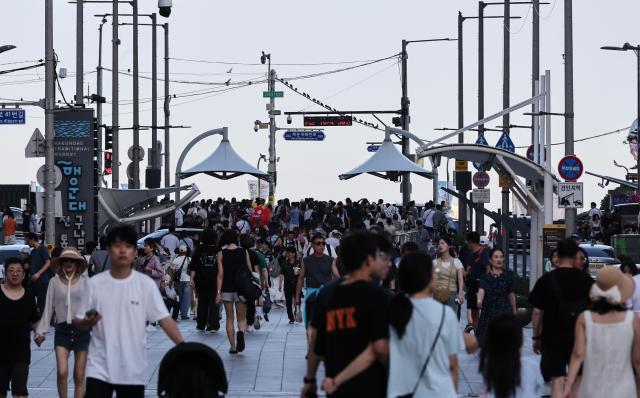
The city has become increasingly popular among travelers from China, Taiwan and Japan, where social media users have coined the phrase "Busan disease" to describe the irresistible urge to revisit the city after a first trip.
According to Yanolja Research, analysis of reviews on Chinese social media platform Xiaohongshu and travel site Ctrip ranked Busan as the highest-rated destination among eight major Asian cities for Chinese visitors, ahead of Tokyo and Singapore.
Google Trends also showed worldwide searches for "Busan" in English increased about 50 percent over the past year, while searches from Japan surged nearly 190 percent.

Copyright ⓒ Aju Press All rights reserved.
