SEOUL, August 18 (AJP) - Hospitals, children's rehabilitation centers and sports facilities will top Kazakhstan's construction priorities for the 2027~2029 budget period, committing the state to another round of building at a time when its own auditors report that much of the last round went unfinished.
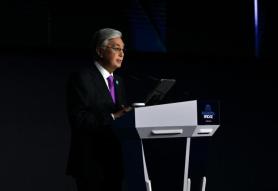
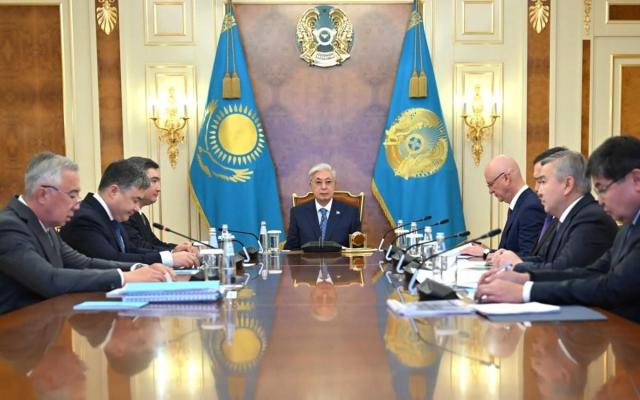
President Kassym-Jomart Tokayev set the priority at a meeting on the economy and budget planning at Akorda on Monday, according to the presidential press service. He was briefed on the state of the economy, the socio-economic forecast for 2027~2029 and the republican budget indicators for those years, and told officials to hold both republican and local budgets in balance and to meet this year's growth targets.
The room reflected how much of the government's fiscal machinery the question touches. Prime Minister Olzhas Bektenov attended, along with presidential administration head Roman Sklyar, National Bank of Kazakhstan Governor Timur Suleimenov, Supreme Audit Chamber Chairman Alikhan Smailov, Deputy Prime Minister and National Economy Minister Serik Zhumangarin, presidential economic assistant Nurlan Baibazarov and Finance Minister Madi Takiyev.
What Tokayev asked for is not a new departure. Kazakhstan has spent the past three years building social facilities at exactly this scale, through a set of national projects that now offer a clear record of what the state can and cannot deliver.
The largest of them, Modernization of Rural Healthcare, has just finished. The Health Ministry says all 655 planned primary care facilities are built, including first-aid posts, feldsher-midwife stations and rural outpatient clinics. Of those, 226 went to villages that had no medical building of any kind, and 419 replaced premises the ministry judged unfit for use. The ministry puts the population served at about one million rural residents.
A second stage is still running. Thirty-two district hospitals are being rebuilt as multidisciplinary central hospitals, with eight completed by late last year in Temirtau, Balkhash, Zhanaarka, Urzhar, Shuskoye, Merke, Talas and Beineu. Renovation is under way at 36 regional hospitals and 17 perinatal centers, and pediatric bed capacity has risen 38 percent.
The school program, Comfortable School, was built to end three-shift teaching and the shortage of pupil places, with schools put up to common standards in cities and villages alike. It opened 105 schools in 2024 and 112 in 2025, of which 45 percent were rural. Another 245 existing schools are being renovated.
Sitting above both is the National Infrastructure Plan, which runs to 2029 and lists 204 priority projects in energy, transport, water and sanitation, and digital infrastructure, at an estimated 40.1 trillion tenge. Roughly 90 percent of that money is expected from outside the state budget, which makes private capital and public-private partnerships the load-bearing assumption of the entire plan.
The need is not in dispute. A separate national project is spending 13 trillion tenge between 2025 and 2029 on 86,000 kilometers of utility networks, aiming to bring average wear on the country's infrastructure down to 40 percent. The Organisation for Economic Co-operation and Development, which reviewed the plan this year, found more than a third of Kazakhstan's power plants running at 70 to 90 percent degradation.
The gap opens at delivery. Yulia Engel, a member of the Supreme Audit Chamber, told the Mazhilis on May 21 that the four national projects running in 2025 were rewritten repeatedly during the year, in deadlines, delivery mechanisms, funding volumes, lists of facilities and target indicators, until they no longer functioned as long-term commitments with fixed parameters.
"They have turned into mechanisms for adaptively redistributing budget resources to match the current level of execution," Engel said. Total underfunding of the four came to 38 percent of the planned volume in 2025 alone.
The chamber's wider audit of last year's budget execution found that more than 20 percent of over 600 investment projects due for completion were not finished, that 99 projects worth 75 billion tenge were dropped mid-year, and that 2.4 trillion tenge was shifted between budget lines during the year. The volume of money spent inefficiently rose by a factor of 1.7 from 2024.
Healthcare showed the same pattern in miniature. From January to October last year, fixed capital investment in the sector reached 214.8 billion tenge, or 89 percent of the 241 billion tenge planned.
Smailov's chamber will assess the draft 2027~2029 budget itself, and its audit program for this year covers both Comfortable School and Modernization of Rural Healthcare.
The three years Tokayev was briefed on are also the years the budget is supposed to tighten. Kazakhstan has committed to cutting the republican deficit from 2.5 percent of GDP this year to 1.7 percent in 2027 and 0.9 percent in 2028, and to weaning the budget off transfers from the National Fund, the sovereign wealth fund built on oil revenue. The 2026 budget carries no targeted transfers from it.
That squeeze is happening in difficult conditions. Value-added tax rose to 16 percent from 12 percent in January, annual inflation was still 10.2 percent in July, and the National Bank has held its base rate at 18 percent since October. The bank expects growth of 3.5 to 4.5 percent this year, below the 5.4 percent the government used in building the current budget.
The construction categories Tokayev named on Monday are also the ones foreign contractors have been circling. Korean engineering, urban development and hospital groups spent this year pitching projects in Astana, and healthcare has featured in bilateral talks alongside energy, transport and critical minerals.
Tokayev accepted President Lee Jae Myung's invitation to Seoul in April. The first Korea-Central Asia summit is set for Sept. 16 and 17.
Copyright ⓒ Aju Press All rights reserved.