
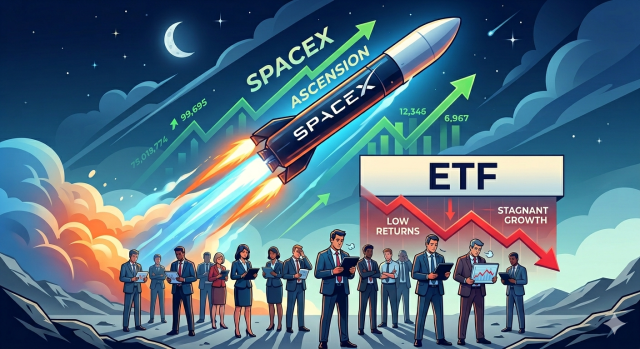
The initial public offering (IPO) of SpaceX has ignited excitement in South Korea's aerospace exchange-traded fund (ETF) market, but the performance following the listing has not met expectations. As investment funds have concentrated on SpaceX, other aerospace stocks have suffered, leading to a paradox where ETFs prominently featuring SpaceX have seen diluted returns.
According to the Korea Exchange, prior to SpaceX's listing on June 12, domestic aerospace ETFs such as TIGER U.S. Space Tech (12.91%), SOL U.S. Aerospace TOP 10 (11.73%), ACE U.S. Space Tech Active (10.75%), KODEX U.S. Aerospace (10.28%), 1Q U.S. Aerospace Tech (5.40%), and WON U.S. Aerospace Defense (5.37%) all recorded high returns. This surge was attributed to the anticipation surrounding SpaceX's IPO, which boosted the entire sector.
However, the mood shifted dramatically the following day. On June 15, the first trading day after SpaceX's listing, most ETFs, including TIGER U.S. Space Tech (-12.02%), SOL U.S. Aerospace TOP 10 (-10.21%), ACE U.S. Space Tech Active (-10.81%), KODEX U.S. Aerospace (-7.82%), 1Q U.S. Aerospace Tech (-4.74%), and WON U.S. Aerospace Defense (-1.94%), gave back most of their previous gains.
This decline is believed to be due to the concentration of funds within the aerospace sector on a single stock. Companies that had previously risen in anticipation of the IPO experienced significant drops as profit-taking and capital shifts occurred. On the day of SpaceX's listing, Rocket Lab fell 10.79%, AST SpaceMobile dropped 15.53%, Intuitive Machines declined 13.12%, EchoStar decreased 10.97%, and Planet Labs fell 8.84%.
In contrast, SpaceX saw a 19.22% increase on its listing day and rose another 19.60% on June 15, closing at $192.50. ETFs that had promoted SpaceX as a key investment point did not fully benefit from its price surge.
The timing of ETF holdings also played a role. Most domestic asset managers failed to secure shares during the IPO and are now acquiring SpaceX through market purchases. KODEX U.S. Aerospace and ACE U.S. Space Tech Active began acquiring shares on the listing day, while SOL U.S. Aerospace TOP 10 added the maximum allocation on June 15. TIGER U.S. Space Tech plans to include SpaceX on June 16.
The challenge lies in the fact that those who could not participate at the IPO price of $135 must now increase their holdings at a much higher price following the surge. As SpaceX's stock price rises, ETFs must buy at elevated prices while also grappling with the underperformance of other constituent stocks, leading to diluted returns. While ETFs are typically valued for their diversification, this situation has prevented them from reflecting SpaceX's gains and has exposed them to negative impacts from capital concentration within the sector.
Market analysts caution about the volatility that often accompanies new listings. Global mega IPOs frequently exhibit overheating immediately after listing, followed by several months of high volatility during the lock-up release and inventory digestion phases. ETFs that increase their holdings at high points post-listing are particularly vulnerable to the risks associated with initial overvaluation.
An asset management official stated, "The space industry is in its early growth stage from a long-term perspective, and new investment opportunities will continue to emerge. We plan to expand our investment portfolio by identifying not only SpaceX but also other high-growth emerging companies."
* This article has been translated by AI.
Copyright ⓒ Aju Press All rights reserved.