
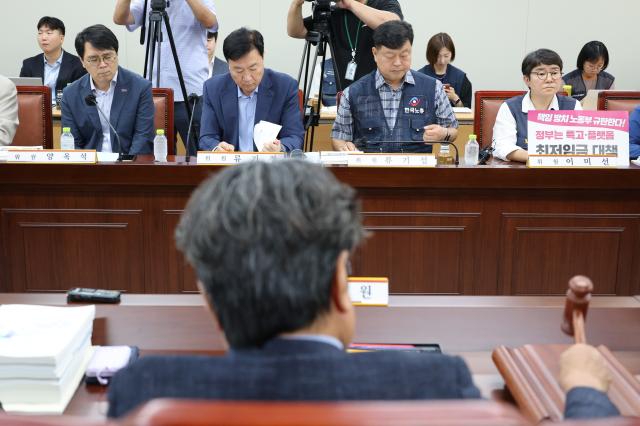
On June 16, the Minimum Wage Commission convened its sixth plenary meeting at the Government Sejong Center to discuss whether to implement sector-specific minimum wage applications for the upcoming year.
The business community contends that the differences in productivity and wage-paying capacity across sectors necessitate a departure from a uniform minimum wage. Ryu Gi-jung, executive director of the Korea Employers Federation, stated, "The burden of minimum wage is particularly heavy for certain sectors, and their business conditions remain very challenging. The outstanding loans for small retailers and the hospitality industry reached a record high of 356 trillion won at the end of the first quarter this year."
He added, "The value added per worker in the hospitality and food services sector is only 28 million won, which is just one-sixth of that in manufacturing. Applying a single standard across all sectors, despite clear differences in labor productivity and wage levels, only undermines the acceptance of the minimum wage in practice."
Yang Ok-seok, head of the Human Resources Policy Division at the Korea Federation of Small and Medium Businesses, emphasized that sector-specific applications are not discriminatory but rather a lifeline for struggling industries to maintain employment. He urged for a proactive review to ensure that small businesses and micro-enterprises have at least some hope.
Conversely, labor representatives argue that sector-specific applications would justify discrimination against low-wage workers. Ryu Gi-seob, secretary-general of the Korean Confederation of Trade Unions, remarked, "Differentiated applications based on sectors would lead to discrimination against workers. If restaurants can pay less than the current minimum wage, who would want to work there?"
He further warned that such a system could lead to the justification of discrimination against foreign workers, disabled workers, and trainees, stating, "The minimum wage system, as defined by the constitution, must not be used as a tool for discrimination."
Lee Mi-sun, vice-chairperson of the Korean Public Service and Transport Workers' Union, called for the abolition of sector-specific applications, labeling them as toxic provisions that exacerbate discrimination and inequality. She asserted that the labor community's demand for a minimum wage of 12,000 won per hour is the minimum survival cost for low-wage workers.
Previously, the Korean Confederation of Trade Unions, the Korean Public Service and Transport Workers' Union, and the Minimum Wage Movement Headquarters proposed an initial demand for a minimum wage of 12,000 won per hour for the next year, representing a 16.3% increase from the current minimum wage of 10,320 won.
Sung Jae-min, a member of the Public Interest Committee and a researcher at the Korea Labor Institute, noted, "The issue of sector-specific applications has been discussed repeatedly over a long period. Given the ongoing concerns about the burden on small businesses and micro-enterprises, a careful and responsible conclusion is necessary."
The Minimum Wage Act allows for the differentiation of minimum wages by type of business. However, actual sector-specific applications have only been implemented once, in the first year of the minimum wage system in 1988, and since 1989, a single minimum wage system has been maintained.
The Minimum Wage Commission is expected to decide on the sector-specific application before beginning detailed discussions on the minimum wage level for next year. Labor representatives have proposed an initial demand of 12,000 won per hour, while the business sector is anticipated to advocate for a freeze or minimal increase.
* This article has been translated by AI.
Copyright ⓒ Aju Press All rights reserved.