
The government is working to create ultra-wide economic and living zones through its "National Space Transformation" initiative. This aims to overcome the limitations of the current metropolitan-centered system by promoting balanced regional development across the country.
By considering regional characteristics, the government plans to identify tailored growth engines and attract anchor companies to foster future industries. Additionally, it will provide substantial support, including regulatory easing and financial incentives, particularly in areas farther from the capital.
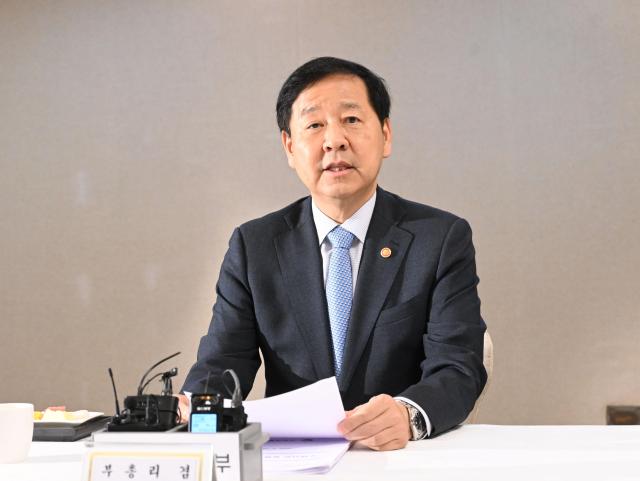
To this end, Gu began visiting the five regions and three specialties to uncover future growth opportunities. He aims to establish a "super-gap growth engine" that will drive South Korea's economic growth. He will also implement the "Pick and Back" strategy to meet with public-private partnerships supporting corporate innovation in each region.
Gu first visited Solar City in Haenam, the largest renewable energy city in South Korea, where he inspected the data center site and solar power generation facilities. He remarked, "Haenam is the forefront of the green transition (GX) advanced technology promoted by the Lee Jae-myung administration, and Solar City is a representative growth hub for South Korea, leading future industries and eco-friendly growth in advanced industries, renewable energy, and tourism."
During a subsequent meeting, Gu introduced the government's K-GX strategy, which focuses on three pillars: GX as a new growth engine, inclusive participation from individuals, businesses, regions, and society, and sustainable development.
The government plans to mass-produce ultra-high-efficiency (35%) tandem cells through super-gap research and development (R&D) by 2030. It also aims to secure fundamental technology for perovskite through collaboration among academia, industry, and research, and to promote the world's first commercialization in sectors such as buildings, wearables, and mobility. Furthermore, it will enhance technology development to expand application spaces, including urban, transport, aquatic, and agricultural areas.
Gu emphasized, "The future growth of Haenam is crucially tied to becoming a leader in advanced technologies and products like next-generation solar power that can dominate the global market. We must develop the renewable energy-based data center and new industry complex near Solar City into a world-class center for advanced green technology."
He added, "The government will support this through the Korean Green Transition strategy, significantly increasing financial investments over the next decade, along with innovative tax incentives, green transition financing, and bold regulatory reforms to promote sustainable green transitions."
Participants in the meeting expressed hope that K-GX would strengthen the connection between local industries based on renewable energy and provide an opportunity for industrial competitiveness to soar.
Meanwhile, Gu plans to visit the AI Industry Convergence Complex in Gwangju and the LG Innotek industrial site in Gumi on June 17 as part of the "Pick and Back" schedule. Suggestions made during these visits will be reflected in policies through the public-private partnership supporting corporate innovation involving the government, businesses, and economic organizations.
* This article has been translated by AI.
Copyright ⓒ Aju Press All rights reserved.