
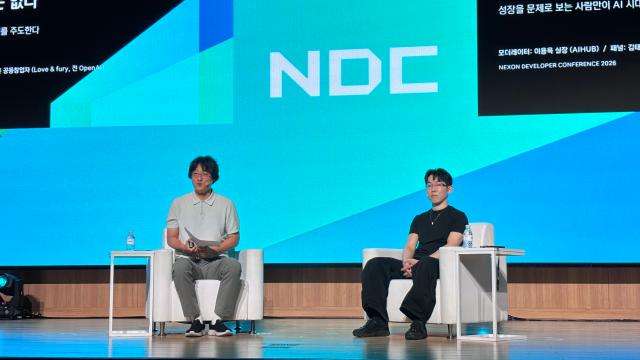
As artificial intelligence (AI) emerges as a key factor transforming how individuals and organizations work, finding ways to link increased personal productivity to organizational performance has become a pressing challenge. Discussions at the 2026 Nexon Developer Conference (NDC) focused on methods to extend the efficiency gained from AI to organizational growth and business outcomes.
During a panel session on June 16 in Seongnam, Gyeonggi Province, Kim Tae-hoon, Chief Technology Officer of Love & Fury, emphasized that competitiveness in the AI era relies more on the ability to define and solve problems than on how quickly one can adopt new tools. The session was conducted in a dialogue format with Lee Yong-wook, head of Nexon Korea. Kim, who participated in the early development of ChatGPT at OpenAI, is currently co-founding Love & Fury to develop virtual fitting services based on AI image generation models.
Lee posed the question, "While individual experiences with AI and productivity are increasing, where do the structural bottlenecks arise that prevent this from translating into organizational and business performance?"
Kim responded that the productivity gap between individuals who effectively utilize AI and those who do not could widen. He explained that individuals who can navigate various development areas—such as AI, backend, frontend, and infrastructure—can significantly expand their scope of work by leveraging AI tools.
However, he noted that improvements in individual productivity do not automatically lead to enhanced organizational performance. This is partly due to the lack of talent capable of handling multiple areas simultaneously and the existing organizational structures not being designed for individuals to take on diverse roles. Kim stressed that in large organizations, outcomes are heavily influenced by leadership strategy and judgment.
Nexon is addressing these organizational challenges through its AI Hub. According to Lee, Nexon established the AI Hub in September of last year to support bottom-up activities aimed at expanding AI utilization across the company. Approximately 30% of employees participate in the internal AI community, where they share the latest AI information and practical experiences. Nexon conducts weekly broadcasts on AI use cases and provides an AI studio and demo environment to facilitate easy experimentation with various generative AI models and smaller models.
Lee then asked how to discern which new tools to try and which to monitor amid the influx of new AI models and tools. Kim replied that having strong problem-solving skills is more critical than merely experimenting with numerous new tools. He noted, "Many of the rapidly emerging tools will likely fade over time, but the ability to define and solve problems remains a core competency, regardless of the tools used."
He identified English-language information access as a fundamental skill in the AI era. Kim pointed out that since AI coding agents operate based on natural language instructions and code context, the language used to explain problems and provide information can significantly affect the quality of the outcomes. Given that the competition among coding agents is centered in the English-speaking development ecosystem, the ability to search for information and interact with AI in English is crucial.
Kim also mentioned that major global AI companies are currently focusing on the intelligence competition of coding agents rather than multilingual support. He noted that Korean can use more tokens than English, which may reduce the amount of code, documents, and conversational context that AI can process at once, potentially leading to context loss during the translation of English-based code, documents, and variable names.
He emphasized the importance of advanced search capabilities, arguing that relying solely on commonly accessible information will not yield differentiated results. Particularly in the AI and development fields, significant discussions and high-quality references are often produced first in English, making it essential to utilize search operators and environments to locate original sources directly.
Kim cautioned that relying only on information reprocessed in Korean could diminish context or accuracy. He explained that problem-solving skills in the AI era extend beyond crafting effective prompts; they also encompass the ability to find quality information and present it in a format that AI can utilize.
He concluded by stating, "In the AI era, it is crucial for individuals to have a clear understanding of why they need to grow." He emphasized that while AI is rapidly evolving and changing work methods, the attitude of defining and solving problems, along with the motivation for growth, remains the foundation of individual competitiveness.
* This article has been translated by AI.
Copyright ⓒ Aju Press All rights reserved.