
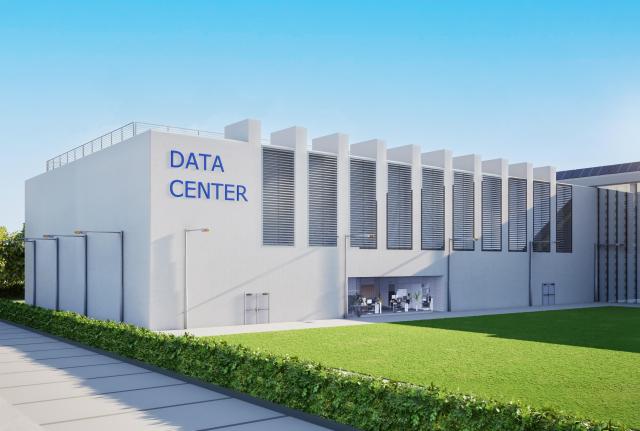
South Korea's electricity rates for data centers are significantly higher than those in major countries, resulting in a substantial disadvantage in the cost competitiveness of artificial intelligence (AI) services compared to the United States and China. While the general electricity rates are relatively low, the industrial rates for high-volume users are considerably more expensive than those in competing nations.
According to the U.S. Energy Information Administration (EIA), the average industrial rate for data centers as of the end of 2025 is 8.62 cents (approximately 131 won) per kilowatt-hour, which is about 37-39% lower than South Korea's rates of 179-182 won per kWh. This means that when operating the same AI data center (AIDC), the cost competitiveness in the U.S. is nearly 40% higher.
Industrial rates apply to large consumers such as factories and data centers that operate 24 hours a day and are designed to be cheaper than commercial and residential rates. In regions like Texas and North Dakota, industrial electricity rates can drop to as low as 6 cents per kWh.
The disparity in power purchase agreements (PPAs) for renewable energy used in AIDCs is also significant between the U.S. and South Korea. As of the first quarter of this year, the average PPA price for solar energy in the U.S. is 6.45 cents per kWh, while for wind energy, it is 7.94 cents. In contrast, South Korea's average PPA price for renewable energy reaches about 13 cents (200 won) per kWh, which is even higher than the average industrial rate.
For a hypothetical cluster of 1,000 NVIDIA H100 GPUs, the annual electricity cost in South Korea would amount to approximately 2.673 billion won, compared to about 2.022 billion won in the U.S. China offers even lower costs; in regions like Gansu, Guizhou, and Inner Mongolia, the cost is only about 1.211 billion won (approximately 5.2 cents per kWh).
In the U.S., states like Virginia and Oregon have established separate rate classes for large loads exceeding 25 megawatts (MW), while Japan subsidizes up to 50% of the capital investment for data centers using decarbonized power. Singapore and Ireland require a certain percentage of green energy as a condition for power connection permits. Despite declaring itself an AI powerhouse, South Korea lacks any dedicated pricing system for data centers.
The relatively high operating costs for data centers compared to other countries lead to increased AI costs for domestic users. The government’s initiative for a 'national representative AI model' means that sovereign AI models must be trained and served from domestic data centers. Given the significant impact of electricity costs on AI service pricing, using local data centers inevitably results in higher token prices.
Yoon Sung-ro, a professor at Seoul National University’s Department of Electrical and Computer Engineering, stated, "In the future, the production of tokens per watt will be crucial. If differences in electricity rates emerge, domestic AI models will lose price competitiveness, ultimately putting them at a disadvantage in the global AI market."
* This article has been translated by AI.
Copyright ⓒ Aju Press All rights reserved.