
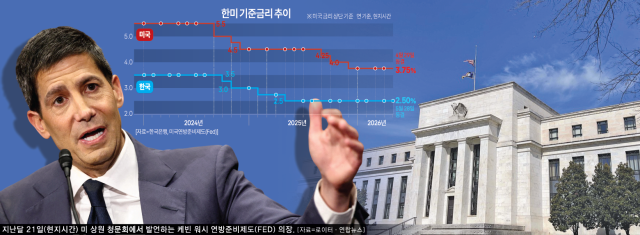
As the Federal Reserve holds its monetary policy meeting this week, the interest rate trajectories of the U.S. and South Korea appear to be diverging. While the U.S. is leaning towards keeping its benchmark interest rate steady, South Korea is poised for a likely rate hike next month. This situation has drawn attention to the future of the Korea-U.S. interest rate gap.
According to financial sources, the Fed is set to convene its Federal Open Market Committee (FOMC) meeting on June 16-17 (local time). This meeting is particularly noteworthy as it marks the first monetary policy session chaired by Kevin Warsh, who took office in April.
Market expectations suggest a high likelihood that the Fed will maintain its policy rate at the current range of 3.50% to 3.75%. Recent U.S. inflation data has largely aligned with market forecasts, indicating that there is little immediate need for further rate increases.
In May, the Consumer Price Index (CPI) in the U.S. rose 4.2% year-over-year, marking the highest level since April 2023. However, since this figure met market expectations, the impact was limited. The Producer Price Index (PPI) followed a similar trend, increasing by 1.1% month-over-month in May, exceeding market predictions, but the core PPI, excluding energy prices, only rose by 0.4%, a slowdown from the previous month's 0.7% increase.
The recent agreement between the U.S. and Iran to pursue a ceasefire is also seen as a factor easing the Fed's burden. Concerns had arisen that ongoing conflicts in the Middle East could drive up international oil prices, thereby affecting U.S. inflation. However, the signing of a memorandum of understanding (MOU) between the two countries could alleviate some inflationary pressures stemming from high oil prices.
Market sentiment regarding tightening has somewhat diminished. According to the Chicago Mercantile Exchange's FedWatch tool, the likelihood of a rate hike in October has dropped from 41% a week ago to 31.9% recently, indicating that the market is reassessing the chances of an increase.
Nonetheless, many analysts believe that the Fed is unlikely to ease its vigilance regarding inflation. The Personal Consumption Expenditures (PCE) price index, which the Fed prioritizes in its monetary policy decisions, is expected to continue its upward trend. Experts predict that the PCE inflation rate for May will be higher than in April.
Central banks in major economies are also maintaining their tightening stance. The Bank of Japan (BOJ) raised its benchmark interest rate by 0.25 percentage points to 1.0% during its monetary policy meeting, marking the first increase in 31 years. The European Central Bank (ECB) also recently raised its policy rate for the first time in nearly three years. As a result, there are opinions that even if the Fed decides to keep rates steady in this meeting, it may still maintain a cautious outlook on future monetary policy regarding inflation.
In South Korea, a rate hike is virtually a foregone conclusion. With major central banks continuing their tightening policies, expectations are high that the Bank of Korea will raise its benchmark rate at the upcoming monetary policy meeting in July, which will be the second meeting under Governor Shin Hyun-sung. This is largely due to ongoing inflationary pressures from high exchange rates and oil prices. Recently, Governor Shin stated, "The conditions for growth, inflation, and financial stability are pointing in a clear direction from a monetary policy perspective," adding, "We will raise rates in a timely manner." Market forecasts suggest that there could be at least two rate hikes within this year.
If the monetary policy paths of the U.S. and South Korea diverge, the interest rate gap is expected to become a variable in the foreign exchange market. Should the Fed raise its policy rate, the Korea-U.S. interest rate gap could widen to historic levels, raising concerns about capital outflows. Conversely, if only South Korea raises its rates, it could help alleviate downward pressure on the won and stabilize the exchange rate. Governor Shin also noted in a monetary policy press conference in May that "the Korea-U.S. interest rate gap is a very important factor," explaining that a reduction in the interest rate gap could relieve depreciation pressure on the won.
* This article has been translated by AI.
Copyright ⓒ Aju Press All rights reserved.