
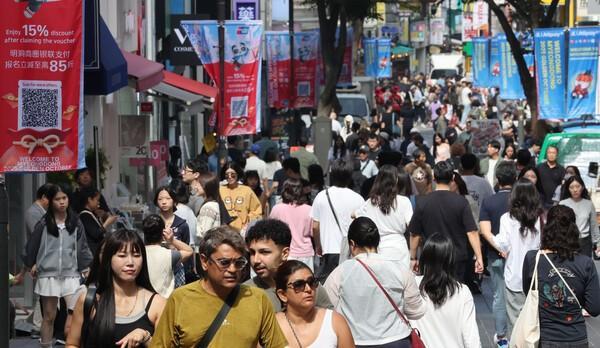
Where are foreign visitors to South Korea spending their money? Recent trends indicate a shift from traditional hotspots like Myeongdong and duty-free shops to areas like Seongsu-dong. Tourists who once filled buses with duty-free shopping bags are now purchasing limited-edition sneakers, visiting pharmacies after beauty treatments, and lining up at pop-up stores in Seongsu-dong. This change has led to a significant increase in card spending by foreign tourists, which surpassed 2 trillion won for the first time in May.
According to an analysis by the Korea Tourism Organization's Korea Tourism Data Lab, foreign tourists' domestic card spending reached 2.1222 trillion won in May, marking a 67.1% increase from the same month last year (1.2702 trillion won) and the highest growth rate since 2023. Cumulative spending from January to May this year totaled 7.9845 trillion won, up 47.3% compared to the same period last year.
The overall increase in spending was primarily driven by Chinese tourists, whose card spending surged by 214.0% in May compared to the previous year. By sector, shopping (77.8%), transportation (70.6%), medical wellness (65.8%), and food and beverage (64.9%) showed notable growth.
In terms of specific sectors, pharmacies recorded the highest growth at 206.1%, followed by toys and entertainment (191.4%) and skin care and massage services (153.9%). Department stores (89.2%), duty-free shops (87.6%), and sports goods and apparel (84.5%) also experienced significant increases.
◆ Tourists Shift from Myeongdong to Seongsu: Spending Patterns EvolveRecently, the spending patterns of foreign tourists have become more segmented according to commercial districts. The rise of the 'gorpcore' fashion trend, which mixes outdoor clothing with casual wear, has led to a 141.9% increase in sales of sports goods and apparel in Seongsu 2-ga 1-dong.
Even the traditional shopping district of Myeongdong is evolving, with experiential shopping gaining traction as tourists seek to create custom limited-edition clothing, resulting in a 162.0% increase in related sales.
◆ Beyond Olive Young: The Rise of Premium PharmaciesOne of the most notable changes is the rapid growth of the pharmacy sector. Foreign tourists are increasingly purchasing pharmaceutical-grade regenerative creams and functional cosmetics at nearby pharmacies after receiving beauty treatments at dermatology clinics.
Sales at pharmacies in Seongsu 2-ga 1-dong skyrocketed by 15,249%, while those in Seongsu 2-ga 3-dong increased by 2,877%, marking unprecedented growth. This consumption pattern is also spreading to other regions, with pharmacies in Haeundae-gu, Busan, seeing a 12,828% increase in sales.
◆ 2030s Line Up for Toy Pop-Ups, Chinese Tourists Buy Luxury GoodsThere is also a noticeable polarization in spending items. The 191.4% increase in the toys and entertainment sector is attributed to the purchase of limited-edition merchandise from global character IP pop-up stores. Tourists have focused their spending on goods from collaborations like Line Friends and BT21, as well as Pokémon cards and figures.
In contrast, Chinese tourists have driven sales of high-end luxury items, including watches and jewelry (69.7%) and accessories (87.0%). In Cheongdam-dong, known for its luxury boutiques, sales of watches and jewelry increased by 135.0%, while accessories rose by 197.7%. The average spending per transaction for Chinese tourists in this sector reached 12.15 million won.
Accessory sales in Jeju's Seogwipo City, home to five-star resorts, also surged by 589.2%. While the overall average price was 530,000 won, the average payment by Chinese tourists was 6.32 million won.
Tourists' travel radius is expanding beyond Seoul to other regions. Spending on rail transport increased by 79.9%, and in Daeryun-dong, Seogwipo City, the demand for private villas and luxury townhouses led to a 193.1% increase in condominium sales.
Im Ji-sook, head of the Korea Tourism Organization's Tourism Data Hub team, stated, "The analysis shows that foreign tourist spending is not just recovering but is becoming more segmented by commercial district, industry, and nationality. We will continue to provide data-driven insights to help local governments and industries respond proactively to these changes."
* This article has been translated by AI.
Copyright ⓒ Aju Press All rights reserved.