
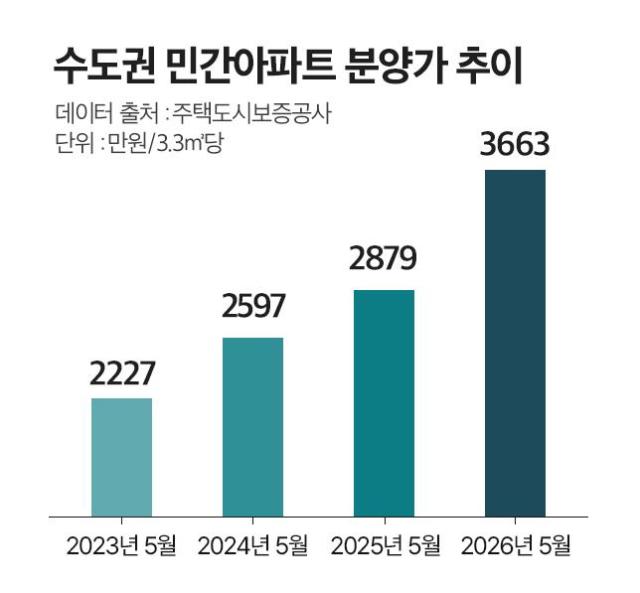
This year, the average price of private apartments in the Seoul area has surged nearly six times more than last year, prompting buyers to flock to units under the price cap system.
According to the Housing and Urban Guarantee Corporation (HUG), as of the end of May, the average price of private apartments in the Seoul area was 3.3 million won per 3.3 square meters, marking a 13.74% increase from 3.22 million won at the end of last year. This increase is approximately 5.9 times higher than the 2.33% rise recorded during the same period last year (December 2024 to May 2025).
The primary driver of this price increase is the soaring construction costs. The Korea Institute of Construction Technology reported that the construction cost index reached a record high of 136.88 in April, marking eight consecutive months of increases since September of last year.
Additionally, the supply conditions for construction materials are deteriorating. The Korea Construction Industry Association's monthly construction market trends report indicated that the material supply index dropped by 29.1 points year-on-year to 63.4 in May. Ongoing instability in the Middle East and disruptions in global supply chains have contributed to rising material prices and uncertainty in supply.
As the burden of rising prices grows, buyers are increasingly turning to units under the price cap system. In the first half of this year, the Acro de Seocho and OTIer Banpo in the Gangnam area of Seoul generated excitement with their relatively low prices, leading to a so-called "lotto subscription" frenzy. In Anyang, the Anyang Everforet Nature & E-Pyeonhansaeong recorded a competitive ratio of 57.1 to 1 in its first-round subscription, reflecting high interest.
However, even units under the price cap system are not entirely insulated from rising construction costs. The price cap system calculates prices by adding basic construction costs and additional costs to land costs, meaning that increases in construction costs will ultimately lead to higher capped prices.
The industry is closely watching the regular announcement of basic construction costs scheduled for September. Basic construction costs are a key component in determining the price ceiling for homes under the price cap system, and the Ministry of Land, Infrastructure and Transport announces adjustments twice a year, in March and September, based on changes in construction costs. As of March 1 of this year, the basic construction cost for buildings between 16 and 25 stories with a usable area of 60 to 85 square meters was set at 2.22 million won per square meter, a 2.12% increase from the previous announcement.
A construction industry official stated, "Basic construction costs can be adjusted frequently based on changes in material and labor costs. As uncertainty around pricing increases, the price advantages of units under the price cap system will become more pronounced."
Meanwhile, new units under the price cap system are expected to be released soon in the Seoul area.
BS Hanyang and Daebo Construction are currently offering the Suji-in House D in the Godeok International City of Pyeongtaek, with a total of 403 units priced in the low 500 million won range for an area of 84 square meters. There are no residency requirements, and the development is expected to benefit from educational infrastructure in the international exchange district.
BS Hanyang and Jeil Construction are also supplying the Suji-in Landscape 1 and 2 in the same Godeok International City, comprising a total of 1,126 units under the price cap system.
Hoban Construction plans to offer 660 units of Hoban Summit Pungmu III in the B4 block of the Pungmu Station urban development area in Gimpo in the second half of the year.
Additionally, the The Sharp Geomdan Lake Park is set to launch in Geomdan New Town in Incheon, while the Hakgok District House Story is preparing for supply in the Yeokgok District of Bucheon.
* This article has been translated by AI.
Copyright ⓒ Aju Press All rights reserved.