
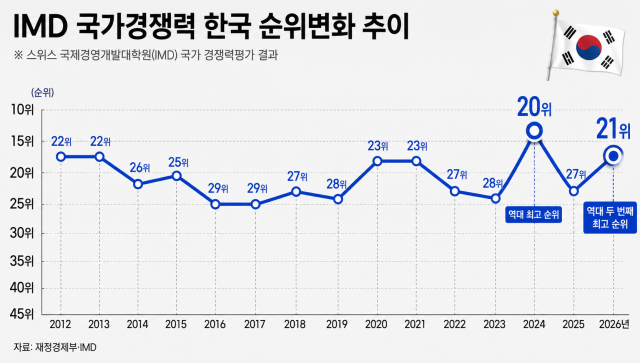
South Korea's national competitiveness has risen six spots to rank 21st globally, marking the second highest position since it was first included in the International Institute for Management Development (IMD) rankings in 1997. The improvements in corporate efficiency and artificial intelligence (AI) infrastructure were key drivers of this increase.
The Ministry of Economy and Finance announced on June 18 that South Korea achieved 21st place out of 70 countries in the 2026 IMD National Competitiveness Report. This is an improvement from last year's 27th place, making it the second highest ranking after the peak of 20th in 2024. Among countries with a per capita income exceeding $30,000 and a population over 50 million, South Korea ranks second, following the United States at 10th.
In the four major evaluation categories, corporate efficiency jumped from 44th last year to 34th this year, a rise of ten spots. All five subcategories—productivity and efficiency, labor market, finance, management practices, and attitudes and values—showed improvement. Notably, South Korea's image abroad has improved, leading to a significant 15-spot increase in the attitudes and values category, from 33rd to 18th. The finance sector received positive assessments due to rising stock indices and improved capital market conditions.
The infrastructure ranking also improved, moving from 21st to 15th. The technology infrastructure category, which now includes AI-related metrics, rose from 39th to 27th, a jump of 12 spots, while the scientific infrastructure maintained its second-place position globally. South Korea also ranked first in the world for the proportion of total research and development (R&D) investment relative to GDP and for corporate R&D investment.
However, government efficiency remained unchanged at 31st. While improvements were noted in tax policy, institutional conditions, and social conditions, declines in financial and corporate conditions prevented an overall ranking increase. The economic performance category fell from 11th to 14th, influenced by weaker evaluations of annual growth rates, inflation, and employment indicators due to sluggish economic conditions in the first half of last year. Nevertheless, the government noted a rebound in growth rates in the second half of the year, which was 1.8% higher than the same period the previous year, along with a recovery in exports, which helped mitigate the decline.
A ministry official stated, "Although the ranking dropped due to economic sluggishness and the effects of the state of emergency last year, growth and exports rebounded in the second half, leading to a recovery. The positive evaluations in corporate efficiency and infrastructure were key factors in the overall ranking increase."
While the government views the recent increase in exports, particularly in semiconductors, positively, concerns remain regarding employment conditions. The official noted, "With the number of employed individuals declining in May, the employment sector could negatively impact future national competitiveness evaluations. We plan to hold a meeting next week, chaired by the first vice minister, to review sector-specific improvement tasks."
Meanwhile, debates continue regarding the credibility of the IMD evaluation. This year, only 37 South Korean business leaders participated in the survey, resulting in a response rate of about 5%. The government explained that it uses the IMD evaluation not as an absolute measure of national competitiveness but as a reference to diagnose strengths and weaknesses and to seek directions for policy improvement.
* This article has been translated by AI.
Copyright ⓒ Aju Press All rights reserved.