
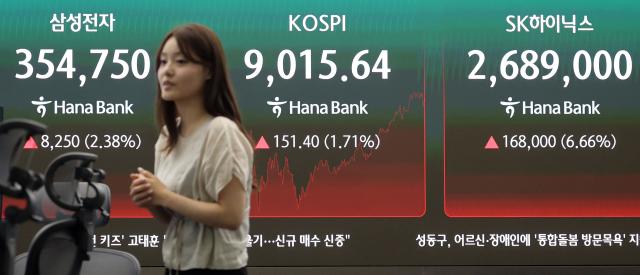
The KOSPI has officially entered the "dream 9,000-point" era, closing above 9,000 points for the first time in history. This achievement comes approximately one month after it surpassed 8,000 points, marking a remarkable increase of over 110% since the beginning of the year. The U.S. Federal Reserve's interest rate hikes could not halt the KOSPI's momentum, which was driven by a rally in AI-related semiconductors.
On June 18, the Korea Exchange reported that the KOSPI index closed at 9,063.84, up 2.25% or 199.60 points from the previous day. During trading, it even exceeded 9,100 points. This record comes just a month after the index surpassed 8,000 points on May 16. The cumulative increase since the start of the year positions the KOSPI as the top performer among major global stock markets.
Prior to the market opening, many analysts predicted a period of consolidation due to the Fed's hawkish stance on potential interest rate hikes in the second half of the year. U.S. stock markets also faced declines. However, optimism surrounding the AI semiconductor rally outweighed concerns about interest rates. Leading companies in the AI value chain, including Samsung Electronics and SK Hynix, showed strong performance. SK Hynix rose by 6.51% to 268,500 won, while Samsung Electronics increased by 4.62% to 362,500 won. Other companies, such as Samsung Electro-Mechanics (up 8.27%) and SK Square (up 6.52%), also performed well.
Foreign investors supported the upward trend by purchasing shares in the latter part of the trading session. While retail and institutional investors sold a net 380.6 billion won and 777.5 billion won, respectively, foreign investors bought a net 1.2826 trillion won.
Expectations are growing that the KOSPI could surpass 10,000 points. Kim Hak-kyun, head of research at Shin Young Securities, stated, "While stock prices have risen significantly, considering the upward trend of leading stocks centered on semiconductors, reaching this level is certainly achievable." He added, "Rather than discussing how high the index can go, we should assess whether there are any shock factors that could disrupt the market's upward momentum. Currently, there are no significant negative signals that could impact the market."
* This article has been translated by AI.
Copyright ⓒ Aju Press All rights reserved.