
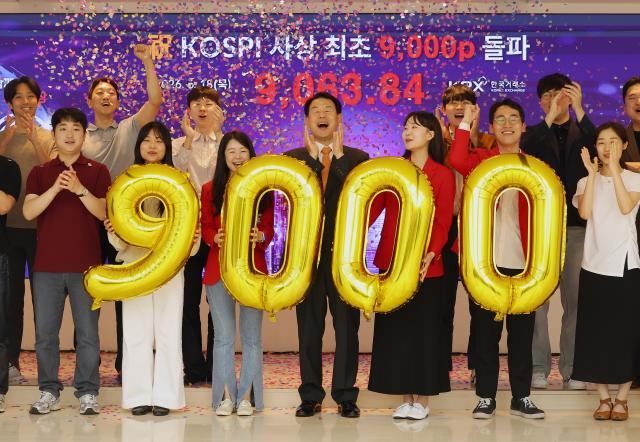
Typically, interest rate hikes are viewed as negative for the stock market, as they increase borrowing costs and shift investor preference toward safer assets. Tech stocks, which are particularly sensitive to rate changes, often experience declines. However, on June 18, the KOSPI defied these expectations, entering the '9,000-point era' as optimism surrounding AI semiconductors outweighed concerns about rising rates.
Despite the hawkish stance of the U.S. Federal Open Market Committee (FOMC), the KOSPI broke through the 9,000-point mark for the first time during trading. While the possibility of a rate hike later this year unsettled global markets, analysts noted that the excitement surrounding AI semiconductors helped to mitigate the impact of rate concerns.
On this day, the KOSPI closed at 9,063.84, up 199.60 points (2.25%) from the previous trading day. The index opened at 8,884.92, up 20.68 points (0.23%), and expanded its gains, reaching 9,000.68 around 12:52 PM, marking its first breach of the 9,000 level just over a month after hitting 8,000.
The pace of the KOSPI's rise has been accelerating. After crossing the 4,500 mark on January 6, the index has doubled in just six months. It surpassed 5,000 on January 22, 6,000 on February 25, and reached 7,000 on May 6. Just six trading days later, on May 15, it exceeded 8,000, and now it has crossed 9,000, demonstrating increasing momentum.
The significance of this 9,000-point breakthrough lies in its defiance of the market's expectations for a more hawkish FOMC outcome. During the June FOMC meeting, members shifted their outlook from anticipating one rate cut (median estimate of 3.4%) this year to now predicting one rate hike (median estimate of 3.8%).
As a result, U.S. markets fell sharply overnight, with the Dow Jones Industrial Average dropping 0.97%, the S&P 500 declining 1.21%, and the tech-heavy Nasdaq Composite falling 1.34%. Although there were concerns about potential adjustments in the domestic market due to the FOMC's impact, these worries ultimately dissipated.
The driving force behind the market's rise was undoubtedly AI semiconductors. Apple CEO Tim Cook's comments about potential memory chip supply shortages boosted investor sentiment. Additionally, SK Hynix announced the start of sample supply for its next-generation AI memory, the seventh-generation High Bandwidth Memory (HBM4E), further fueling buying interest in the semiconductor sector.
Indeed, SK Hynix's stock surpassed 2.6 million won during trading, setting a new record, while Samsung Electronics also contributed to the index's rise with a gain of over 4%. Lee Kyung-min, a researcher at Daishin Securities, noted, "Large semiconductor and IT sectors are seeing concentrated demand, leading to renewed market focus."
Foreign investors also joined the buying spree. From May 15 to June 17, foreign investors sold a net 53.34 trillion won, contrasting with individual investors who bought a net 41.38 trillion won during the same period. However, on this day, strong performance expectations centered around AI semiconductors prompted foreign investors to purchase over 1.2 trillion won worth of stocks.
Investor attention is now turning to the '10,000-point' mark. Analysts believe that if the profit growth driven by AI semiconductors continues and positive results are confirmed during the upcoming earnings season, there is ample room for further gains. Eugene Investment & Securities forecasts the KOSPI could rise to as high as 10,400, while Hana Securities predicts 10,380, and KB Securities estimates it could reach 10,500.
Lee Kyung-min added, "Expectations for earnings are likely to strengthen as we enter the full earnings season."
* This article has been translated by AI.
Copyright ⓒ Aju Press All rights reserved.