
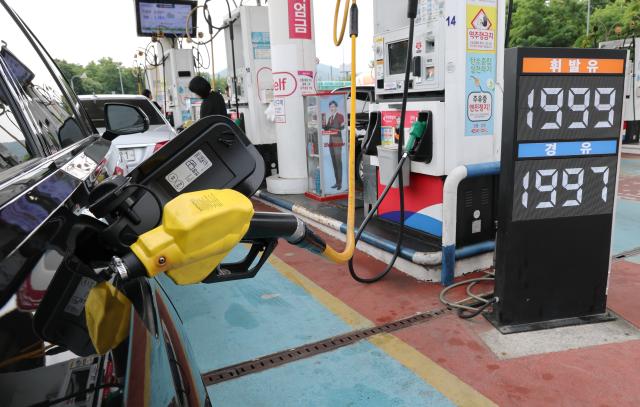
There are speculations that the government's decision to keep the existing price indicates a move toward concluding the price cap policy. The government appears to be taking a flexible approach while monitoring the situation in the Middle East and the Strait of Hormuz.
◆ Government Maintains Sixth Price Cap...Exit Strategy Under Consideration
Yang Gi-wook, head of the Ministry of Trade, Industry and Energy's Resource Security Division, stated during a briefing on June 18 that the government plans to maintain the sixth price cap. He explained that if a seventh price cap were established, it would be held for two to four weeks, but the situation in the Strait of Hormuz could change rapidly over the weekend, prompting the decision to maintain the current prices. Thus, until the seventh price cap is designated, the prices will remain at 1,934 won per liter for gasoline, 1,923 won for diesel, and 1,530 won for kerosene.
The government has outlined conditions for lifting the price cap, including the end of the Middle East conflict, normalization of shipping through the Strait of Hormuz, and stabilization of international oil prices. With the conflict reportedly moving toward resolution due to a U.S.-Iran agreement, international oil prices have decreased to the $70 to $80 range. However, the government emphasizes the need to assess the normalization of shipping through the Strait of Hormuz.
Yang noted, "The shipping through the Strait of Hormuz ultimately relates to supply and demand issues," adding that it is crucial to determine whether the transportation routes for crude oil can be secured and if supply recovery is anticipated.
The decision not to announce a new seventh price cap has led to various interpretations. Previously, the government had regularly reassessed the price cap every two to four weeks. However, this time, it opted to maintain the existing sixth price.
Establishing a seventh price cap could signal a commitment to uphold the system for at least two weeks. Given the rapidly changing situation in the Middle East, the government seems to prefer maintaining the current prices to respond flexibly to developments.
However, the Ministry of Trade, Industry and Energy has ruled out an immediate end to the price cap. While international oil prices have stabilized significantly from the initial surge to around $100 per barrel at the conflict's onset, factors such as maritime transport premiums, exchange rates, and delays in reflecting domestic prices must be considered.
Discussions with the refining industry regarding pricing are ongoing. The government believes that the market prices set by refiners remain higher than the price cap. Typically, it takes about two to three weeks for declines in international oil prices to be reflected in domestic prices.
◆ Industry Negotiations on Loss Compensation Expected
There is a high likelihood of intense negotiations regarding loss compensation for refiners. The Ministry announced that it would issue a draft regulation for financial support related to the designation of maximum oil sale prices, which will be open for public comment for ten days. The draft includes principles and criteria for financial support, calculation procedures, and the composition and operation of a settlement committee.
A key point is that the loss compensation criteria are based on the actual costs incurred by refiners rather than international oil product prices. The industry has argued that the difference between the Singapore Oil Price Index (MOPS) and the domestic price cap should be recognized as a loss. In contrast, the government believes that using MOPS as a benchmark could lead to excessive compensation beyond actual costs.
Yang explained, "What refiners wanted was for us to consider the difference between international oil prices and domestic prices," adding that the government's approach involves calculating the introduction price along with associated costs and reasonable margins. He further stated, "MOPS prices are not reflected in this calculation."
The financial support criteria will be reviewed by a settlement committee composed of up to 20 private experts in accounting, law, and the oil market, along with government representatives. They will evaluate cost calculations, appropriate margins, support amounts, and disbursement. The names of committee members and meeting details will remain confidential, with the final decision on support and amounts made by the Minister of Trade, Industry and Energy.
The crux of the matter lies in the differing perceptions of loss between the government and the refining industry. The industry claims that losses have already reached several trillion won since the implementation of the price cap. However, the government believes that these estimates are likely closer to MOPS standards. The government suggests that the 4.2 trillion won budget allocated through supplementary budgets should suffice for current loss compensation needs.
Yang remarked, "The 3 to 4 trillion won figure that refiners are considering may have been calculated based on MOPS, and actual financial support will likely be less than that," adding that a separate assessment is needed to determine whether opportunity losses will be recognized as domestic losses.
* This article has been translated by AI.
Copyright ⓒ Aju Press All rights reserved.