
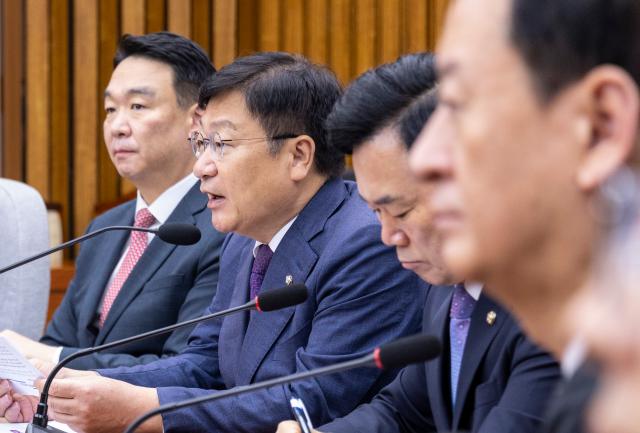
During a meeting at the National Assembly, Jung acknowledged that while the KOSPI's rise is generally positive, it is also generating feelings of deprivation among the public. He noted, "We must listen humbly to the concerns that the KOSPI is becoming a number that brings more disappointment than joy."
He expressed that the news of the KOSPI's increase is good, adding, "The People Power Party also congratulates the KOSPI's surpassing of 9,000," but pointed out that only 109 stocks rose, while 791 fell and 17 remained unchanged. He highlighted growing concerns about market polarization, particularly with major semiconductor stocks like Samsung Electronics and SK Hynix.
Jung also remarked that the KOSPI market has experienced 26 instances of a trading halt, known as a sidecar, this year alone, matching the total for the entire year of 2008 during the global financial crisis. He stated, "A market that repeatedly experiences such sharp rises and falls cannot be considered healthy."
Additionally, he warned that the increase in debt investment by individual investors, which is one factor driving the index up, poses a risk to the economy. He emphasized that the most serious issue is the persistently high exchange rate, noting that the won-dollar exchange rate closed at 1,536 won, surpassing the 1,530 won mark again.
Jung described the situation as a phase where the high exchange rate in the 1,500 won range has effectively become entrenched. He criticized President Lee for missing the mark when he confidently predicted during a New Year press conference in January that the exchange rate would stabilize around 1,400 won within a month or two.
He also recalled that during his first anniversary press conference, the president referred to the current high exchange rate as a temporary phenomenon. Jung questioned whether this assessment was based on sound reasoning and information, stating, "An increase in the exchange rate ultimately indicates that the world views South Korea's future dimly. The Lee administration should not be intoxicated by the KOSPI figures but should comprehensively reform economic policies related to real estate taxation and labor to improve the structural health and competitiveness of our economy."
* This article has been translated by AI.
Copyright ⓒ Aju Press All rights reserved.