
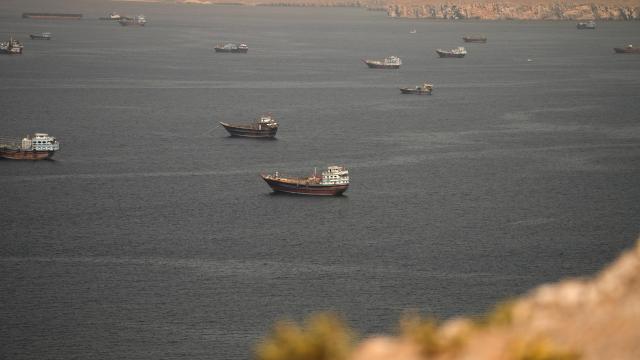
A memorandum of understanding (MOU) between the United States and Iran took effect on June 18, leading to the resumption of shipping traffic in the Strait of Hormuz. This development raises hopes for the escape of over 20 South Korean vessels that have been stranded in the strait.
According to the Associated Press, Richard Mead, editor of the British maritime publication Lloyd's List, announced during a press briefing that major shipping companies have begun operations in the Strait of Hormuz for the first time since the outbreak of war in Iran on February 28, marking a 110-day hiatus. The United Kingdom Maritime Trade Operations (UKMTO), a naval security organization under the British Navy, also downgraded the maritime security threat level in the Strait from 'serious' to 'normal' on the same day.
Reports indicate that several major vessels previously trapped in the Strait of Hormuz are now departing. Reuters reported that three Saudi oil tankers carrying a total of 6 million barrels of crude oil exited the strait on June 18. Italian Foreign Minister Antonio Tajani confirmed that one vessel from the Italian shipping company Grimaldi also left the strait. Shipping data firm Kpler noted that six vessels passed through the Strait on June 17, with that number increasing to 11 on June 18.
Vice President Kamala Harris stated during a White House press conference that the official 60-day negotiation period began that day, adding that the U.S. Navy has lifted the blockade. She noted that 12.5 million barrels of oil passed through the Strait overnight, indicating that navigation is resuming.
In response, Iran's Supreme National Security Council (SNSC) announced that the Persian Gulf Shipping Authority (PGSA), which oversees navigation in the Strait, will waive tolls for vessels transiting the Strait for the next 60 days in accordance with the U.S.-Iran MOU. The PGSA has begun accepting transit applications for vessels trapped in the Strait and the Persian Gulf.
According to Articles 4 and 5 of the MOU, the U.S. agreed to lift the maritime blockade immediately upon signing and to refrain from any interference with Iran, while Iran committed to taking necessary measures, including mine removal, to normalize navigation in the Strait.
Currently, it is estimated that around 500 commercial vessels, including 24 South Korean ships, remain trapped in the Strait and the Gulf, with expectations that they will gradually exit the Strait.
However, experts predict that full normalization of the Strait may take several weeks due to the time required for mine removal. Nikos Petrakakos, managing director of the British shipping company Tufton, stated, "The process will inevitably be slow until there is complete assurance that there are no mines, as safe passage will be limited to narrow routes." He added that while the normalization timeline could shorten to within a week once the mine issue is resolved, many vessels are likely to approach cautiously at first.
* This article has been translated by AI.
Copyright ⓒ Aju Press All rights reserved.