
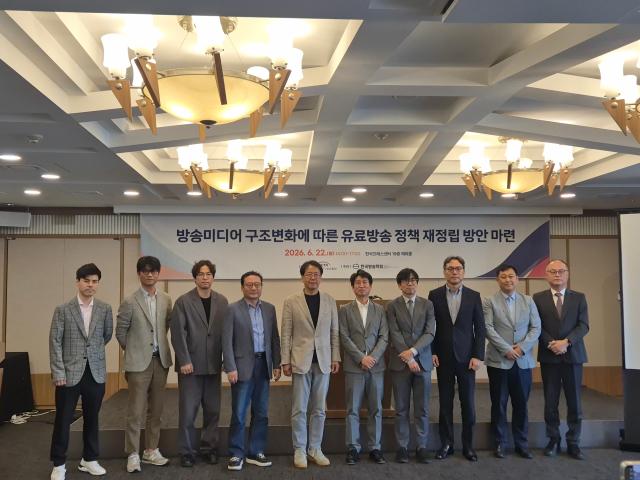
 A seminar on 'Policy Reform for Paid Broadcasting Amid Structural Changes' was held at the Press Center in Jung-gu, Seoul, on June 22. [Photo by Na Seon-hye]
Warnings have emerged that without timely support for cable TV operators, a situation akin to the "second JTBC crisis" could arise. As both subscribers and revenue decline while costs increase, there is a pressing need for government assistance.
On June 22, a seminar titled "Policy Reform for Paid Broadcasting Amid Structural Changes" took place at the Press Center in Jung-gu, Seoul. Lee Jong-kwan, a senior expert at the law firm Sejong, stated, "If we miss the timing for short-term responses, a second JTBC crisis could occur in the cable TV sector. We need to design policies that reduce cost burdens in the short term while increasing revenue and profitability in the long term."
Lee assessed that the domestic broadcasting media industry has transitioned from a growth phase to a decline phase. He noted, "Broadcasting revenue has decreased for two consecutive years for the first time since statistics began to be collected. The fact that the industry size is shrinking without external shocks may signal that the broadcasting industry is entering a decline phase after its maturity period."
He specifically pointed out that cable TV system operators (SOs) are experiencing simultaneous declines in broadcasting revenue and increased cost burdens. Lee reported, "SOs' operating profits are projected to drop by 51% in 2023 and 76% in 2024. This is not just an issue for one operator but a problem for the entire cable TV SO sector."
The core revenue source for cable TV, subscription fees, is also expected to decline rapidly. According to analysis, the average revenue per user (ARPU) based on subscription fees is projected to decrease from 3,883 won in 2024 to 2,555 won by 2030 under negative forecasts, reflecting an annual decline of 6.4%. The number of subscribers is also expected to drop from 12.27 million in 2024 to around 11.37 million by 2030 under negative projections.
Consequently, subscription fee revenue is expected to decrease from 571.9 billion won in 2024 to 424 billion won under positive forecasts and 348.5 billion won under negative forecasts by 2030. If the current structure remains unchanged, subscription fee revenue could decline by 140 billion to 220 billion won by 2030 compared to 2024.
Analysis by Jeong Hoon, a professor at Cheongju University, supports this crisis scenario. Jeong found that the operating profit margin for broadcasting operations has worsened each year when separating broadcasting from non-broadcasting businesses.
Research indicates that the operating profit margin for broadcasting operations was -6.7% in 2022, -10.9% in 2023, -10.9% in 2024, and an estimated -7.0% in 2025. During the same period, the reported performance showed profits of 7.3%, 3.6%, 0.9%, and 2.7%, respectively. Jeong noted, "The research revealed a gap of 9 to 15 percentage points between broadcasting business profits and reported performance."
In fact, broadcasting revenue decreased by 8.9%, from 1.7513 trillion won in 2022 to 1.5952 trillion won in 2025. The broadcasting sector has recorded operating losses for four consecutive years, with losses reaching 181.6 billion won in 2023 and 179.1 billion won in 2024. In contrast, the share of non-broadcasting businesses, such as rental services, increased from 35.4% to 40.1% during the same period. Jeong explained, "While the reported operating profit margin appears positive, separating broadcasting from non-broadcasting shows that the broadcasting sector is in the negative. Financially, the structure relies on profits from non-broadcasting businesses to sustain the broadcasting operations."
In light of these findings, Lee urged a shift in government policy. He stated, "The government is not unaware of the difficulties faced by SOs. Since the introduction of IPTV real-time services in 2009 and Netflix's entry into the domestic market in 2017, the market has changed rapidly, yet there have been no significant regulatory changes or relaxations in the broader framework of the broadcasting media industry."
He added, "We cannot address a declining industry with a regulatory framework created during a growth period. A new regulatory framework suitable for a declining industry must be established."
* This article has been translated by AI.
Copyright ⓒ Aju Press All rights reserved.