
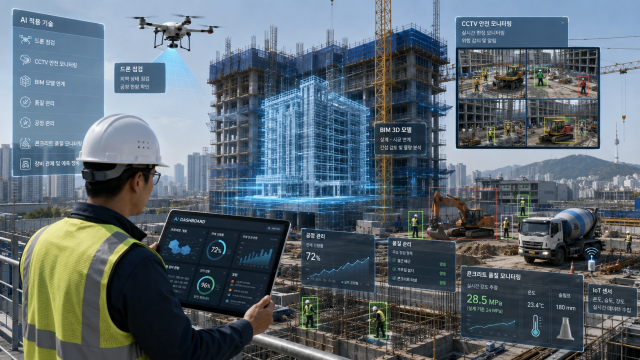
The construction industry is entering a significant phase of artificial intelligence (AI) transformation. While AI was previously recognized for enhancing internal efficiencies in design automation, construction management, and safety, its influence is now expanding to site selection, permitting, and the private investment market. Amid a decline in public projects and a sluggish housing market, AI is emerging as a key factor reshaping construction companies' revenue streams and business models.
According to the Korea Construction Policy Institute on June 22, AI data centers, power grids, integrated rail development, and renewable energy are becoming new areas for private investment. The government has set a target to discover private projects worth 100 trillion won (approximately $75 billion) over the next five years, averaging 20 trillion won annually. This represents a 43% increase compared to the average of 14 trillion won in private projects over the past five years.
The construction sector views the expansion of the private investment market as a potential solution to fill gaps in project orders. Traditionally focused on social overhead capital (SOC) such as roads and railways, the private investment landscape is likely to broaden to include digital and energy infrastructure.
AI data centers, in particular, represent a shift for construction firms from simple building projects to complex infrastructure ventures. These centers require large sites, reliable power supply, cooling systems, security, communication networks, and operational stability. They can also be linked to power grid expansion, renewable energy infrastructure, and the development of industrial complexes, providing construction companies with new opportunities beyond their existing housing and civil engineering portfolios.
Choi San, a senior researcher at the Korea Construction Policy Institute, stated, "The private investment market is likely to expand from traditional road and rail projects to future industrial infrastructure such as data centers, power grids, and energy facilities. Construction companies will need to enhance their capabilities beyond mere construction to include project planning, financing, and operations."
The approach to mitigating initial permitting risks is also expected to change. The Ministry of Land, Infrastructure and Transport is promoting the development of an "AI-based integrated permitting pre-assessment service" as part of a government-wide initiative. Construction firms and developers are paying close attention to how this will affect project speed and profitability. The duration of permitting can vary from several months to years, impacting construction start dates, financing costs, and sales schedules.
With the introduction of AI-based pre-assessment services, developers will be able to analyze land use, building coverage ratios, floor area ratios, and restrictions in real-time. This system will not only assess permitting feasibility but also recommend suitable sites, provide customized checklists, estimate fees, and determine timelines, allowing construction firms to filter risks and identify promising sites early in the project lifecycle.
Lee Eun-hyung, a researcher at the Korea Construction Policy Institute, noted, "In development projects, the uncertainty of the permitting process directly impacts project viability. Once AI-based pre-assessment services are established, they will help reduce the decision-making burden for developers and construction firms by allowing for more objective evaluations of project feasibility at early stages."
However, the AI infrastructure market does not provide equal opportunities for all construction firms. The sectors of data centers, power grids, and renewable energy require a combination of technical expertise, funding capabilities, and operational experience, creating high barriers to entry.
Industry insiders warn, "The AI-based infrastructure market is likely to be dominated by large firms due to the simultaneous demand for technology and capital. Mid-sized and small construction companies must develop support systems to participate in new markets through joint ventures or specialization strategies, rather than remaining solely in subcontracting roles."
* This article has been translated by AI.
Copyright ⓒ Aju Press All rights reserved.