
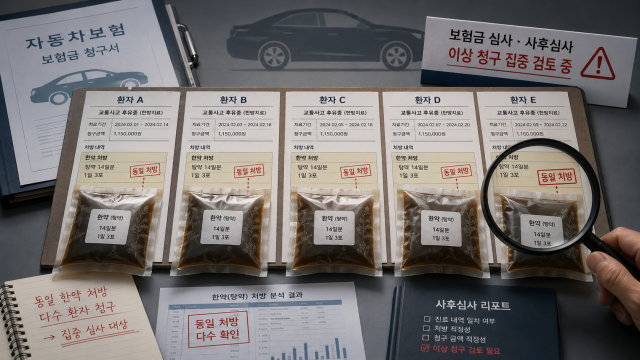
Numerous traditional medicine facilities have been caught submitting identical herbal medicine claims for different traffic accident patients, despite the requirement for personalized prescriptions. This revelation comes as the government targets illegal patient recruitment practices in hospitals and traditional medicine clinics, prompting calls within the insurance industry for a comprehensive overhaul of the auto insurance claim structure.
On June 22, an analysis of 72 adjustment cases from a major property and casualty insurance company over the past three years revealed that 68 cases, or 94.4%, involved traditional medicine facilities. Among these, 44 cases were from traditional clinics and 24 from hospitals. Local verification audits conducted by the Health Insurance Review and Assessment Service (HIRA) involve on-site inspections of medical records and treatment legitimacy, leading to reductions or recoveries of improperly billed medical fees.
The most frequently flagged item was herbal medicine prescriptions. Of the 68 facilities in question, 49 (72%) were found to have prescribed herbal medicines with identical compositions and dosages. While herbal medicine should be tailored to each patient's constitution and pain level, some facilities were criticized for using the same ingredients and dosages repeatedly, leading to accusations of a "factory-style" prescription process.
President Lee Jae-myung recently criticized the illegal "payback" practices at some hospitals and traditional medicine clinics. Paybacks involve hospitals offering cash refunds or incentives to attract patients, which can encourage unnecessary treatments. President Lee stated on social media, "This seems clearly illegal, yet such payback practices continue to persist," and called for corrective measures.
Additionally, there were 46 cases of excessive hospitalization charges, which promote the recruitment of "fake patients". The most common issue was the absence of medical staff during nighttime hours, accounting for 30 cases, followed by unauthorized patient outings (10 cases) and insufficient nursing staff (9 cases). This indicates that traffic accident patients were often admitted without proper care.
Other issues included billing for physical therapy not performed by licensed practitioners (17 cases) and inadequate documentation of patient symptoms (27 cases). There were even instances of unapproved facilities producing herbal injections or mixing other substances into injections. The total amount the insurance company needed to recover due to these fraudulent claims reached 289.29 million won, but only 117.69 million won has been successfully recovered.
Such fraudulent and excessive billing practices ultimately impact ordinary drivers. Since auto insurance relies on premiums paid by policyholders, the moral hazard of some hospitals can lead to increased loss ratios, raising premiums for all policyholders.
An insurance industry representative stated, "While legitimate treatments should be covered, we need to strengthen review criteria and post-management for items like herbal medicine, hospitalization, and physical therapy that are repeatedly adjusted during local verification audits. Additionally, there should be prompt improvements to verify the necessity of long-term treatments exceeding eight weeks for minor injury patients."
* This article has been translated by AI.
Copyright ⓒ Aju Press All rights reserved.