
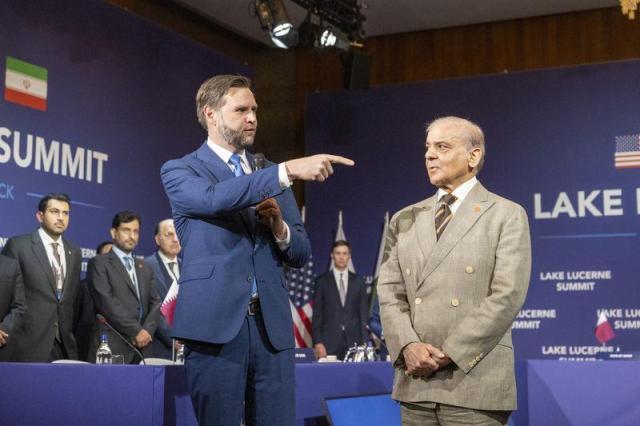
The United States and Iran have concluded their first high-level follow-up talks aimed at implementing a Memorandum of Understanding (MOU) after extensive negotiations. Despite a warning from President Donald Trump about the possibility of renewed Iranian aggression during the discussions, both sides reached agreements on managing safe navigation in the Strait of Hormuz and establishing a mechanism to prevent military conflicts in Lebanon.
On June 22, local time, Reuters, AP, and Al Jazeera reported that the high-level talks took place at the Bürgenstock Resort in Switzerland, mediated by Qatar and Pakistan. Vice President JD Vance represented the US, while Mohammad Bagher Ghalibaf, the Speaker of the Iranian Parliament, led the Iranian delegation. The talks, which began the previous day, concluded in the early hours of the morning.
According to a joint statement released by the mediating countries after the negotiations, both nations agreed to establish a high-level committee to oversee the implementation of the MOU. They will also form working groups to address issues related to nuclear matters, sanctions, compliance monitoring, and dispute resolution. These bodies will manage discussions aimed at reaching a final agreement within 60 days.
The issues concerning Lebanon and the Strait of Hormuz were also designated for separate management. With the support of the mediators, both sides agreed to establish a conflict prevention mechanism to ensure compliance with the cessation of military operations in Lebanon. Additionally, they will create an emergency communication channel to prevent accidents and miscalculations during commercial shipping in the Strait of Hormuz. Both countries also agreed to continue practical negotiations for the remainder of the week on specific details.
Iran's representatives viewed the outcomes of the talks positively. Foreign Ministry spokesperson Esmail Baghaei stated in a national broadcast that there had been "good progress" on issues related to safe navigation in the Strait of Hormuz, the authorization for the sale of Iranian oil, and the release of frozen assets. Foreign Minister Abbas Araghchi also advocated for exemptions from sanctions on oil and petrochemical exports and the release of some frozen funds. However, there was no official confirmation from the US side. Vice President Vance remarked that "this negotiation is merely the starting point for practical discussions" and emphasized that not all issues could be resolved at once.
The security situation in Lebanon was a major topic during the negotiations, particularly concerning the first clause of the MOU, which states the need to "immediately and permanently cease military operations on all fronts, including Lebanon." Vice President Vance acknowledged the complexity of the Lebanese issue, stating, "These matters are always a bit complicated," while Minister Araghchi noted that the conflict prevention mechanism in Lebanon would serve as a "first test."
However, the atmosphere of the negotiations cooled temporarily due to comments from President Trump. During the talks, Trump threatened via his social media platform Truth Social that the US would respond forcefully if Iran failed to restrain Hezbollah. Following this statement, the Iranian semi-official news agency Tasnim reported that the Iranian delegation refused to return to the four-party talks and communicated through the mediators. Conversely, a US diplomat told Reuters that the Iranian side did not leave the negotiation table, and discussions continued late into the night.
* This article has been translated by AI.
Copyright ⓒ Aju Press All rights reserved.