
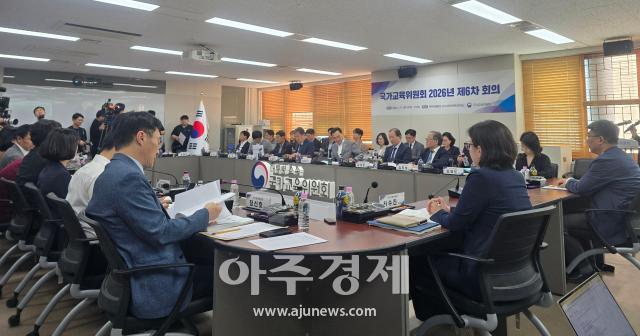
The National Education Commission, an administrative committee under the President, is launching a public communication initiative to explore fundamental changes in education in light of the artificial intelligence (AI) revolution.
From June 22 to July 10, the commission will conduct an online public opinion collection period under the theme, 'The Direction of Our Education in the AI Era.' According to the commission, this initiative aims to gather the voices of citizens to actively reflect their insights in the development of a new educational framework suitable for the upcoming AI era.
To facilitate this process, the commission has presented three core questions for the public to consider. The first topic is 'Unique Human Capabilities and True Learning in the AI Era,' which asks what distinguishes human capabilities from AI and how genuine learning can be achieved.
The second topic focuses on 'School Education in the AI Era.' It seeks to explore how existing curricula and subjects should be restructured and how classroom instruction and assessment should evolve in response to the AI revolution.
The final topic addresses the establishment of an educational system that connects learning to careers in the AI era. As the development of AI weakens the traditional links between education and employment, the commission aims to gather national wisdom on how children can navigate their learning to find jobs.
Any citizen of South Korea can freely participate in this opinion collection process. Interested individuals can access the 'Public Opinion Platform' on the National Education Commission's website (ne.go.kr), log in or verify their identity, and submit their opinions on the three questions.
Additionally, the platform allows for interactive communication, enabling users to express agreement with others' opinions by clicking 'like' or to leave comments. The collected feedback will serve as essential foundational data to ensure that citizens' voices are adequately reflected in the future long-term national education development plan.
Chairperson Cha Jeong-in stated, "The AI revolution is changing many aspects of human life and the skills required, and the education system must be rebuilt to align with these changes. It is crucial to listen broadly to the public's opinions, as the AI transition is a matter that affects us all."
A commission official noted that for the online opinion collection to yield effective results, it is essential that citizens' valuable suggestions go beyond mere online polling and are integrated into actual long-term education policies. This will require in-depth deliberation with education experts and meticulous verification based on the collected data. The official added, "We will continue to foster close cooperation among departments and systematic follow-up discussions to refine the proposed ideas into concrete policy tasks for the national education development plan."
From June 22 to July 10, the commission will conduct an online public opinion collection period under the theme, 'The Direction of Our Education in the AI Era.' According to the commission, this initiative aims to gather the voices of citizens to actively reflect their insights in the development of a new educational framework suitable for the upcoming AI era.
To facilitate this process, the commission has presented three core questions for the public to consider. The first topic is 'Unique Human Capabilities and True Learning in the AI Era,' which asks what distinguishes human capabilities from AI and how genuine learning can be achieved.
The second topic focuses on 'School Education in the AI Era.' It seeks to explore how existing curricula and subjects should be restructured and how classroom instruction and assessment should evolve in response to the AI revolution.
The final topic addresses the establishment of an educational system that connects learning to careers in the AI era. As the development of AI weakens the traditional links between education and employment, the commission aims to gather national wisdom on how children can navigate their learning to find jobs.
Any citizen of South Korea can freely participate in this opinion collection process. Interested individuals can access the 'Public Opinion Platform' on the National Education Commission's website (ne.go.kr), log in or verify their identity, and submit their opinions on the three questions.
Additionally, the platform allows for interactive communication, enabling users to express agreement with others' opinions by clicking 'like' or to leave comments. The collected feedback will serve as essential foundational data to ensure that citizens' voices are adequately reflected in the future long-term national education development plan.
Chairperson Cha Jeong-in stated, "The AI revolution is changing many aspects of human life and the skills required, and the education system must be rebuilt to align with these changes. It is crucial to listen broadly to the public's opinions, as the AI transition is a matter that affects us all."
A commission official noted that for the online opinion collection to yield effective results, it is essential that citizens' valuable suggestions go beyond mere online polling and are integrated into actual long-term education policies. This will require in-depth deliberation with education experts and meticulous verification based on the collected data. The official added, "We will continue to foster close cooperation among departments and systematic follow-up discussions to refine the proposed ideas into concrete policy tasks for the national education development plan."
* This article has been translated by AI.
Copyright ⓒ Aju Press All rights reserved.