
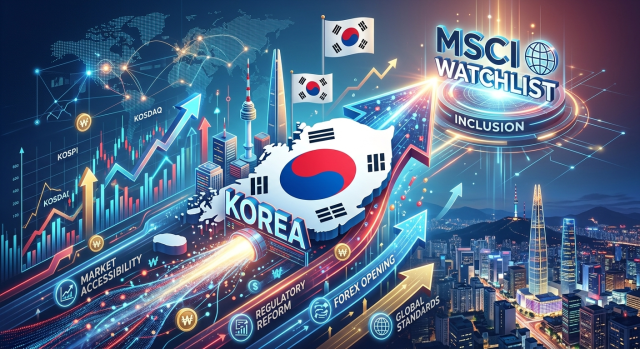
The decision on whether South Korea will be reinstated to the Morgan Stanley Capital International (MSCI) developed markets watchlist will be announced early on June 24, Korean time. South Korea was placed on the watchlist in 2008 but was removed in 2014 after failing to achieve developed market status due to market accessibility issues. The country is now attempting to return to the watchlist after 12 years. However, recent assessments from MSCI indicate that the likelihood of reinstatement is uncertain, as most key accessibility criteria still require improvement.
According to financial industry sources on June 22, expectations for reinstatement had been bolstered by the government's implementation of the MSCI roadmap, the resumption of short selling, and the opening of the foreign exchange market. However, the sentiment has shifted recently. In its annual market accessibility review released on June 19, MSCI maintained its negative ratings on most core evaluation criteria, except for the availability of investment products, which has dampened hopes for reinstatement.
In the 2026 Global Market Accessibility Review published on June 19, MSCI upgraded South Korea's evaluation of investment product availability from a negative to a positive rating. This change reflects the Korea Exchange's expansion of trading hours for Korean index derivatives to 24 hours since April, in partnership with the Eurex in Germany and the ICE Futures in the United States.
However, the upgrade applied only to the single category of investment product availability. Consequently, the number of negative ratings for South Korea's stock market decreased from six to five compared to last year, but critical areas such as foreign exchange market liberalization, investor registration and account opening, information flow, clearing and settlement, and securities mobility still require improvement.
MSCI noted, "While South Korean authorities are continuously implementing reform tasks, fundamental accessibility issues remain unresolved." The organization acknowledged the government's reform efforts, including the launch of a 24-hour foreign exchange market and the establishment of an offshore won payment network, but stated that a fully functional offshore foreign exchange market has yet to be established.
Market analysts view this accessibility review as a key indicator of the potential for reinstatement to the watchlist. The government has been pursuing a roadmap for foreign exchange market reforms with the goal of inclusion in the MSCI developed markets index. However, MSCI emphasizes the importance of whether actual investors are experiencing improvements in market accessibility rather than just the introduction of new regulations.
Regardless of the outcome regarding reinstatement to the watchlist, related institutional improvements are expected to proceed as planned. Starting in July, the government will operate the won-dollar market effectively on a 24-hour basis and will gradually introduce an offshore won payment network that allows foreign financial institutions to utilize domestic won accounts. The foreign investor registration system is also being transitioned to a Legal Entity Identifier (LEI) framework, and the scope of mandatory English disclosures is being expanded.
Improvements in the clearing and settlement sector are also planned. Previously, foreign investors were only allowed limited over-the-counter transactions under the Capital Markets Act, with on-exchange transactions being the norm. This system was established to manage foreign investment limits but has been criticized by global institutional investors for lacking trading flexibility.
Meanwhile, some market participants caution that the benefits of inclusion in the MSCI developed markets index should be viewed with skepticism, regardless of whether South Korea is reinstated to the watchlist.
Typically, inclusion in a developed markets index is expected to attract significant passive fund inflows, but the actual benefits may be limited. Currently, South Korea holds a relatively high weight in the MSCI emerging markets index, but moving to the developed markets index would mean competing with major markets like the United States, Japan, and the United Kingdom.
In particular, stocks included in the developed markets index are likely to be concentrated in a few large-cap companies such as Samsung Electronics and SK Hynix. Since the inclusion is determined based on global market capitalization, many domestic stocks may inevitably be excluded from the index.
A representative from the financial investment sector stated, "Passive funds move according to the index inclusion weight, so inclusion in the developed markets index could actually deepen the concentration of funds into certain large-cap stocks. It is difficult to accurately estimate the scale of active fund inflows, so we cannot definitively say that inclusion in the developed markets index will lead to a large net inflow."
* This article has been translated by AI.
Copyright ⓒ Aju Press All rights reserved.